
Have you ever asked “what is ISO 45001”? You’re not alone. Many companies in all types of fields—from making car parts to running healthcare clinics—look for ways to keep their employees safe and healthy. ISO 45001 offers a clear answer. It is an international standard for how businesses manage health and safety at work, so workers go home in the same condition they arrived.
ISO 45001 helps you put in place a system (called an Occupational Health and Safety Management System or OHSMS) that fits your business, no matter how big or small. Whether you have five people in a small food shop or five thousand in a noisy manufacturing plant, this standard gives you a roadmap for keeping everyone safe.
Request Quotation
Why Does ISO 45001 Matter?
Every workplace has risks. A hospital might worry about the spread of infection, while a factory has to think about slips, falls, and machine accidents. The ISO 45001 standard gives you a way to spot these hazards, put fixes in place, and keep checking to make sure nothing is missed.
This isn’t just about ticking boxes. The ISO 45001 2018 version is designed for today’s workplaces. It uses plain language and focuses on finding risks early, training everyone, following the law, and making sure the company’s leaders take real responsibility. It puts safety and health at the center of your work culture.
Why Adopt the ISO 45001 Standard?
No matter your industry, caring for your people is essential. Keeping your staff safe isn’t just about avoiding fines, it’s about doing the right thing.
The ISO 45001 2018 standard:
- Helps you find and fix hazards before anyone gets hurt.
- Makes safety a job for everyone—not just the safety manager—so that top management and everyday workers all work together.
- Gives employees a way to share their ideas, spot problems, and help make working safer for all.
- Helps you follow local and national laws and manage legal and regulatory requirements more effectively.
- Demonstrates to clients, employees, and investors that your business is serious about safety.
By putting the ISO 45001 standard into action, you are making safety a normal part of every meeting, project, and task.
The Structure of ISO 45001:2018 Standard Explained
The ISO 45001 2018 standard uses a structure called Annex SL. This is the same organization used by other well-known standards like ISO 9001 (quality) and ISO 14001 (environment). This makes it much easier to connect and combine different management systems.
Here’s what you’ll find in each major part (called clauses) of the standard, explained simply:
Clause 1: Scope- This section says that the standard is for any organization that wants to make their workplace safer and healthier. It applies to every part of your business, including workers, managers, and visitors. Whether you are a bakery with one shop or a large manufacturer with many locations, this clause is for you.
Clause 2: Normative References- You don’t need to buy or read other documents to work with ISO 45001. It is self-contained.
Clause 3: Terms and Definitions- Clear words make for clear understanding. This part defines what “hazard,” “risk,” “incident,” and other words mean—so nobody is confused.
Clause 4: Context of the Organization- This is where you look at what makes your business unique:
- What are your biggest risks? (heavy machinery, illness, chemicals, slips)
- What are your strengths and weaknesses?
- Who cares about your safety performance? (workers, clients, neighbors, government regulators)
- Are you growing, changing locations, or introducing new technology?
You need to answer these questions before you can build a good OHSMS.
Clause 5: Leadership and Worker Participation- Top management must be in charge of safety—they need to make decisions, provide resources, and encourage everyone to be involved.
Workers are not just “doing as told”—they are part of the safety team. They join in making rules, reporting dangers, and reviewing what works. This is not just for checking boxes. Audits typically look for evidence of worker participation.
Clause 6: Planning- You can’t make a good safety plan unless you know what can go wrong. This clause covers:
- Finding hazards in real life (from a sharp blade in food prep, to anxiety at tech startups)
- Understanding which risks matter most, and why
- Listing every safety law that applies to you—so you follow the rules, not just guess
- Setting goals—like “No lost-time injuries next quarter” or “100% fire drill attendance”
Clause 7: Support- A plan without the right resources will fail. Support includes:
- Money for safety improvements, PPE, or machine guarding
- Training workers—real hands-on practice, not just a yearly lecture
- Communication channels—workers can report risks, get updates, and know who to turn to
- Documents and records—easy to read, easy to access, and not overloaded with jargon
Clause 8: Operation- This is all about doing the work safely, every day:
- Following safe work procedures for dangerous jobs (lock-out/tag-out for machinery, safe handling of cleaning chemicals)
- Managing changes—bringing in a new line, hiring contractors, or moving offices
- Checking that suppliers and outside workers are as committed to safety as you are
- Planning for emergencies (gas leaks, fires, violence, medical issues) with clear drills and training so no one panics when things go wrong
Clause 9: Performance Evaluation- Are your safety efforts working? This clause asks you to:
- Track injuries, near misses, and days lost to sick leave
- Carry out internal audits to check your system is being followed
- Hold management review meetings to look at safety performance and decide on improvements
You don’t just put a system in place and forget about it; you check regularly and make it better.
Clause 10: Improvement- As your business changes, so do your risks. When something goes wrong, don’t just blame the worker—find out why it happened and fix the root cause. Always look for ways to keep getting safer, smarter, and stronger.
Benefits of ISO 45001 Certification
ISO 45001 certification is much more than a piece of paper to hang on the wall. Here are real, clear benefits, with examples:
- Fewer Workplace Injuries- Example: At a textile manufacturing plant, moving all raw fabric rolls with carts instead of by hand (after a hazard review) reduced back injuries among workers. With ISO 45001, this hazard identification led directly to measurable safety outcomes
- Lower Costs- Example: A food factory switched to anti-fatigue mats after seeing a spike in leg pain complaints. After implementing an ISO 45001-based system, they tracked a drop in medical compensation claims and fewer paid sick days.
- Strong Legal Compliance- Example: An electronics assembly unit used ISO 45001:2018 to review their ventilation and chemical storage. After updating to the newest legal requirements, site managers passed a surprise government inspection without issue.
- Reputation Boost- Example:An engineering firm applying for an international airport contract showed its ISO 45001 certification and received high marks for health and safety, moving them up on the client’s preferred supplier list.
- Higher Morale- Example: In a logistics company, after giving warehouse workers a direct line to report slip hazards, managers fixed issues faster. Injury rates and staff turnover dropped, and employee satisfaction surveys improved.
- Faster Emergency Response- Example: In a cold storage business, workers practiced ammonia spill drills every month, thanks to the clear emergency preparedness planning in the ISO 45001 standard. When a real leak happened, response was quick and nobody was hurt.
Key Eligibility Criteria for ISO 45001 Certification
Wondering if you qualify for ISO 45001 certification? Here’s what you need:
- A real, working safety management system—not just on paper, but in action every day.
- Management commitment—not just a signature, but actual involvement (attending safety meetings, reviewing accidents, setting budgets for improvements).
- Worker involvement—staff need to be able and willing to speak up about risks, suggest changes, and be included.
- Understanding legal duties—keep a register showing which safety and health laws apply, and that you are following them.
- At least 3–6 months of records—showing that your system is running, through safety meeting notes, training attendance, accident reports, and improvement logs.
ISO 45001 is designed for every industry. Here are a few different examples:
- Dairy Processing: Focus on hygiene controls, high-pressure cleaning risks, slip prevention.
- Tech Startups: Focus on ergonomic desk setup, stress management, safe electrical layouts.
- Retail Chains: Focus on shelf stacking injuries, fire escape access, and trip hazards.
- Construction Sites: Focus on falls, machinery use, PPE, and scaffolding safety.
- Warehousing: Focus on forklift operation safety, racking stability, lighting.
ISO 45001 Certification Process
Getting ISO 45001 certification is a step-by-step process. Here’s an easy-to-follow breakdown:
Step 1: Gap Assessment
Start by comparing your current safety efforts to the requirements of the ISO 45001 2018 standard.
- Walk through your site, looking for hazards like slippery floors, unsafe wiring, or blocked exits.
- Make checklists—what are you already doing right? What’s missing?
Step 2: Build a Project Plan
- Appoint a project leader (someone who can drive change, not just a title-holder).
- Set realistic goals, deadlines, and a budget for safety improvements and training.
Step 3: Documentation
- Write a clear safety policy that is easy to understand.
- Make your risk registers and reporting forms simple, with examples from your type of work.
- Streamline procedures—write only what you need and use real-life photos or diagrams.
Step 4: Implementation and Training
- Train workers where it makes sense—run a forklift refresher for your warehouse drivers or teach office staff about safe lifting techniques.
- Hold regular toolbox talks, have open Q&A sessions, and encourage anonymous safety suggestions.
- Make sure reporting incidents isn’t a hassle.
Step 5: Internal Audits
- Appoint or hire someone to audit your system, ideally someone with a fresh set of eyes.
- Interview staff, check records, and walk the site. Look for real problems, not paperwork mistakes.
Step 6: Management Review
- Gather safety stats, audit results, and staff feedback.
- Directors and team leaders should join in, not just observe.
- Use this meeting to make real decisions—like allocating more funds for urgent repairs or approving a fresh training cycle.
Step 7: Certification Audit Stage 1
- Call in an independent certification auditor (from your chosen certification body).
- They’ll review your documents (policies, attendance logs, incident slips, training records).
- You’ll get a report: what you did well, what needs fixing.
Step 8: Certification Audit Stage 2
- This is the on-site visit. The auditor will tour all areas, check that staff know about safety procedures, and observe real work.
- Gaps like old fire extinguishers, blocked exits, or expired first aid supplies will be flagged.
Step 9: Corrective Actions
- Fix all issues quickly: restock kits, retrain staff, rewrite unclear procedures.
- Auditors might ask to see proof (photos, receipts, updated records).
Step 10: Certification Awarded
- With all actions complete, the certification body issues your ISO 45001 certificate. Certificates are typically issued on a three-year cycle, with surveillance audits (usually annual) and recertification at the end of the cycle.
Sample Certificate
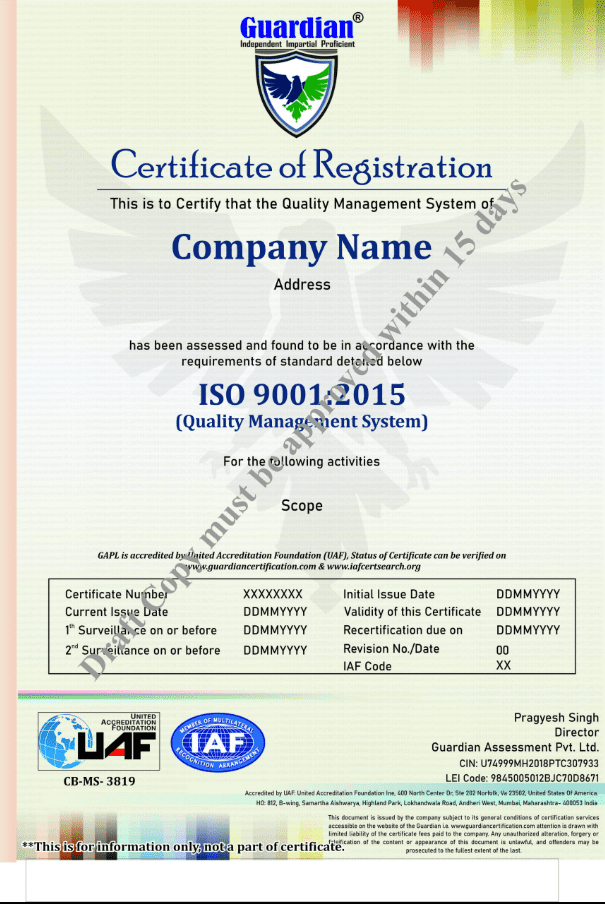
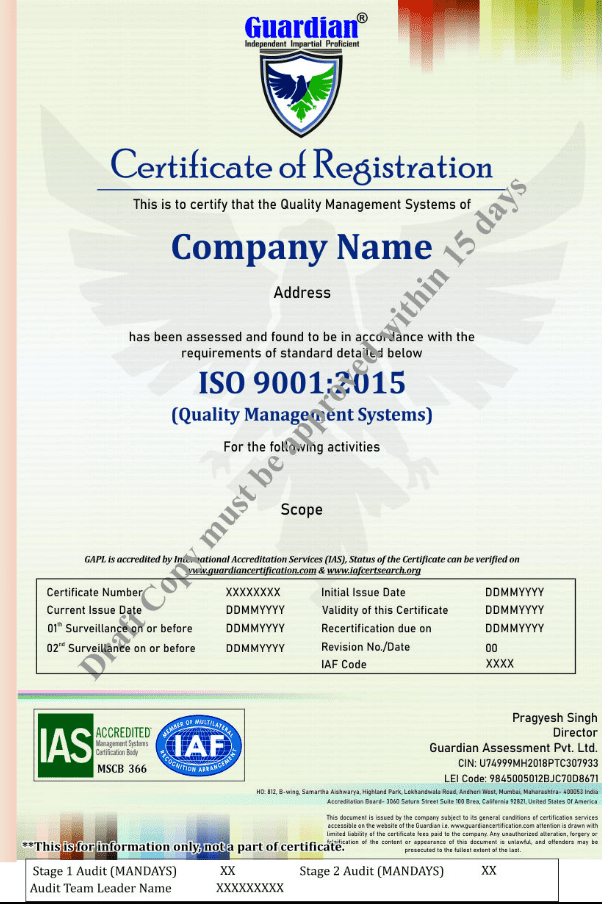
Request Quotation
Other Standards
Recognition
Sample Certificate
Practical ISO 45001 Documentation & Recordkeeping
Good documentation is helpful—not a burden. Keep your records short, clear, and tailored to what your business actually does.
Core Required Documents
- Scope of OHSMS: A page that shows who is covered (e.g., “All production and office staff at Main Street location”).
- Health & Safety Policy: A short statement from the management, printed out and posted up where everyone can read it.
- Roles and Responsibilities: Lists like “Cleaning supervisor checks for spills daily,” “Machinist does weekly blade safety tests.”
- Risk Register: Table listing actual site hazards: “Wet floor outside cold storage,” “Stacking crates more than 2m prohibited,” etc.
- Objectives and Targets: Specific, measurable goals like “Zero missing fire exit signs in next quarter.”
- Emergency Plan: Easy-to-follow steps for what to do in a fire, medical emergency, or chemical leak.
Records to Keep
- Legal Checklist: Table with laws relevant to your exact business (noise limits, chemical handling, etc.).
- Training Records: List every worker, with tick boxes for each training completed. Update after every session.
- Meeting Notes: Summaries from toolbox talks, safety meetings—brief but include key points discussed and who attended.
- Monitoring Records: Checklists from daily walkarounds, monthly reviews, incident logs, injury and absentee data.
- Calibration Records: Dates and results for tools like scales, sensors, air quality meters.
- Audit Reports: Action points and fixes from internal and certification audits.
- Supplier Safety Checks: Brief forms showing your contractors know and follow your rules.
ISO 45001 Certification Cost
Knowing what drives the cost of ISO 45001 certification will help you plan and avoid surprises.
What Affects Certification Price?
- Size of your team: More employees means more interviews, walkthroughs, and days the auditor needs to be on site. For example, a small packhouse may have a one-day audit, while a large car assembly line could take several days.
- Number of locations: If you operate from more than one factory or office, each site may be sampled or reviewed.
- Type of hazards: High-risk jobs (mining, chemical plants) take more time and deeper checks.
- How ready you are: If you already have a working system, you spend less on outside experts.
Three Main Cost Areas
- Preparation:
- Staff time to update procedures.
- Training and hiring a specialist (if needed).
- Implementation:
- Buying new gear, safety signs, or updating equipment.
- Running health exams, air testing, or installing new alarms or guards.
- Audit Fees:
- Certification body’s fixed fee.
- Per-day audit rates, plus auditor travel if you’re far from main cities.
- Follow-up audits for the next two years (surveillance).
Tip: The cheapest option isn’t always best—only work with a certification body accredited for your industry.
ISO 45001 Certification Accreditation: Why It’s Critical
Getting certified is only worth it if your certificate is recognized everywhere. Accreditation makes this possible.
What is Accreditation?
- Your business: wants certification.
- The certification body: audits you.
- The accreditation body: (e.g., UAF, IAS) checks that the certifier is fair and honest.
- IAF: operates a global recognition arrangement for accreditation bodies, which helps certificates gain broader international acceptance.
Unaccredited certification is like a fake brand guarantee—it might look the part but won’t pass customer or government checks.
How Do You Check Accreditation?
- Go to www.iafcertsearch.org and make sure the certification body is truly accredited.
- Make sure your industry type is listed (pharma, auto, food, etc.).
- Ask for proof of valid accreditation covering ISO 45001 for your sector.
Why Is It So Important?
- Many international buyers and tenders prefer certificates issued under IAF-recognized accreditation.
- Without it, you might lose contracts or be forced to restart the audit with a real certifier.
Integrating ISO 45001 with Other Management Standards
If you already have ISO 9001 (quality) or ISO 14001 (environment), adding ISO 45001 certification is easier and saves effort.
How to Integrate for Real Savings
- Make a combined policy: one easy-to-read statement that covers safety, quality, and environment.
- Merge forms and checklists: the same inspection sheet can check for spilled liquids (safety) and chemical leaks (environment).
- Do joint audits: walk the site once to check for three things, rather than separate trips.
- Example: At a glass bottle factory, audits now check for waste recycling (environment), cutting injury risks (safety), and product defects (quality) all at once.
Integration Advantages
- Less paperwork, more time focused on real improvements.
- Cheaper audits.
- Management can see every risk and opportunity in one place.
Next Steps Toward ISO 45001 Certification
The ISO 45001 standard makes safety a true part of everyday business, not a paperwork job. By fully using its steps—clear documents, worker participation, leader involvement, and accredited audits—you build trust, avoid costly problems, and keep people safe.
No matter if you run a food packing site, a growing logistics startup, or a construction company, following this step-by-step guide will put you on track for ISO 45001 certification. With every checklist, every talk, and each improvement, you make your workplace safer and strengthen your reputation—one day at a time.
Apply for ISO 45001:2018 Certification
If you plan to pursue ISO 45001:2018 certification, request a quotation by providing your organization’s information in the application form. You can download the inquiry form from our website or submit your inquiry through the “Contact US” button. Alternatively, send your inquiry via email to guardianassessment@gmail.com. You have the option to choose more than one standard, and if you consider that other standards may benefit your organization, you may integrate the standards within the accredited certification range and apply for certification for ISO 9001, ISO 14001, ISO 45001, ISO 21001, ISO 27001, and ISO 37001.
Frequently Asked Questions (FAQ)
Here are the answers to the questions we hear most often about ISO 45001 certification.
Ans) ISO 45001 is a modern, international standard launched in 2018. It updates and improves on the old OHSAS 18001 by making top management responsible, including every type of work risk (from machines to stress), and by using a design that fits other standards. It puts more focus on leadership, worker consultation, and using information from incidents to prevent repeats.
Ans) Not usually, but many big customers and government projects require it for contracts. It also helps you show government inspectors that you’re doing everything the law requires for health and safety.
Ans) Absolutely! Whether you make jam in a small kitchen or have an auto repair shop, you can adapt the standard just for your risks and resources. Many small companies start with a focused, simple version and expand as they grow.
Ans) This means the 2018 version of the standard—the newest edition with improvements fitting today’s workplaces. It’s the only valid version for businesses starting certification now.
Ans) They review and revise all policies and systems, update risk registers, add leadership participation, train everyone, and go through a new external audit.
Ans) You’ll have to keep the system active: record incidents, run audits, make improvements, and pass “surveillance” audits every year. Every three years, a more thorough review is required.
Ans) Yes. You can extend your OHSMS to include safety checks and controls for logistics partners, maintenance contractors, or anyone else working at your site.
Ans) Healthcare firms need infection logs, equipment checks, and extra training for emergencies. Equipment renters should keep test records on cranes, checklists for handovers, and operator licenses as part of their OHSMS.