
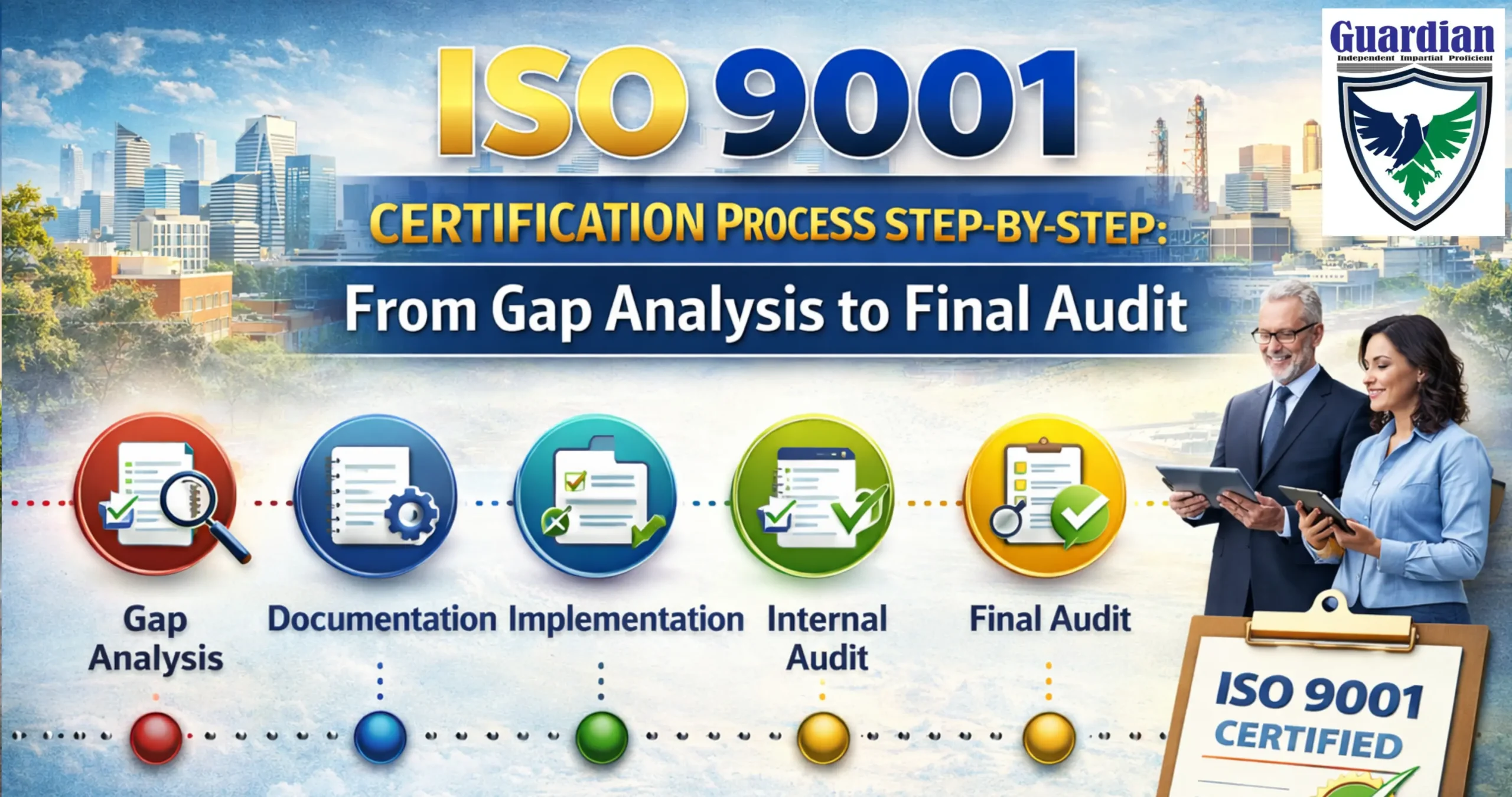
ISO 9001 Certification Process Step-by-Step: From Gap Analysis to Final Audit
Are you looking for a clear, simple guide to the ISO 9001 certification process? Many organizations want to strengthen their quality management system and achieve ISO 9001 certification to show commitment to consistent quality, customer satisfaction, and continual improvement. This step-by-step blog walks you through the entire journey, from gap analysis to the final audit, using easy language, practical tips, and real-world examples that apply to any business size or sector.
Whether you are new to quality standards or refining an existing system, following these ISO 9001 certification steps helps you build a strong foundation. The process focuses on creating, implementing, and verifying a Quality Management System (QMS) that meets international requirements. No shortcuts exist, but with proper planning, the path becomes straightforward and rewarding.
In this complete guide, you will discover what happens at each stage, why it matters, and how to avoid common mistakes. By the end, you will understand how to prepare confidently for certification. Let’s begin with the first critical step that sets the tone for success.
Start right: Gap analysis gives a clear roadmap, not guesswork.
Make it real: Implementation and records matter more than paperwork.
Prove it: Internal audits + management review prepare you for Stage 2.
Table of Contents
- Step 1: Conducting a Thorough Gap Analysis
- Step 2: Developing Quality Management System Documentation
- Step 3: Implementing the Quality Management System
- Step 4: Training Employees and Building Awareness
- Step 5: Performing Internal Audits
- Step 6: Conducting Management Reviews
- Step 7: Selecting a Certification Body and Preparing for External Audits
- Step 8: Undergoing the Stage 1 Audit (Documentation Review)
- Step 9: Addressing Findings and Final Preparation
- Step 10: The Final Audit (Stage 2 Certification Audit)
- Why Following This Process Matters
- Tips for a Smooth Journey
- Conclusion
- Frequently Asked Questions (FAQs)
Step 1: Conducting a Thorough Gap Analysis
Gap analysis is the starting point of every successful ISO 9001 certification process. It compares your current operations against the requirements of the ISO 9001 standard to find what already works, what needs fixing, and what is missing entirely.
Think of it as a health check for your business processes. You identify gaps in areas like leadership commitment, risk management, customer focus, and performance measurement.
How to perform an effective gap analysis:
- Assign a responsible person or small team with good knowledge of your operations and the standard.
- Use or create a detailed checklist covering ISO 9001 clauses.
- Review existing documents, interview team members, and observe daily processes.
- Document findings clearly: compliant areas, partial matches, and complete gaps.
- Prioritize gaps and create an action plan with owners and due dates.
- Review the report with top management so leadership approves the direction.
Common mistake to avoid: Skipping employee input. People doing the work daily often know the real process better than the documents. Their input makes your gap analysis accurate and practical.
This step prevents wasted effort later and creates a realistic roadmap. It also highlights quick wins that build momentum before bigger changes begin.
Step 2: Developing Quality Management System Documentation
With gaps identified, the next ISO 9001 certification step involves creating or updating documentation for your QMS. ISO 9001 requires clear policies, procedures, and records that show how you meet requirements consistently.
Key documents typically include:
- Quality policy and quality objectives
- Scope of the QMS
- Process maps or flowcharts (if useful for clarity)
- Procedures for risk assessment, internal audits, corrective actions, and management review
- Forms and templates for records (or digital records structure)
Keep documentation simple and practical. Focus on what adds value, not unnecessary paperwork. Some organizations use a quality manual, while others use integrated digital tools and structured procedures. Either approach can work if it is consistent and accessible.
Tips for strong documentation:
- Involve process owners so procedures reflect real work, not ideal theory.
- Use simple language that employees can understand.
- Link documents to business goals for stronger buy-in.
- Ensure version control and easy access for relevant staff.
Once documents exist, you are ready to bring the system to life. A written system becomes powerful only when it is used consistently.
Step 3: Implementing the Quality Management System
Documentation alone is not enough. The real value of ISO 9001 comes when you put the QMS into daily operation. Implementation turns plans into habits across the organization.
Start by communicating new or updated processes to employees. Provide training and clarity so everyone understands their role. Roll out changes in a controlled way, starting with high-priority gaps from your analysis.
What to monitor during implementation:
Use simple KPIs and evidence such as customer complaints, on-time delivery, defect rates, rework levels, service response times, and employee feedback. The goal is to spot early issues, correct them, and stabilize the system.
Best practices for successful implementation:
- Assign clear responsibilities to leaders and team members.
- Integrate the QMS into existing workflows rather than creating extra work.
- Encourage open feedback because employees often spot issues first.
- Run the system long enough to generate records and evidence of effectiveness.
Many organizations operate the QMS for a meaningful period before formal audits so there is real evidence, not only new documents. This builds confidence for internal audits and external certification.
Step 4: Training Employees and Building Awareness
Training is a crucial part of ISO 9001 implementation. People must understand how the QMS affects their work and why quality matters. Without training, procedures stay on paper and the system becomes weak.
What training should cover:
- Quality policy and objectives, and how each role supports them
- Role-specific procedures, record-keeping, and work instructions
- Risk awareness and reporting of process issues
- Corrective actions and how improvements are made
Effective training approaches:
- Interactive workshops, short sessions, and practical examples from your own operations
- E-learning modules or short videos for consistency
- Competency checks to confirm understanding
- Separate internal auditor training so audits stay objective
Well-trained teams reduce errors and improve engagement. Training also supports leadership and engagement expectations in ISO 9001.
Step 5: Performing Internal Audits
Internal audits act as a practice run for certification audits. They check whether your QMS works as documented and meets ISO 9001 requirements. Internal audits are not just a compliance exercise. They test effectiveness.
Key elements of a good internal audit program:
- Create an audit schedule that covers all processes over time.
- Use checklists based on ISO 9001 and your internal procedures.
- Focus on evidence and results, not just “presence of documents.”
- Record findings objectively as strengths, issues, and improvement opportunities.
- Keep auditors independent from the areas they audit.
Corrective actions follow each audit. This step builds confidence that your system is ready for external review and helps catch issues early.
Step 6: Conducting Management Reviews
Top management must actively review the QMS at planned intervals. This meeting evaluates overall performance and decides on improvements. It demonstrates leadership commitment and keeps the system aligned with business direction.
During management review, discuss:
- Internal audit results and corrective action progress
- Customer feedback and satisfaction data
- Process performance and product or service conformity
- Risks, opportunities, and changes affecting the organization
- Improvement priorities and resource needs
Document the review outcomes, including decisions and action items. Regular management reviews keep the QMS alive and improvement-driven.
Step 7: Selecting a Certification Body and Preparing for External Audits
Once internal checks show the system is stable, select a certification body to conduct external audits. Choose a body with relevant sector experience, a clear audit approach, and a reputation for fairness.
Prepare by organizing your documentation and records. Ensure internal audits and management reviews have occurred and corrective actions are properly closed. Some organizations also perform a readiness review or mock audit internally to reduce surprises.
Step 8: Undergoing the Stage 1 Audit (Documentation Review)
Stage 1 audit is often called the readiness review. It focuses mainly on documentation and overall QMS design. Auditors check whether key elements are documented and whether your system appears ready for a full implementation audit.
Auditors typically check:
- QMS scope, policies, objectives, and alignment with ISO 9001 clauses
- Evidence that internal audits and management reviews have been completed
- Understanding of key processes, risks, and controls
- Basic readiness to demonstrate the system in practice
At the end, you receive a report with findings and improvement needs. Address these promptly so you enter Stage 2 with confidence.
Step 9: Addressing Findings and Final Preparation for the Final Audit
Use the time between Stage 1 and Stage 2 to close gaps, strengthen evidence, and confirm corrective actions. If auditors highlighted weak areas, focus on fixing root causes and improving consistency.
Double-check that staff understand key procedures, records are complete, and processes are followed consistently. This preparation reduces surprises during the final audit and increases the chance of smooth certification.
Step 10: The Final Audit – Stage 2 Certification Audit
Stage 2 is the main event. Auditors evaluate how well the QMS is implemented in practice. They look for evidence that the system works consistently and supports quality outcomes.
During Stage 2, auditors typically:
- Observe processes in action
- Interview employees across roles and levels
- Review records and evidence of effectiveness
- Assess risk management, customer focus, and continual improvement
At the closing meeting, auditors present findings, including nonconformities if any. If issues exist, you submit corrective actions and evidence within an agreed timeframe. Once resolved, the certification body recommends certification.
Successful completion of Stage 2 leads to the award of your ISO 9001 certificate. This confirms your QMS is robust and capable of driving real business benefits.
Why Following This Process Matters
Each step in the ISO 9001 certification process builds on the previous one. Gap analysis prevents blind spots. Documentation ensures clarity. Implementation and audits prove effectiveness. The final audit verifies alignment with the standard.
Organizations that invest effort here often see improved efficiency, fewer errors, happier customers, and stronger team morale. ISO 9001 builds a culture of quality that lasts beyond certification day.
Tips for a Smooth Journey
- Involve people at every level: Real ownership makes the system work.
- Keep records organized: Good evidence reduces audit stress.
- Focus on improvement: Treat findings as chances to get better.
- Celebrate milestones: Recognition keeps motivation high.
- Use the QMS as a business tool: A practical system supports growth and stability.
Conclusion
The path from gap analysis to the final ISO 9001 audit may seem long, but each stage serves a clear purpose. By following this step-by-step guide, you create a quality management system that truly works for your organization.
Start with gap analysis, stay committed through implementation and internal checks, and approach Stage 2 with confidence. Achieving ISO 9001 certification demonstrates dedication to excellence and supports better customer trust, operational consistency, and long-term improvement.
Use this guide as your roadmap and enjoy the journey toward higher quality standards.
Frequently Asked Questions (FAQs)
Ans) ISO 9001 certification means an independent body has verified that your Quality Management System meets international requirements for consistent quality and customer satisfaction. Organizations pursue it to improve processes, reduce errors, build customer confidence, and demonstrate commitment to continual improvement in a structured way.
Ans) The timeline varies based on organization size, current systems, and resources. Most businesses complete the full journey—from gap analysis to final audit—in several months to a year. This includes time for implementation, internal audits, and operating the system long enough to generate records before external audits.
Ans) Stage 1 is a preliminary documentation review that checks readiness and identifies major gaps in design. Stage 2 (the final audit) examines actual implementation through observations, interviews, and records to confirm the system works effectively in practice and meets all requirements.
Ans) Many organizations succeed using internal teams, especially if they have experience with quality systems. Consultants can help speed up gap analysis, documentation, and training when internal resources are limited. The choice depends on your team’s knowledge and available time.
Ans) Non-conformities are areas where the system does not fully meet requirements. Minor issues usually require a corrective action plan and evidence within a short period. Major issues may need more time or a follow-up visit. Once resolved satisfactorily, certification proceeds normally. Most organizations use findings as opportunities for genuine improvement.


