ISO 21001 Implementation Timeline: How Long for Educational Institutions?
Are you an educational leader wondering about the ISO 21001 implementation timeline? Many institutions ask: “How long does it really take to implement ISO 21001?” or “What is the full ISO 21001 certification process for schools and training centers?”
This guide answers these questions in simple language. We cover the ISO 21001 implementation timeline, step-by-step process, factors that affect duration, and practical tips without using specific numbers, locations, or exact figures. If you want to improve learner satisfaction, streamline operations, and show commitment to quality education, understanding the ISO 21001 certification timeline is a smart first step.
Timeline depends on readiness: Existing systems and documentation speed things up.
Phased approach works best: Plan, implement, verify, improve, then certify.
Keep it practical: Simple processes beat heavy paperwork every time.
Table of Contents
- What is ISO 21001 and Why Does It Matter?
- Key Benefits of ISO 21001 for Educational Organizations
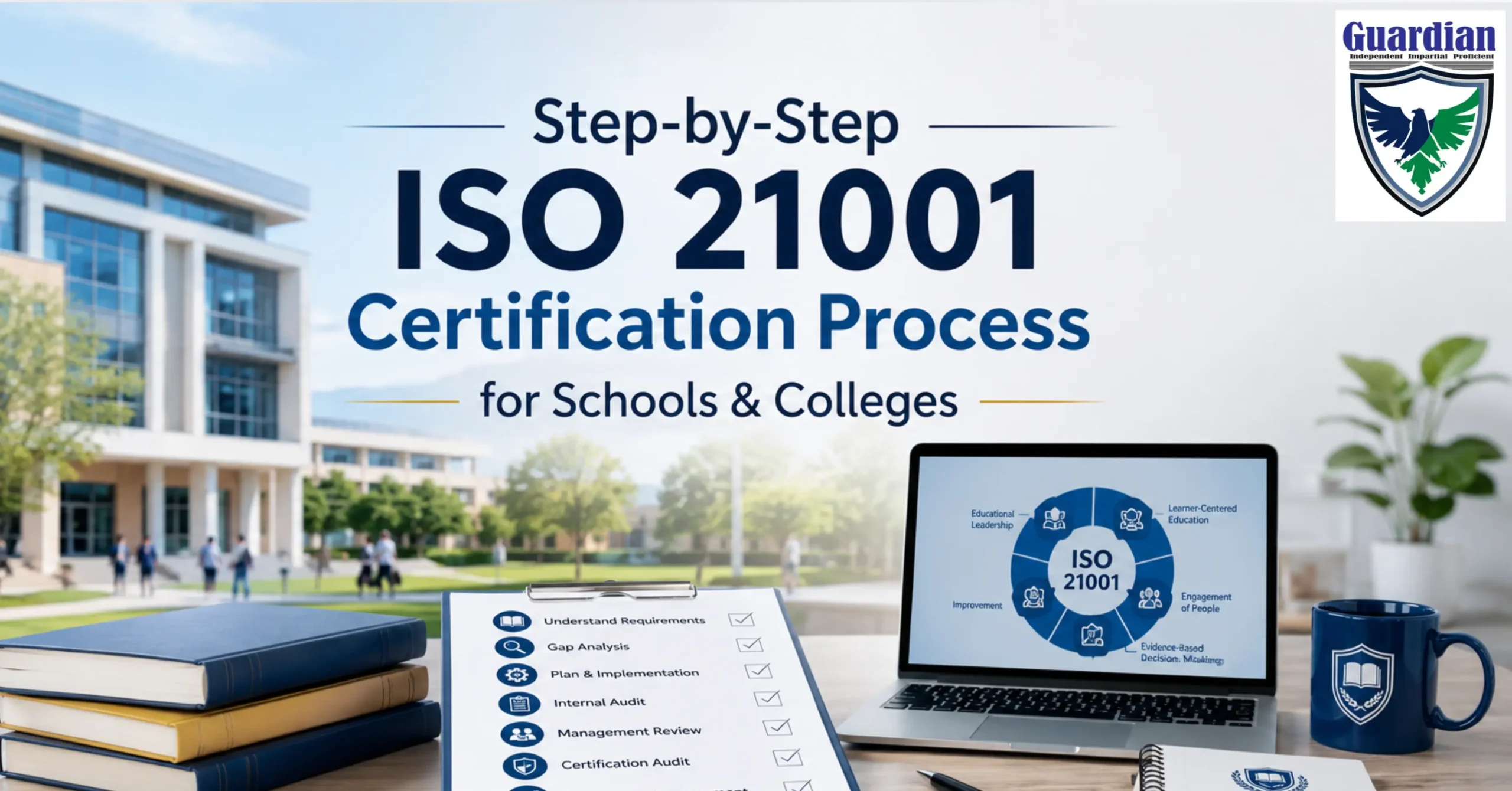
- Step-by-Step Guide to ISO 21001 Implementation
- Typical ISO 21001 Implementation Timeline: What “Long” or “Short” Looks Like
- Factors That Affect Your ISO 21001 Implementation Timeline
- Practical Tips to Make Implementation Faster and Smoother
- Common Challenges and How to Overcome Them
- Conclusion: Start Your ISO 21001 Journey Today
- Frequently Asked Questions (FAQs)
What is ISO 21001 and Why Does It Matter for Educational Institutions?
ISO 21001 is an international standard designed specifically for Educational Organizations Management Systems (EOMS). It helps any type of educational institution, whether it’s a school, college, university, vocational training center, or online learning platform, build a strong system that focuses on learners.
Unlike general quality standards, ISO 21001 puts learners at the center. It covers everything from planning courses to measuring outcomes, ensuring consistent delivery, and continuously improving teaching methods.
Educational institutions implement ISO 21001 because it creates a structured way to:
- Align daily operations with the institution’s mission and vision
- Meet the needs of learners, staff, parents, and other stakeholders
- Demonstrate accountability and transparency
In today’s competitive education sector, having a clear ISO 21001 implementation timeline helps leaders plan resources and set realistic expectations. The standard follows the Plan–Do–Check–Act (PDCA) cycle, which makes it practical and easier to integrate into existing processes.
Key Benefits of ISO 21001 for Educational Organizations
Implementing ISO 21001 brings improvements that institutions can feel in daily operations. Here are key benefits explained in simple terms:
Better learner outcomes: Processes become learner-focused, which supports higher satisfaction and stronger results.
Increased efficiency: Clear procedures reduce confusion and reduce time loss in administration.
Stronger stakeholder confidence: Parents, students, and partners see that the institution follows recognized best practices.
Continuous improvement culture: Regular reviews help identify issues early and fix them before they grow.
Enhanced credibility: Certification supports your quality message without relying on heavy marketing claims.
Risk management: Helps identify problems in teaching, assessment, or administration early.
Staff motivation: Clear roles and training help staff feel supported and engaged.
These benefits are why many institutions choose to follow an ISO 21001 implementation timeline and treat it as a long-term system, not a one-time project.
Step-by-Step Guide to ISO 21001 Implementation
The ISO 21001 certification process follows a logical sequence. Each phase builds on the previous one. Below is a clear breakdown. As requested, subheadings are presented as bold text (not H3).
1) Understanding the standard and conducting gap analysis
Start by learning ISO 21001 requirements and comparing them with your current practices. This “gap analysis” answers:
“Where are we now, and what needs to change?” Review policies, teaching methods, learner feedback systems, and record-keeping.
Identify strengths, weaknesses, and priority areas. Involve a small team of leaders and staff to keep it practical.
2) Planning and getting leadership commitment
Leadership support is essential. Define your EOMS scope, set objectives linked to learner satisfaction and quality goals,
and create a clear project plan with responsibilities. Form a cross-functional team that includes academics, administration, and support functions.
Strong leadership commitment keeps the process moving and reduces resistance.
3) Training and building awareness
Everyone should understand their role in the system. Run awareness sessions for all staff and provide deeper training for key roles
such as process owners and internal auditors. Explain how daily work connects to learner-focused goals.
Training reduces confusion and strengthens ownership across teams.
4) Developing documentation and processes
Create or update documents that explain how the institution operates. Focus on key areas like curriculum planning,
delivery of teaching and learning, assessment practices, learner support, communication, and performance monitoring.
Use simple templates so documentation remains practical and does not become paperwork for its own sake.
5) Implementing the system in daily operations
Put processes into practice. Many institutions roll out changes in a controlled manner, either by department or by process group.
Monitor how teaching delivery, assessments, and learner services run under the new system.
Collect feedback early and correct practical issues while momentum is high.
6) Conducting internal audits
Internal audits verify whether the system works the way it is written. Train internal auditors and run audits across key processes.
Record findings clearly and ensure corrective actions are assigned and completed.
Internal audits reduce surprises during external certification and strengthen confidence in the system.
7) Management review
Leadership reviews system performance and discusses internal audit findings, learner feedback, objectives progress, risks, and improvement opportunities.
Management review ensures the EOMS stays aligned with institutional goals and supports informed decision-making.
8) External certification audit
An independent certification body checks readiness and implementation. A typical audit approach includes a documentation review stage and a practical implementation stage
(interviews, observations, record checks). If gaps are found, corrective actions are completed and verified before certification is issued.
Typical ISO 21001 Implementation Timeline: What “Long” or “Short” Looks Like
The most common question is: “How long for ISO 21001 certification?” The honest answer is: it depends. Some institutions move faster because they already have structured processes, documentation, and strong internal review habits. Others take longer because they are building systems from the ground up or coordinating across multiple programs or campuses.
In general, the timeline becomes shorter when:
- Leadership commitment is strong and visible
- Existing processes are already documented and consistently followed
- Learner feedback systems are already active and measurable
- Teams can dedicate time to implementation tasks
- Internal auditing skills are available or developed early
The timeline becomes longer when:
- Processes vary widely across departments with no common method
- Documentation is missing or outdated
- Staff resistance is high or communication is weak
- Roles and responsibilities are unclear
- Corrective actions are delayed or not properly closed
After certification, the system continues through surveillance checks and periodic renewal. This keeps the improvement cycle active and prevents the institution from “starting over.”
Factors That Affect Your ISO 21001 Implementation Timeline
Several factors can speed up or slow down implementation. Understanding them helps you build a realistic plan for your institution.
Size and complexity: Larger institutions, multiple campuses, or many programs typically require more coordination and alignment work.
Existing systems: If you already operate structured processes or another management framework, many steps become faster.
Team commitment: Active leadership and staff involvement can reduce delays significantly.
Resource availability: Dedicated people, time allocation, and simple tools help avoid bottlenecks.
Change management: Strong communication reduces resistance and keeps momentum stable.
Practical Tips to Make Implementation Faster and Smoother
Want to stay on track? These practical tips help many institutions complete the ISO 21001 certification process efficiently:
- Start small: Pilot new processes in one department or one program before expanding.
- Use existing documents: Update what already works instead of rewriting everything.
- Keep regular check-ins: Short progress meetings reduce drift and confusion.
- Celebrate small wins: When a phase completes successfully, recognize the team effort.
- Keep communication open: Staff and learners should understand why changes are happening.
- Link everything to learner benefit: When teams see the “why,” motivation stays higher.
Common Challenges and How to Overcome Them
Every implementation journey has hurdles. Below are common ones and practical ways to handle them:
Resistance to change:
Explain how the system improves daily work and learner outcomes. Involve staff early so it feels like improvement, not enforcement.
Too much paperwork:
Keep documents short, practical, and aligned with real processes. The goal is consistency, not volume.
Lack of time:
Integrate ISO 21001 actions into existing meetings, academic reviews, and operational routines instead of creating extra layers.
Unclear roles:
Define responsibilities clearly during planning. Assign process owners so everyone knows who leads what.
Conclusion: Start Your ISO 21001 Journey Today
The ISO 21001 implementation timeline may seem long at first, but the rewards, better education quality, happier learners, and smoother operations, last for years. By following structured steps and keeping the timeline realistic, educational institutions can achieve certification successfully.
Begin with gap analysis and strong leadership support. The process is flexible and designed to fit real educational needs. Once the system is operating well, certification becomes a verification step, not a stressful last-minute event.
Final message:
Map out your institution’s timeline phase by phase, assign ownership, keep documentation practical, and focus on learner outcomes. Quality education starts with quality management.
Frequently Asked Questions (FAQs)
Ans) The timeline typically ranges from several months to over a year, depending on the institution’s size, current processes, and team dedication. Most complete the full cycle in 6–12 months, including all steps from planning to certification.
Ans) ISO 9001 is a general quality management standard for any organization. ISO 21001 is made specifically for educational institutions. It adds learner-focused requirements, special attention to teaching processes, and educational outcomes that ISO 9001 does not cover.
Ans) No, it is voluntary. However, many institutions choose it to demonstrate commitment to quality, improve learner satisfaction, and gain a competitive edge in the education sector.
Ans) The key steps include gap analysis, planning, training, documentation, implementation, internal audits, management review, and the two-stage external certification audit. After certification, annual surveillance audits keep the system effective.
Ans) Yes. The standard is flexible and works for schools, colleges, universities, vocational centers, online platforms, and training providers of any size. It adapts to different teaching methods and learner needs.