
ISO 9001:2015 played an important role in shaping how organizations manage quality. For more than a decade, it provided a framework for businesses to improve their processes, meet customer requirements, manage risks and continually improve their performance. If you’ve come across an ISO 9001:2015 certificate, an older quality manual or a government tender that still mentions the 2015 edition, you may be wondering whether it is still relevant.
The answer is yes, although its status has changed.
On 16 September 2026, the International Organization for Standardization (ISO) published ISO 9001:2026, replacing the 2015 edition. This began a transition period for organizations already certified to ISO 9001:2015. While ISO 9001:2026 is now the current edition, existing 2015 certificates can remain valid during the transition period, subject to applicable certification requirements.
This guide explains what ISO 9001:2015 was, why it mattered, how its requirements worked, whether organizations can still obtain certification to it, and how the transition to ISO 9001:2026 affects existing certificate holders.
What Was ISO 9001:2015?
ISO 9001:2015 was the fifth edition of ISO 9001 certification, the international standard for Quality Management Systems (QMS). Published in September 2015, it replaced ISO 9001:2008. In simple terms, it helped organizations establish a systematic way of managing quality.
Rather than relying only on final inspections or correcting problems after they occurred, the standard encouraged organizations to look at their entire way of working — from understanding customer requirements to planning activities, controlling processes, reviewing results and making improvements. ISO 9001:2015 was designed for organizations of different sizes and industries, including manufacturing, construction, engineering, healthcare, information technology, education, logistics and professional services.
One of its strengths was flexibility. A small service business and a large manufacturing company could both apply the standard, even though their processes and operations were very different. ISO 9001:2015 was withdrawn as the current published edition on 16 September 2026, when ISO 9001:2026 was released. However, withdrawal of the standard does not mean that every existing ISO 9001:2015 certificate immediately becomes invalid. Accredited certifications are subject to separate transition arrangements.
What Changed in the 2024 Climate Amendment?
In February 2024, ISO published ISO 9001:2015/Amd 1:2024, an amendment introducing climate change considerations into the standard. The amendment addressed two parts of ISO 9001:2015:
- Clause 4.1 – Context of the Organization: Organizations were required to determine whether climate change was a relevant issue for their QMS.
- Clause 4.2 – Interested Parties: A note clarified that relevant interested parties could have requirements relating to climate change.
This did not mean every organization had to introduce a separate environmental management programme. Instead, organizations needed to consider whether climate change was relevant to their activities and could affect their ability to achieve the intended results of their Quality Management System.
For example, a manufacturing company might consider whether extreme weather could disrupt raw-material supplies or affect production continuity. A service company might consider whether climate-related disruptions could affect its ability to meet customer commitments.
The amendment remained relevant to organizations operating under ISO 9001:2015. Its climate-related considerations were also carried forward into ISO 9001:2026. Following publication of the 2026 edition, the 2024 amendment was withdrawn as a separate publication. For the original amendment details, see the historical ISO 9001:2015/Amd 1:2024 record.
Why Was ISO 9001:2015 Important?
ISO 9001:2015 was a significant step in the development of quality management. Earlier editions were sometimes associated with detailed documentation and formal procedures. The 2015 edition placed greater emphasis on how the management system worked in practice and how it supported the organization’s overall direction. It encouraged organizations to think beyond individual departments and understand how their activities connected.
The main areas of emphasis included:
- Organizational context: Understanding internal and external factors that could affect the organization.
- Leadership involvement: Making top management more directly responsible for the effectiveness of the QMS.
- Customer focus: Understanding customer requirements and monitoring customer satisfaction.
- Risk-based thinking: Considering potential problems and opportunities when planning activities.
- Process management: Managing related activities as interconnected processes.
- Performance evaluation: Using monitoring, measurement and review to understand how well the system was working.
- Continual improvement: Identifying problems, taking corrective action and improving processes over time.
Another important development was greater flexibility in documented information. Organizations could determine which additional procedures and records were necessary for their operations instead of following one fixed documentation structure. Together, these changes helped make quality management more closely connected to everyday business activities.
Request Quotation
Other Standards
Recognition
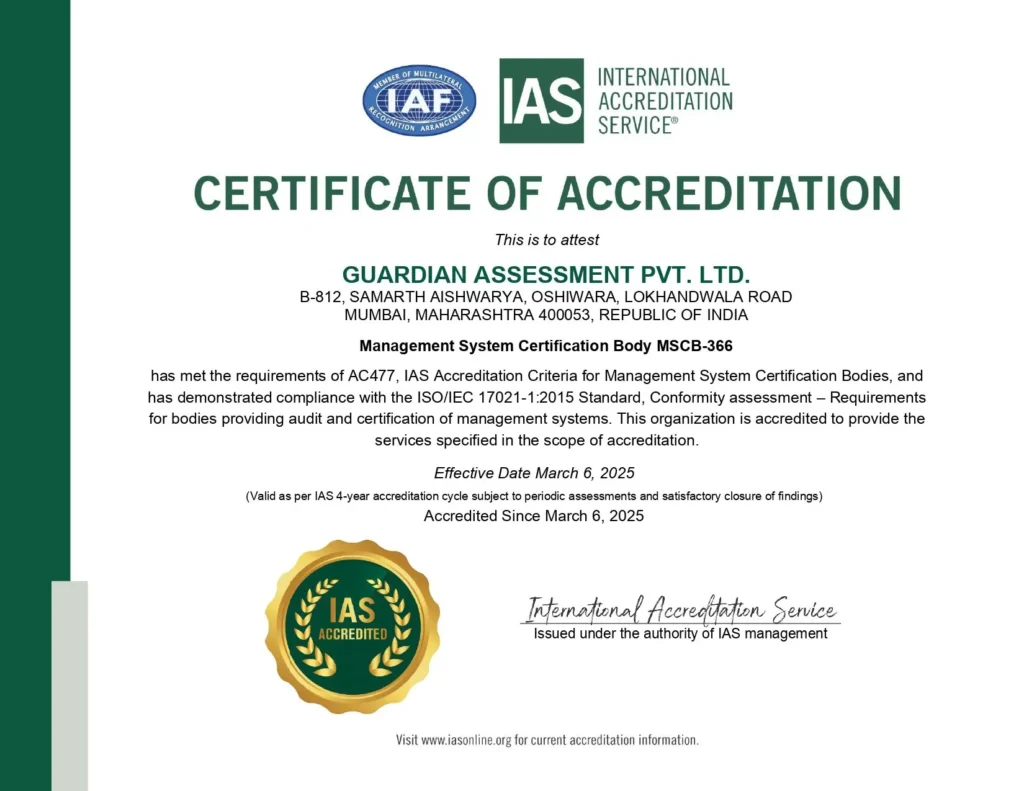
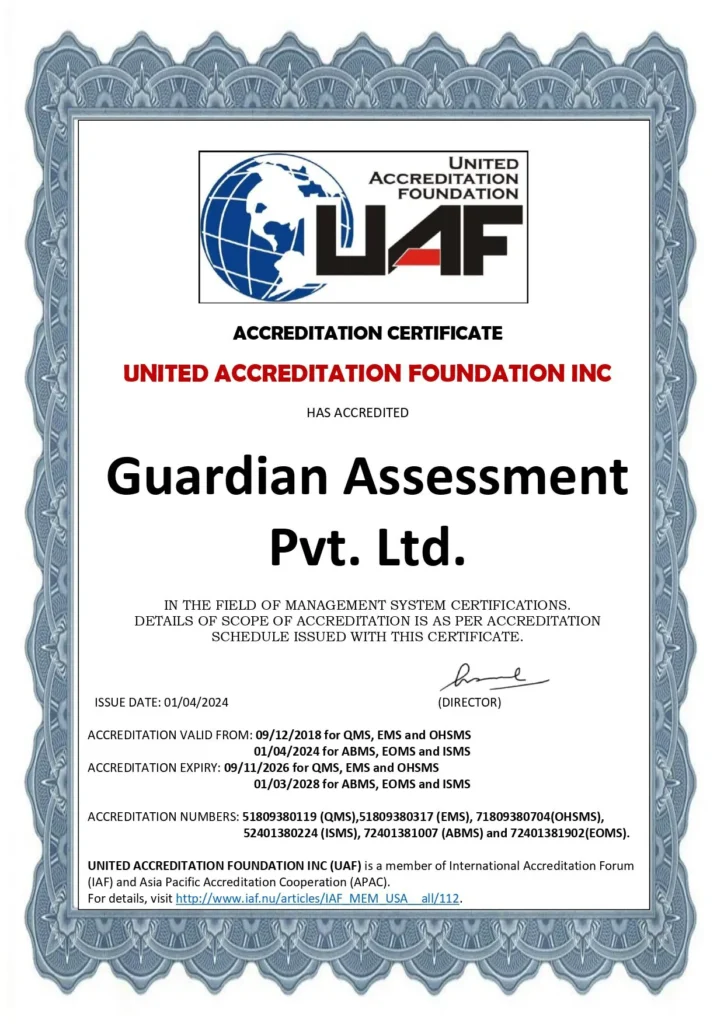
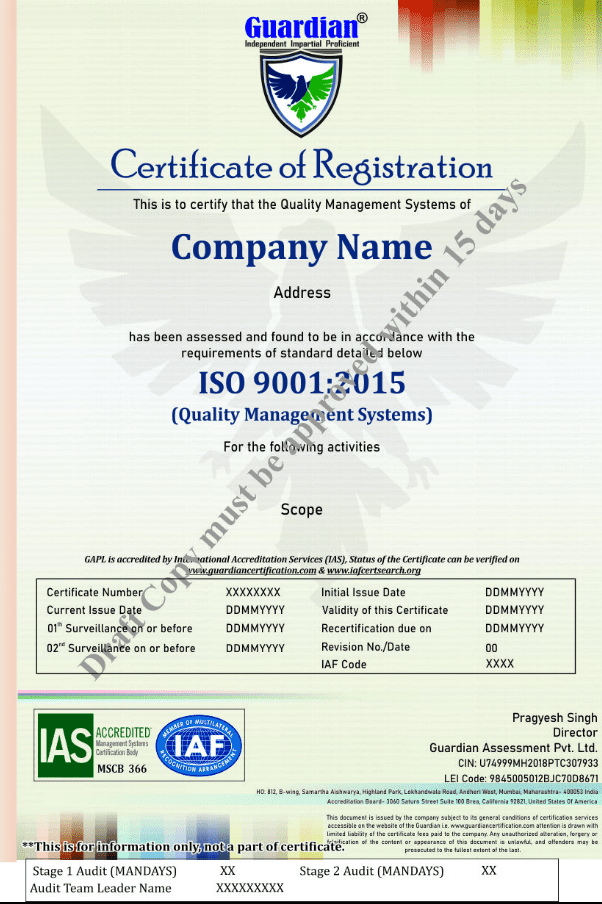
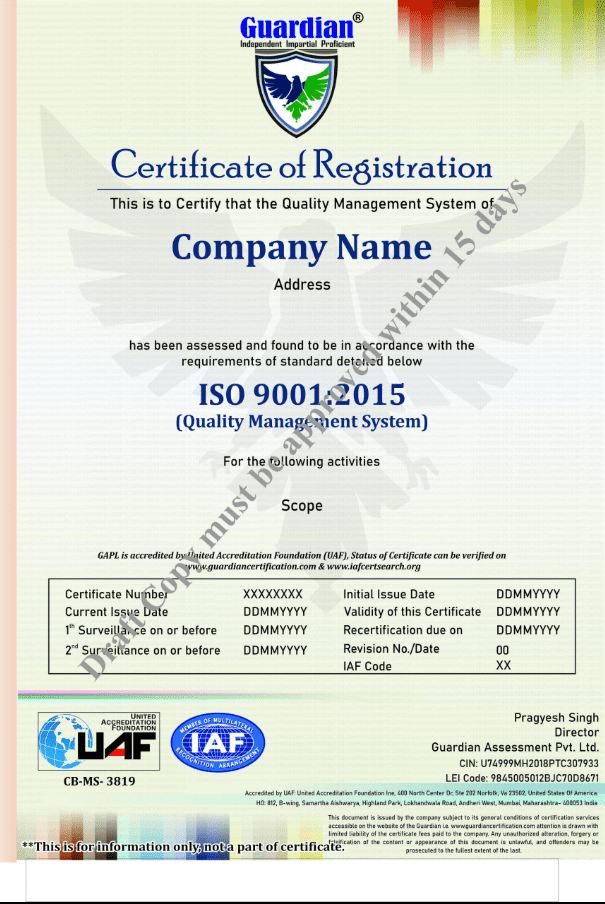
Sample Certificate
ISO 9001:2015 Requirements: Clauses 4 to 10
ISO 9001:2015 organized its main requirements into Clauses 4 to 10. Each clause covered a different part of the Quality Management System, but the requirements were designed to work together.
Clause | What It Covered |
4 – Context of the Organization | Understanding internal and external issues, interested parties, QMS scope and processes. |
5 – Leadership | Management commitment, customer focus, quality policy, roles and responsibilities. |
6 – Planning | Addressing risks and opportunities, establishing quality objectives and planning changes. |
7 – Support | Resources, competence, awareness, communication and documented information. |
8 – Operation | Operational planning, customer requirements, external providers, production and service delivery. |
9 – Performance Evaluation | Monitoring, measurement, customer satisfaction, internal audits and management reviews. |
10 – Improvement | Nonconformities, corrective action and continual improvement. |
How Did These Requirements Work Together?
Consider a manufacturing company experiencing repeated delays from a supplier. Under the ISO 9001:2015 framework, the company could identify the supply issue as a risk, review its purchasing arrangements, establish supplier performance controls and monitor whether those controls were effective. If problems continued, the organization could investigate their causes and take corrective action.
This example shows how planning, operations, monitoring and improvement work together. The intention was not simply to comply with individual clauses, but to operate a management system that could consistently achieve its intended results.
Key Features of ISO 9001:2015
Several features distinguished ISO 9001:2015 from earlier editions.
1. A Common Structure for Management Systems: ISO 9001:2015 adopted the harmonized high-level structure used by many other ISO management system standards. This made it easier for organizations to coordinate quality management with standards such as ISO 14001 for environmental management and ISO 45001 for occupational health and safety.
2. Understanding the Organization’s Context: Organizations were expected to understand the circumstances in which they operated. This meant considering questions such as:
- What internal and external issues affect our activities?
- What do our customers expect?
- Which legal and regulatory requirements apply?
- Which interested parties have relevant requirements?
Understanding these factors helped organizations establish a QMS appropriate to their actual operating environment.
3. Risk-Based Thinking: ISO 9001:2015 placed greater emphasis on identifying and addressing risks and opportunities.
For example, a service company might identify the risk of missed deadlines when key employees are unavailable. It could respond by improving work allocation, maintaining appropriate competence and establishing backup arrangements. The idea was to consider potential problems before they affected results, rather than relying entirely on corrective action afterward.
4. Greater Leadership Involvement: The standard placed clear responsibility on top management for supporting the Quality Management System. Leadership was expected to establish direction, promote customer focus, provide necessary resources and ensure that quality objectives were aligned with organizational activities. Quality management was intended to be part of how the organization was managed, not a separate responsibility assigned only to a quality department.
5. The Process Approach: One of the central ideas of ISO 9001:2015 was that organizational activities should be managed as connected processes. A simple example is: Customer Requirements → Planning → Purchasing → Production or Service Delivery → Monitoring → Customer Feedback → Improvement
Each process has inputs, activities, responsibilities and outputs. Looking at how processes interact helps organizations identify where problems occur and where improvements may be useful.
6. Flexible Documented Information: ISO 9001:2015 introduced greater flexibility in how organizations managed documentation. It did not generally require a separate quality manual or a fixed set of documented procedures. Instead, organizations were expected to maintain and retain the documented information required by the standard and necessary for the effective operation of their processes. This allowed organizations to use documentation appropriate to their size, activities and complexity.
The Seven Quality Management Principles
ISO 9001:2015 was based on seven quality management principles. These principles explain the thinking behind its requirements.
Principle | What It Means in Practice |
Customer Focus | Understanding customer needs and consistently meeting applicable requirements. |
Leadership | Establishing direction and creating conditions for effective quality management. |
Engagement of People | Involving competent people and helping them understand their responsibilities. |
Process Approach | Managing related activities as connected processes. |
Improvement | Continually looking for ways to improve processes, products, services and performance. |
Evidence-Based Decision-Making | Using reliable information and results to support decisions. |
Relationship Management | Managing relationships with suppliers and other relevant interested parties. |
These principles remained important throughout the life of the 2015 edition and continue to influence modern Quality Management Systems.
ISO 9001:2015 Certification Process
An ISO 9001:2015 certificate showed that an independent certification body had assessed an organization’s Quality Management System and determined that it met the requirements of the 2015 edition within a defined certification scope. It did not mean that ISO itself had certified the organization or that every individual product or service was guaranteed to be free from defects.
How Did the Certification Process Work?
Certification generally followed these stages:
- QMS preparation: The organization established and implemented its Quality Management System.
- Stage 1 audit: The certification body reviewed relevant documentation and assessed readiness.
- Stage 2 audit: Auditors evaluated whether the system was implemented and working effectively.
- Corrective action: Any identified nonconformities were addressed according to the applicable requirements.
- Certification decision: The certification body reviewed the audit information and made an independent decision.
- Surveillance and recertification: Periodic audits helped confirm that the system continued to meet the requirements.
The certification process normally operated within a three-year cycle, subject to surveillance audits and continued conformity. For a detailed explanation of the audit process, documentation, and general certification requirements, see the ISO 9001 Certification guide.
Can Organizations Still Get ISO 9001:2015 Certification?
This is an important question now that ISO 9001:2026 has been published. ISO 9001:2015 has been replaced as the current published standard, but accredited certification to the 2015 edition remains possible for a limited part of the transition period. Whether a new ISO 9001:2015 certificate can be issued depends on the certification body’s applicable accreditation and transition arrangements.
Some certification bodies may stop issuing certificates to the older edition earlier than others. Under the published international transition requirements:
Date | What It Means |
31 March 2028 | From this date, new and initial accredited ISO 9001 certifications may only be issued to ISO 9001:2026. |
30 September 2029 | Organizations already certified to ISO 9001:2015 must complete their transition to ISO 9001:2026. |
During the transition period, the availability of new ISO 9001:2015 certification depends on the certification body’s applicable accreditation and transition arrangements. Organizations seeking certification should confirm the available edition directly with their chosen certification body. These dates follow the official ISO/TC 176 transition guidance.
ISO 9001:2015 for Government Tenders and GeM
ISO 9001:2015 still appears in some government tenders, public sector procurement documents, and Government e-Marketplace (GeM) requirements in India. This is understandable. Many procurement documents were prepared when the 2015 edition was the current version of ISO 9001. But what happens when a tender specifically asks for ISO 9001:2015?
- If You Hold an ISO 9001:2015 Certificate: A valid, accredited ISO 9001:2015 certificate may continue to satisfy a tender requirement during the transition period. However, acceptance depends on the tender’s exact eligibility conditions and the issuing authority’s requirements. Having a certificate with the correct edition number does not automatically guarantee acceptance.
- What if Your Certificate Is ISO 9001:2026?: ISO 9001:2026 certification is the current edition of the same international standard. However, some procurement documents may still refer specifically to ISO 9001:2015. Where this happens, organizations should confirm with the tender authority whether a certificate issued to the newer edition will be accepted. A certificate to the newer edition should not automatically be assumed acceptable as a substitute when a tender specifically names ISO 9001:2015.
- What Should You Check Before Submitting a Tender?: Before relying on an ISO 9001 certificate for a government tender, PSU procurement or GeM requirement, check:
- Standard edition: Does the tender specify ISO 9001:2015 or another edition?
- Certificate validity: Is the certification currently active and in good standing?
- Accreditation: Does the certificate meet the stated accreditation requirements?
- Certification scope: Does the certificate cover the activities relevant to the tender?
- Verification: Can the certificate and its current status be verified?
- Tender conditions: Has the issuing authority provided any clarification about acceptable editions?
The important point is that neither a 2015 nor a 2026 certificate guarantees tender eligibility by itself. The certificate must satisfy the actual procurement requirements. Where the tender wording is unclear, seeking clarification from the issuing authority before submitting a bid is the safest approach.
Is an ISO 9001:2015 Certificate Still Valid?
Yes. Existing ISO 9001:2015 certificates may remain valid during the transition period, provided they remain in good standing and meet the applicable certification requirements. Publication of ISO 9001:2026 does not automatically invalidate an existing ISO 9001:2015 certificate.
However, organizations must complete their transition to ISO 9001:2026 by 30 September 2029. A certificate may cease to be valid earlier because of:
- Its stated expiry date.
- Suspension or withdrawal by the certification body.
- Failure to complete required surveillance audits.
- Failure to resolve nonconformities or meet other applicable certification conditions.
Regardless of the expiry date printed on the certificate, ISO 9001:2015 certification cannot continue beyond the transition deadline of 30 September 2029.
What Should You Do if You Hold a 2015 Certificate?
Start by checking the certificate’s current status with the issuing certification body. Confirm the certification scope, expiry date, surveillance arrangements and applicable transition requirements. If the certification is still active, you can continue planning the move to ISO 9001:2026 within the permitted transition arrangements. The important thing is not to assume that a printed expiry date alone guarantees validity, or that the transition can safely be left until the final deadline.
How to Transition from ISO 9001:2015 to ISO 9001:2026
For organizations already operating a QMS based on ISO 9001:2015, the transition does not necessarily mean starting again from the beginning. Many of the ideas introduced or strengthened in the 2015 edition continue in ISO 9001:2026, including the process approach, customer focus, leadership, risk-based thinking and continual improvement. The new edition also introduces updated requirements and clearer guidance that organizations need to understand and address.
A Practical Transition Approach
- Review Your Existing Certificate: Check its scope, current status, expiry date and issuing certification body.
- Understand Your Current QMS: Look at how existing processes, responsibilities, controls, objectives and documented information are organized.
- Review ISO 9001:2026: Study the new edition and identify which requirements have changed or need additional attention.
- Identify the Gaps: Compare your existing QMS against the new requirements. This may highlight processes, records, responsibilities or employee awareness activities that need updating.
- Make and Evaluate the Changes: Update the relevant parts of the QMS, communicate changes to employees and allow the revised processes to operate. Use internal audit and management review activities to evaluate whether the changes are effective.
- Coordinate With Your Certification Body: Confirm the transition assessment, timing and applicable requirements. Depending on the certification arrangements, the transition assessment may be combined with a surveillance or recertification audit, or conducted separately.
For detailed information about the changes introduced in the current edition, see the ISO 9001:2026 guide.
Why ISO 9001:2015 Still Matters
Although ISO 9001:2015 is no longer the current edition, it remains an important reference. Many organizations still have certificates, QMS documentation, training materials and historical audit records that refer to it. Understanding the 2015 edition can therefore help when reviewing:
- Existing or former ISO 9001:2015 certificates.
- Older government tender requirements.
- Legacy quality manuals and procedures.
- Historical audit findings and corrective actions.
- Supplier qualification records.
- Training materials based on the 2015 edition.
- Differences between earlier and current ISO 9001 requirements.
From a historical perspective, ISO 9001:2015 also represents an important stage in the development of quality management. It helped establish a more integrated approach in which organizational context, leadership, process management, risk-based thinking and continual improvement became central to the QMS. Those ideas remain relevant today, even as the standard continues to evolve.
Planning Your Transition to ISO 9001:2026?
With ISO 9001:2026 now published, businesses can begin reviewing their existing quality management systems and planning for the transition from ISO 9001:2015. Guardian Assessment Pvt. Ltd. supports organizations in understanding the certification process and preparing for the applicable requirements of the new edition.
With UAF and IAF-related accreditation credentials, Guardian Assessment can help you understand the next steps for your organization’s ISO 9001 certification requirements. Whether you already hold ISO 9001:2015 certification or are planning to pursue certification under ISO 9001:2026, contact our team to discuss your requirements and transition planning.
Ready to take the next step? Contact Guardian Assessment to discuss your ISO 9001 certification needs.
Frequently Asked Questions
ISO 9001:2015 was the fifth edition of the international standard for Quality Management Systems. It was published in September 2015 and established requirements for managing processes, meeting customer requirements, and continually improving quality management.
Not necessarily. An effectively operating ISO 9001:2015 system provides a useful starting point. Organizations need to review the new requirements, identify gaps, make necessary changes, and complete the applicable transition assessment.
An existing ISO 9001:2015 certificate may remain valid during the transition period, provided it remains in good standing and satisfies applicable certification requirements. Organizations must complete the transition to the 2026 edition by 30 September 2029.
For a limited period during the transition, this may be possible under the applicable accreditation and certification arrangements. From 31 March 2028, new and initial accredited ISO 9001 certifications may only be issued to ISO 9001:2026.
Organizations holding ISO 9001:2015 certification must complete their transition by 30 September 2029, subject to any earlier certificate expiry or other applicable certification requirements.
No. ISO 9001:2015 did not generally require a separate quality manual. Organizations had to maintain and retain documented information required by the standard and necessary for their management systems.