
Quality affects how customers experience an organization’s products and services. Inconsistent quality can lead to customer complaints, rework, delays, and loss of trust. A well-managed Quality Management System (QMS) helps an organization establish consistent processes, understand customer requirements, and improve the way it operates.
Published on September 16, 2026, ISO 9001:2026 is the sixth edition of the international quality management standard. It replaces ISO 9001:2015, including Amendment 1:2024 on climate action. The revised edition retains the established QMS framework while clarifying selected requirements and strengthening the focus on leadership, quality culture, ethical behaviour, and the separate consideration of risks and opportunities.
Organizations already certified to ISO 9001:2015 should begin reviewing the revised requirements and planning their transition. Under the applicable Global ACI transition requirements, the transition period ends on September 30, 2029. Organizations seeking certification for the first time should consider the current edition and the availability of certification under the relevant certification arrangements.
This guide explains the evolution of ISO 9001, the key updates in the 2026 edition, the benefits of certification, and the practical steps organizations can take to prepare for certification or transition.
ISO 9001 Certification at a Glance
Key Information | Details |
Standard | ISO 9001:2026 |
Full Title | Quality Management Systems — Requirements |
Edition | Sixth edition |
Publication Date | September 16, 2026 |
Previous Edition | |
Previous Amendment | ISO 9001:2015/Amd 1:2024 |
Transition Deadline | September 30, 2029, under applicable Global ACI transition requirements |
Certification Body | Independent third-party certification body, if an organization chooses to seek certification |
Accreditation | Accreditation is specific to the certification body, standard edition, and certification scope |
Applicability | Organizations of different sizes, types, and industries |
Certification Cycle | Generally a three-year cycle, subject to applicable certification requirements and continued conformity |
Main Purpose | To help organizations establish, implement, maintain, and continually improve a Quality Management System |
The 2026 edition retains the established Quality Management System framework while clarifying selected requirements and strengthening the focus on leadership, quality culture, risk and opportunity planning, and management of change.
What Is ISO 9001 Certification?
ISO 9001:2026 is an international standard that specifies requirements for a Quality Management System. A QMS helps an organization establish processes for consistently providing products and services that meet customer requirements and applicable statutory and regulatory requirements.
Quality requirements vary depending on an organization’s activities. For example, a manufacturing business may need to manage production processes, product inspections, equipment, and supplier quality. A service provider may focus on customer communication, service delivery, staff competence, and handling customer feedback.
A QMS provides a structured way to manage these activities. It helps organizations establish a quality policy, define responsibilities, set objectives, monitor performance, address nonconformities, and improve processes over time.
ISO 9001:2026 does not require every organization to follow an identical quality programme. The system should reflect the organization’s context, products and services, customer requirements, applicable obligations, and operational processes.
Organizations can implement ISO 9001:2026 without seeking certification. Those that choose certification undergo an independent assessment by a certification body against the applicable requirements. Any certificate issued covers the approved certification scope, including the activities and locations identified in the certification documents.
Request Quotation
Other Standards
Recognition
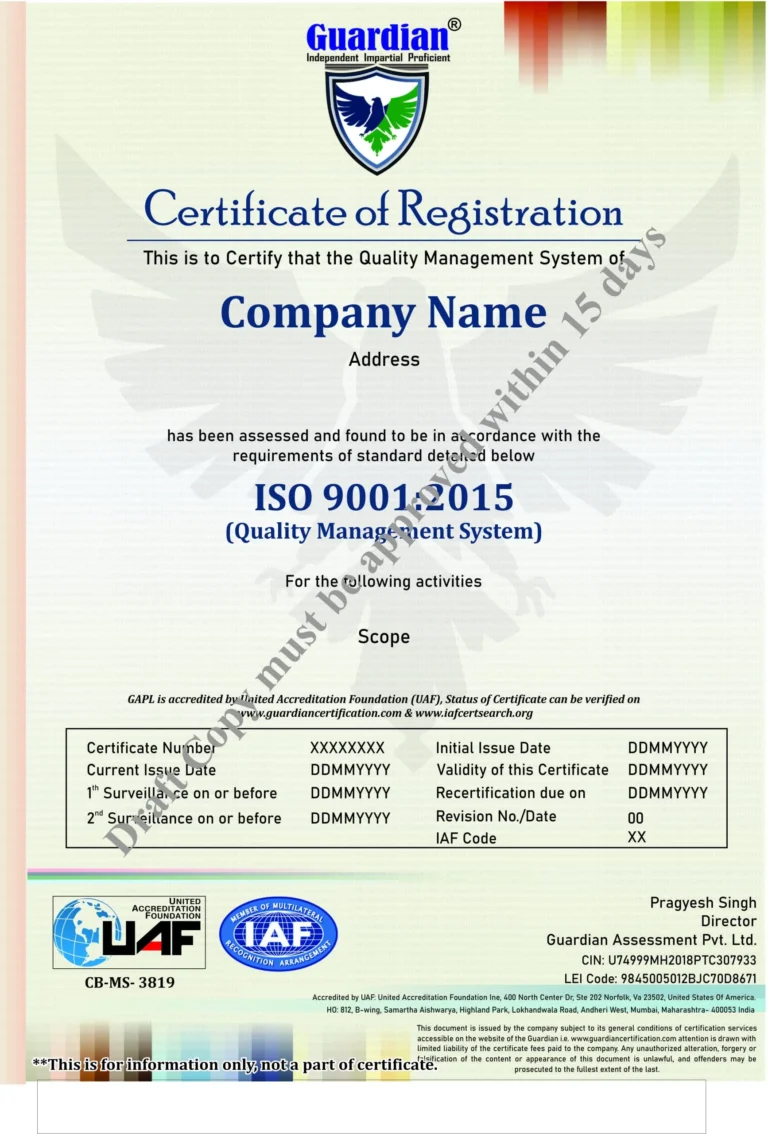
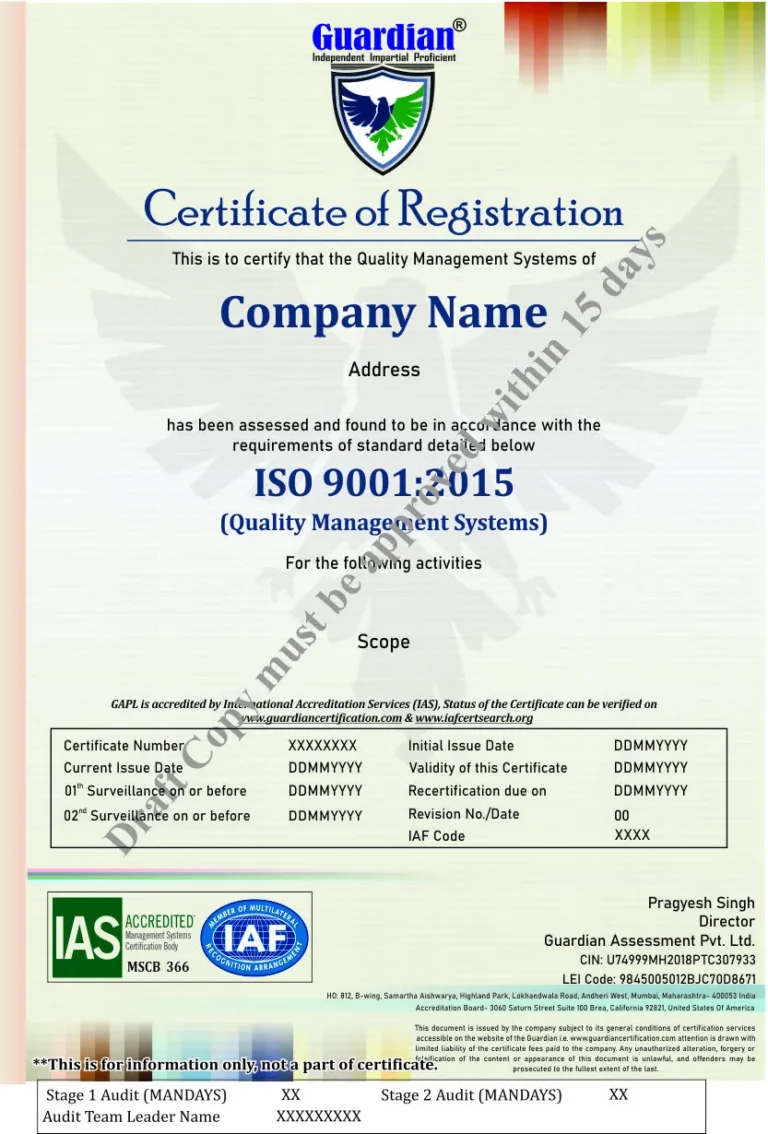
Sample Certificate
The Evolution of ISO 9001 (1987 to 2026)
Since its first publication in 1987, ISO 9001 certification has evolved to help organizations manage quality through a structured Quality Management System. Each edition has refined the framework to reflect changes in business practices, customer expectations, and quality management approaches.
1. ISO 9001:1987 — The First Edition: The first edition of ISO 9001 was published in 1987. It established an international framework for quality assurance, with requirements covering activities such as design, development, production, installation, and servicing. The early editions were particularly focused on establishing documented quality procedures and demonstrating control over production and service-related activities.
2. ISO 9001:1994 — Greater Emphasis on Preventive Action: The second edition was published in 1994. It clarified several quality assurance requirements and placed greater attention on preventive action. The objective was to help organizations identify potential quality problems and take action before they affected products, services, or customer satisfaction.
3. ISO 9001:2000 — Introducing the Process Approach: The 2000 edition brought a significant change in how organizations approached quality management. It placed greater emphasis on the process approach, customer satisfaction, and continual improvement. Rather than focusing mainly on individual procedures, organizations were encouraged to manage connected processes and understand how they contributed to consistent results.
4. ISO 9001:2008 — Clarifying Existing Requirements: The fourth edition was published in 2008. It clarified requirements from the 2000 edition and improved consistency in how organizations interpreted and applied the standard. It did not introduce a major change to the overall QMS framework.
5. ISO 9001:2015 — A Broader Management Approach: The fifth edition was published in September 2015. It introduced the common high-level structure used by many ISO management system standards. It strengthened the focus on organizational context, leadership, risk-based thinking, interested parties, and the management of documented information. It also made the standard more adaptable to service-based organizations and different business environments.
6. ISO 9001:2024 — Climate Action Amendment: In 2024, ISO introduced a climate-action amendment to ISO 9001:2015. It required organizations to determine whether climate change was a relevant issue in their organizational context and recognized that relevant interested parties may have climate-related requirements. This was an amendment to the 2015 edition, not a separate edition of ISO 9001.
7. ISO 9001:2026 — The Sixth Edition: Published on September 16, 2026, ISO 9001:2026 is the sixth edition of the standard. It replaces ISO 9001:2015 together with the 2024 climate-action amendment. The updated edition builds on the established QMS framework, with clearer wording and guidance. It strengthens the focus on leadership, quality culture, ethical behaviour, and the separate consideration of risks and opportunities. Organizations certified to ISO 9001:2015 should review the revised requirements and plan their transition under the applicable certification arrangements.
Why Was ISO 9001 Updated in 2026?
ISO 9001:2026 was developed to improve the clarity and usability of the standard while keeping its central purpose: helping organizations consistently meet requirements and improve customer satisfaction. Organizations now operate in a business environment shaped by digital technologies, interconnected supply chains, changing customer expectations, and evolving operational risks. The revised edition reflects these developments and reinforces the role of quality management in supporting business performance and informed decision-making.
The update also places clearer emphasis on leadership, quality culture, ethical behaviour, and the distinction between risks and opportunities. Additional explanatory content is intended to help organizations understand the requirements and apply them more consistently. For organizations already using ISO 9001:2015, the update provides an opportunity to review how their QMS operates and identify any adjustments needed under the revised requirements. Organizations seeking certification for the first time can use the 2026 edition as the basis for establishing their QMS, subject to the applicable certification arrangements.
The changes do not mean that every organization needs to rebuild its Quality Management System from the beginning. The amount of work required depends on the existing system, the organization’s activities, and the differences identified during its review.
What Has Changed in ISO 9001:2026?
ISO 9001:2026 builds on the established quality management framework, with targeted updates to improve clarity, usability, and relevance. The main changes relate to quality culture and ethical behaviour, the structure for addressing risks and opportunities, management of change, terminology, and explanatory guidance.
Some changes introduce explicit requirements, while others clarify or strengthen expectations that were already part of the 2015 framework. The following sections explain the principal areas organizations should review when preparing for the revised edition.
1. Greater Emphasis on Quality Culture and Ethical Behaviour — Clauses 5.1.1 and 7.3: The revised edition explicitly addresses quality culture and ethical behaviour within leadership and awareness requirements.
Under Clause 5.1.1, top management is expected to promote quality culture and ethical behaviour. Clause 7.3 also requires people working under the organization’s control to be aware of the organization’s quality culture and ethical behaviour. This makes the role of organizational values and everyday conduct more visible within the QMS. Quality management is not limited to procedures, inspections, or corrective actions. It also depends on the decisions, attitudes, and practices followed throughout an organization.
For example, management may demonstrate this commitment through responsible decision-making, open communication, attention to customer requirements, and support for employees who identify quality concerns. Organizations should review how leadership demonstrates these expectations and how employees understand their contribution to quality.
2. Clarifications to Leadership and Quality Policy Requirements — Clauses 5.1 and 5.2: ISO 9001:2026 clarifies aspects of leadership commitment and the relationship between the quality policy, organizational context, and strategic direction. The revised wording makes the connection between the organization’s purpose, its context, and its quality policy clearer. It also reinforces that the policy should be put into practice, understood, and followed within the organization. These changes build on existing leadership and quality-policy requirements rather than introducing the need for a quality policy for the first time.
For example, a service organization may align its quality policy with priorities such as reliable service delivery, timely customer support, and consistent performance. It should also ensure that employees understand how the policy relates to their responsibilities. Organizations should review whether their quality policy remains relevant to their business direction and whether it is communicated and applied throughout the organization.
3. Separate Consideration of Risks and Opportunities — Clauses 6.1.1 to 6.1.3: The revised edition provides a clearer structure for determining and addressing risks and opportunities. Clause 6.1 is organized into three subclauses:
- Clause 6.1.1 — Determining risks and opportunities: Identifying relevant risks and opportunities that need to be addressed.
- Clause 6.1.2 — Actions to address risks: Determining actions to manage risks that could affect the intended results of the QMS.
- Clause 6.1.3 — Actions to address opportunities: Determining actions to pursue opportunities that may improve the QMS and its results.
This structure makes the distinction between risks and opportunities more explicit. It does not prescribe a particular risk assessment method or require every organization to use separate registers.
For example, a manufacturer may identify the risk of supplier delays while also recognizing an opportunity to improve delivery performance through better supplier coordination. Organizations should review how they identify, evaluate, address, and monitor risks and opportunities within their QMS.
4. Strengthened Planning and Management of Change — Clause 6.3: ISO 9001:2026 strengthens the existing requirements relating to planned changes to the Quality Management System.
The 2015 edition already required organizations to plan QMS changes and consider their purpose, potential consequences, system integrity, resources, and responsibilities. The revised edition adds clearer expectations concerning the communication of changes, monitoring and evaluating their effectiveness, and reviewing the results. Changes to processes, equipment, suppliers, responsibilities, technology, or organizational arrangements can affect the QMS and its intended results. Organizations should consider these effects when planning changes and determine how they will be managed.
For example, introducing a new production process may affect product specifications, employee competence, inspection activities, or process controls. Reviewing these implications before and after implementation can help the organization identify and manage potential issues. Organizations should review their existing change-management practices against Clause 6.3 and determine what adjustments are needed.
5. Climate Change Considerations and Their Relevance to the QMS — Clauses 4.1 and 4.2: The climate-action amendment introduced in 2024 is incorporated into ISO 9001:2026. Organizations are expected to determine whether climate change is a relevant issue in their organizational context. They should also consider whether interested parties have climate-related requirements relevant to the QMS.
Climate-related conditions may affect an organization’s ability to provide products and services consistently. For example, extreme weather may disrupt suppliers, transportation, infrastructure, or the availability of resources. The relevance of these issues will vary between organizations. Businesses should consider their own context and determine whether climate-related matters affect their QMS rather than assuming that every organization needs the same actions.
6. Updated Terminology and Guidance in Annex A: ISO 9001:2026 includes a limited number of core ISO management system terms and definitions in Clause 3. ISO 9000 remains the normative reference for quality management fundamentals and vocabulary. The revised edition also includes an updated Annex A, which provides additional clarification on the structure, terminology, and intent of the requirements. This guidance is intended to help users understand the standard and apply its requirements more consistently.
Annex A is informative. It helps explain the requirements but does not introduce additional requirements or replace the need to follow the standard’s main clauses. The previous Annex B has been removed as part of the restructuring of the guidance. References to other ISO/TC 176 standards are now included in Annex A and relevant ISO/TC 176 resources. Organizations should review the updated terminology and guidance when comparing their existing QMS with the 2026 edition.
ISO 9001:2015 vs. ISO 9001:2026
The following table summarizes the main areas organizations should review. It is a high-level comparison, not a substitute for a clause-by-clause assessment of the published standards.
Area | ISO 9001:2015 | ISO 9001:2026 |
Edition status | Previous edition | Current edition |
Climate considerations | Includes the 2024 climate-action amendment when applied | Replaces the 2015 edition and incorporates the 2024 amendment |
Leadership and culture | Requires leadership commitment and promotion of improvement | Explicitly addresses quality culture and ethical behaviour |
Quality policy | Requires a quality policy appropriate to the organization’s purpose and context | Clarifies the relationship between the quality policy, organizational context, and strategic direction |
Risks and opportunities | Addresses risks and opportunities within Clause 6.1 | Separates their determination and actions into Clauses 6.1.1, 6.1.2, and 6.1.3 |
Managing change | Requires planning changes to the QMS | Adds clearer expectations for communication, monitoring, evaluation, and review of changes |
Terms and definitions | Relies on ISO 9000 for quality management vocabulary | Includes selected core ISO management system terms in Clause 3 |
Guidance | Includes Annex A and Annex B | Updates Annex A and removes the previous Annex B |
Transition | Previous edition | Transition under applicable Global ACI arrangements ends September 30, 2029 |
Important: The revision clarifies and strengthens parts of the existing framework; it should not be interpreted as meaning that every topic listed above is entirely new. Organizations should consult the published standard to determine the precise changes relevant to their QMS.
Benefits of ISO 9001:2026 Certification
ISO 9001:2026 certification can demonstrate that an organization’s Quality Management System has been independently assessed against the applicable requirements of the revised standard. Its practical value depends on how well the organization implements and maintains its QMS.
- More Consistent Product and Service Quality: A QMS helps define responsibilities, establish process controls, and monitor performance. This can support more consistent delivery of products and services. For example, a manufacturing business can use its QMS to establish production controls, monitor product quality, and address issues that may affect customer requirements.
- Improved Customer Satisfaction: Understanding customer requirements and monitoring customer feedback can help organizations identify areas where products, services, or processes need improvement. A structured approach to handling complaints, evaluating feedback, and reviewing customer satisfaction can help organizations make more informed decisions about quality.
- Better Process Control and Operational Efficiency: The framework encourages organizations to understand how their processes interact and how they contribute to intended results. Reviewing these processes can help identify inefficiencies, reduce avoidable errors, improve coordination, and support more informed operational decisions.
- Better Visibility of Risks and Opportunities: Reviewing risks and opportunities can help management identify issues that may affect quality and consider actions that could improve performance. This may include evaluating supplier reliability, process interruptions, resource availability, changing customer requirements, and opportunities for improving service delivery.
- Improved Understanding of Responsibilities: ISO 9001 requires organizations to define responsibilities, support employee competence, and communicate relevant information about the QMS. These arrangements can help employees understand their roles and how their work contributes to product and service quality.
- A Framework for Continual Improvement: Monitoring, internal audits, management reviews, and corrective actions help organizations identify opportunities to improve their QMS over time. Rather than treating quality management as a one-time project, organizations can use the system to review performance, address gaps, and evaluate progress toward their quality objectives. Certification does not guarantee defect-free products or services, automatic legal compliance, or acceptance by every customer. Its value depends on effective implementation and the needs of the organization and its stakeholders.
ISO 9001:2026 Transition Deadline and Timeline
Global Accreditation Cooperation Incorporated (Global ACI) has published transition requirements for moving from ISO 9001:2015, including Amendment 1:2024, to ISO 9001:2026. These requirements apply to Global ACI Multilateral Recognition Arrangement signatories and their accredited certification bodies operating within the applicable scope. Organizations should confirm which transition requirements apply to their certification arrangements.
Under the applicable Global ACI timetable, the transition period ends on September 30, 2029.
Date | Transition milestone |
September 16, 2026 | ISO 9001:2026 was published |
March 31, 2027 | Accreditation bodies are to be ready to assess against and support ISO 9001:2026 |
June 30, 2027 | Certification bodies must submit their transition declaration and supporting information |
September 30, 2027 | Accreditation-body transition decisions are to be completed |
March 31, 2028 | From this date, new and initial accredited certifications may only be issued to ISO 9001:2026 under the applicable transition requirements |
September 30, 2029 | Deadline for organizations certified to ISO 9001:2015 to complete their transition under the applicable arrangements |
When Should Your Business Start Preparing?
It is sensible to begin reviewing your QMS well before the final deadline. Waiting until the last few months may leave insufficient time to address audit findings, implement corrective actions, and complete the certification decision. A practical preparation plan is to:
- Review ISO 9001:2026 and identify the requirements relevant to your organization.
- Compare the revised edition with your existing QMS.
- Identify gaps in documented information and implementation.
- Review leadership responsibilities, quality culture, and awareness arrangements.
- Update relevant risk, opportunity, and change-management processes.
- Train employees and communicate changes where needed.
- Agree on a transition audit schedule with your certification body.
- Allow time to close any nonconformities and complete the transition.
The timing should reflect your existing certification cycle, operational needs, and your certification body’s transition arrangements.
How to Transition from ISO 9001:2015 to ISO 9001:2026
Organizations already certified to ISO 9001:2015 can use the following roadmap to prepare for the revised edition.
Step 1: Review the Published Standard: Obtain and review ISO 9001:2026. Identify the revised requirements and clarifications relevant to your existing Quality Management System. Use the published standard as the basis for determining the changes that apply to your organization rather than relying solely on unofficial summaries.
Step 2: Conduct a Gap Assessment: Compare your existing QMS with the revised requirements. Identify areas where documentation, leadership responsibilities, risk and opportunity planning, change management, employee awareness, or implementation practices may need attention. A gap assessment helps prioritize actions instead of making unnecessary changes across the entire management system.
Step 3: Update Your Quality Management System: Revise the relevant parts of your QMS based on the findings. This may involve reviewing the quality policy, quality objectives, risks and opportunities, change-management arrangements, employee awareness, process controls, and documented information. The extent of the changes will depend on how effectively your current system already meets the applicable requirements.
Step 4: Communicate Changes to Employees: Ensure that employees understand any revised responsibilities or procedures that affect their work. Training and communication should be appropriate to each person’s role. Employees involved in activities that affect product or service quality may require more specific instruction about the controls and practices they must follow.
Step 5: Check Implementation and Evidence: Review whether the updated QMS is being implemented in practice. Relevant evidence may include process monitoring results, customer feedback, training records, supplier evaluations, internal audit findings, management review outputs, and records of actions taken, as applicable. Address identified gaps before the transition audit.
Step 6: Arrange the Transition Audit: Contact your certification body to agree on the transition arrangements and audit schedule. The audit will assess the QMS against the applicable requirements of ISO 9001:2026. If nonconformities are identified, the organization will need to address them in accordance with the certification body’s procedures. The transition is complete only when the applicable certification requirements and decision process have been satisfied within the relevant deadline.
Can the Transition Audit Be Combined with a Surveillance or Recertification Audit?
Yes. Under the applicable Global ACI transition arrangements, the transition may take place during a scheduled surveillance audit, a recertification audit, or a separate transition audit. The most suitable option depends on your certification cycle, audit requirements, readiness, and the arrangements offered by your certification body. Before confirming the schedule, discuss the following:
- Whether your existing audit date can accommodate the transition assessment.
- What additional audit time or evidence may be required.
- Whether your QMS review and implementation activities will be complete before the audit.
- How any nonconformities will be addressed.
- Whether there is sufficient time to complete the certification decision before the applicable deadline.
Combining audits may help coordinate the assessment with your existing certification cycle, but it does not remove the need to meet the revised requirements.
What Happens If Your Business Misses the Transition Deadline?
Organizations covered by the applicable Global ACI transition requirements must complete the transition from ISO 9001:2015 to ISO 9001:2026 by September 30, 2029. After September 30, 2029, ISO 9001:2015 certificates will no longer remain valid under the applicable Global ACI transition arrangements. Organizations must complete their transition to ISO 9001:2026 within the prescribed period to maintain certification under these arrangements.
The practical consequences may include an inability to demonstrate current accredited ISO 9001 certification to customers, procurement teams, business partners, or other interested parties. The specific effect will depend on the applicable certification arrangements and the requirements of the relevant customer, contract, tender, or procurement process.
To reduce the risk of a delayed transition:
- Start the gap assessment early.
- Agree on an audit schedule with your certification body.
- Complete necessary system updates before the audit.
- Allow time to address any audit findings.
- Confirm that the certification decision and updated certificate can be completed within the applicable deadline.
How to Get ISO 9001:2026 Certification
Organizations applying for certification for the first time can prepare their Quality Management System against the 2026 edition. Existing certificate holders should follow the transition route applicable to their current certification. A typical certification process includes the following activities.
- Application Review: The organization provides information about its activities, products and services, locations, and proposed certification scope. This information helps the certification body determine the applicable certification arrangements.
- Audit Planning: The audit arrangements are planned according to the organization’s scope, activities, and applicable certification requirements.
- Quality Management System Assessment: The audit team evaluates relevant documented information, implementation, and evidence against the applicable requirements of the standard.
- Audit Findings and Corrective Actions: If nonconformities are identified, the organization must address them in accordance with the certification body’s procedures and provide the required evidence.
- Certification Decision: The certification body reviews the audit outcome and determines whether the applicable certification requirements have been met.
- Certificate Issuance: A certificate is issued when the applicable requirements and certification decision process have been satisfied. The exact arrangements depend on the type of application, the organization’s circumstances, the certification body’s accreditation status, and its procedures.
For more information about the general process, visit the ISO Certification Process page.
Documents to Review Before Transitioning to ISO 9001:2026
There is no single document list that applies identically to every organization. The documented information and records needed depend on the organization’s products and services, processes, customer requirements, and Quality Management System. As part of your transition preparation, consider reviewing:
- Quality policy and QMS scope.
- Organizational context and relevant interested-party requirements.
- Process descriptions, interactions, criteria, and operational controls.
- Risks, opportunities, and planned actions.
- Quality objectives and plans for achieving them.
- Customer requirements, communication, and contract review records.
- Design and development information, where applicable.
- Supplier selection, evaluation, and monitoring records.
- Responsibilities, competence, awareness, and training records.
- Organizational knowledge relevant to the QMS.
- Monitoring, measurement, and quality performance records.
- Product and service provision, inspection, and release records, as applicable.
- Internal audit programmes, records, and findings.
- Management review records and resulting actions.
- Nonconformities and corrective action records.
- Records relating to planned changes to the QMS.
This is a preparation checklist, not a universal mandatory document list. Review the applicable requirements to determine what your organization needs to maintain or update.
How to Check an ISO 9001:2026 Certificate Is Genuine
An ISO 9001:2026 certificate should be verified to confirm that it was issued by a competent certification body and covers the organization’s approved certification scope. A certification body audits organizations against the standard, while an accreditation body assesses the certification body’s competence and impartiality. Accreditation under an internationally recognized arrangement can provide additional confidence in the certification process.
To check an ISO 9001:2026 certificate:
- Check it with the certification body. Guardian certificates can be verified through our client search.
- Check the certification body’s accreditation. Visit the relevant accreditation body’s directory to confirm its accreditation status and applicable certification scope. Guardian provides management system certification services under applicable UAF and IAS accreditation scopes.
- Check IAF CertSearch. Visit IAF CertSearch, the global database of accredited management system certifications, to check whether the certificate is listed.
Note: Verify that the certification body’s accreditation arrangements cover ISO 9001:2026. Accreditation for ISO 9001:2015 does not, by itself, establish accreditation for the 2026 edition. A certificate’s presence in a database or the certification body’s accreditation status alone does not establish that every certificate is accredited.
Integrating ISO 9001 With Other Management System Standards
Many organizations integrate their Quality Management System (QMS) with other management systems, such as environmental, occupational health and safety, information security, and educational organization management systems. An Integrated Management System (IMS) can help coordinate policies, procedures, responsibilities, internal audits, and management reviews while reducing duplicated activities.
Under IAF MD 11, integrated management system audits may allow a reduction in audit time when the applicable integration criteria are met. Guardian Assessment offers certification services for applicable management system standards, including:
- ISO 14001 (Environmental Management System)
- ISO 45001 (Occupational Health and Safety Management System)
- ISO/IEC 27001 (Information Security Management System)
- ISO 21001 (Educational Organizations Management System)
- ISO 37001 (Anti-Bribery Management System)
Note: Guardian Assessment also provides compliance assessments for specialized frameworks, including ISO 22000 (Food Safety), ISO 13485 (Medical Devices), ISO 50001 (Energy), ISO/IEC 27701 (Privacy), ISO/IEC 20000-1 (IT Service Management), ISO 41001 (Facility Management), ISO 55001 (Asset Management), and ISO/IEC 42001 (Artificial Intelligence). Compliance assessments should not be confused with accredited certification.
Why Choose Guardian as Your ISO 9001:2026 Certification Body
- UAF and IAS accreditation. Guardian provides management system certification services under applicable UAF and IAS accreditation scopes. Confirm the current accreditation scope and transition status for ISO 9001:2026 before applying.
- Auditors who understand your industry. Auditors are assigned based on your organization’s activities, products or services, operational processes, and quality management requirements.
- Impartial certification. We audit and certify management systems without providing consultancy on the systems we certify. Certification decisions are reviewed independently.
- Combined audits. Organizations can combine ISO 9001 audits with other applicable management system standards, subject to the relevant accreditation scopes and audit requirements.
- Certificate transfer support. If you already hold an eligible accredited ISO 9001 certificate from another certification body, you can explore transferring it to Guardian, subject to applicable transfer requirements and review.
Apply for ISO 9001:2026 Certification
Tell us about your organization, its products or services, operational activities, locations, and quality management arrangements. You can apply for ISO 9001:2026 certification independently or combine it with other applicable management system standards, subject to the relevant certification and accreditation requirements.
Frequently Asked Questions
Existing ISO 9001:2015 certificates can remain valid during the transition period under the applicable Global ACI arrangements. Organizations must complete their transition by September 30, 2029, under those arrangements. The continued validity of a certificate should be considered in the context of the applicable accreditation and certification requirements.
The transition deadline under the applicable Global ACI requirements is September 30, 2029. Organizations certified to ISO 9001:2015 should complete the required assessment and certification decision before this date. It is advisable to begin preparations early to allow time for system updates and corrective actions.
Yes. A new business can establish its QMS against ISO 9001:2026 and seek certification to this edition. However, accredited certification depends on whether the chosen certification body has completed the applicable accreditation transition for the 2026 edition. The organization's scope and readiness will also affect the certification process.
Both editions may be relevant during the transition period, depending on the certification body's accreditation status and the applicable transition timetable. From March 31, 2028, new and initial accredited certifications may only be issued to ISO 9001:2026 under the applicable Global ACI requirements. Existing ISO 9001:2015 certificates can remain valid until the transition deadline, subject to those arrangements.
No. The 2026 edition builds on the existing Quality Management System framework, so organizations do not automatically need to start again. They should compare their current system with the revised requirements and identify areas that need updating. The extent of the work depends on the organization's existing processes, documentation, and implementation.
A transition assessment is required to determine whether the QMS meets the revised requirements. Under the applicable transition arrangements, this assessment may be combined with a scheduled surveillance audit or recertification audit, or conducted separately. The certification body determines the audit arrangements and any additional audit time required.