
Bribery risks can arise in everyday business activities, from dealing with suppliers and contractors to managing payments, partnerships and business relationships. Organizations need a clear approach to identifying these risks and making sure that appropriate controls are in place.
This is where ISO 37001 certification becomes relevant. It helps organizations demonstrate that their Anti-Bribery Management System (ABMS) has been independently assessed against the applicable requirements of the standard. It also provides a structured approach to managing bribery risks, promoting ethical conduct, and improving how organizations prevent, detect and address bribery concerns.
Guardian Assessment Private Limited provides management-system certification services. Organizations considering ISO 37001 certification should confirm the applicable standard, certification scope, audit arrangements and any accreditation requirements before applying.
Which Edition of ISO 37001 Applies Now?
ISO 37001:2025 is the current edition of the Anti-Bribery Management Systems standard. Published in February 2025, it replaces ISO 37001:2016 and updates the framework organizations use to establish, implement, maintain, and improve their anti-bribery management systems. Key areas addressed in the 2025 edition include:
- Compliance culture: Greater emphasis on a culture that supports compliance and ethical conduct.
- Climate change considerations: Provisions addressing climate change within the management system context, where relevant.
- Conflicts of interest: Attention to identifying and managing conflicts of interest as part of an effective anti-bribery approach.
- Anti-bribery function: Clarification of the function responsible for overseeing the anti-bribery management system.
- Harmonized structure: Updated alignment with the common structure used by management-system standards.
Organizations certified to ISO 37001:2016 should review the applicable transition requirements and plan their transition accordingly. Under the International Accreditation Forum’s IAF MD 30:2025 transition requirements, the transition period ends on 28 February 2027 for certifications covered by those requirements.
Organizations applying for initial certification should confirm that the certification body can assess ISO 37001:2025 and that the requested certification scope and any applicable accreditation arrangements are in place.
ISO 37001 Certification at a Glance
Item | Details |
Standard | ISO 37001:2025 |
Full name | Anti-bribery management systems — Requirements with guidance for use |
Management system | Anti-Bribery Management System (ABMS) |
Main purpose | Help prevent, detect, and respond to bribery |
Who can apply | Public, private, and not-for-profit organizations of different sizes and sectors |
Assessment | Independent audit of the management system within the defined certification scope |
Typical certification cycle | Three years, subject to applicable certification requirements |
Surveillance | Periodic surveillance audits, commonly annual |
Is certification mandatory? | Generally voluntary, but it may be required by a customer, tender, contract, or other applicable arrangement |
Certification outcome | A certificate may be issued following a positive certification decision |
Certification does not guarantee that bribery will never occur, establish automatic compliance with every applicable law, or guarantee acceptance by every customer or tender authority.
Request Quotation
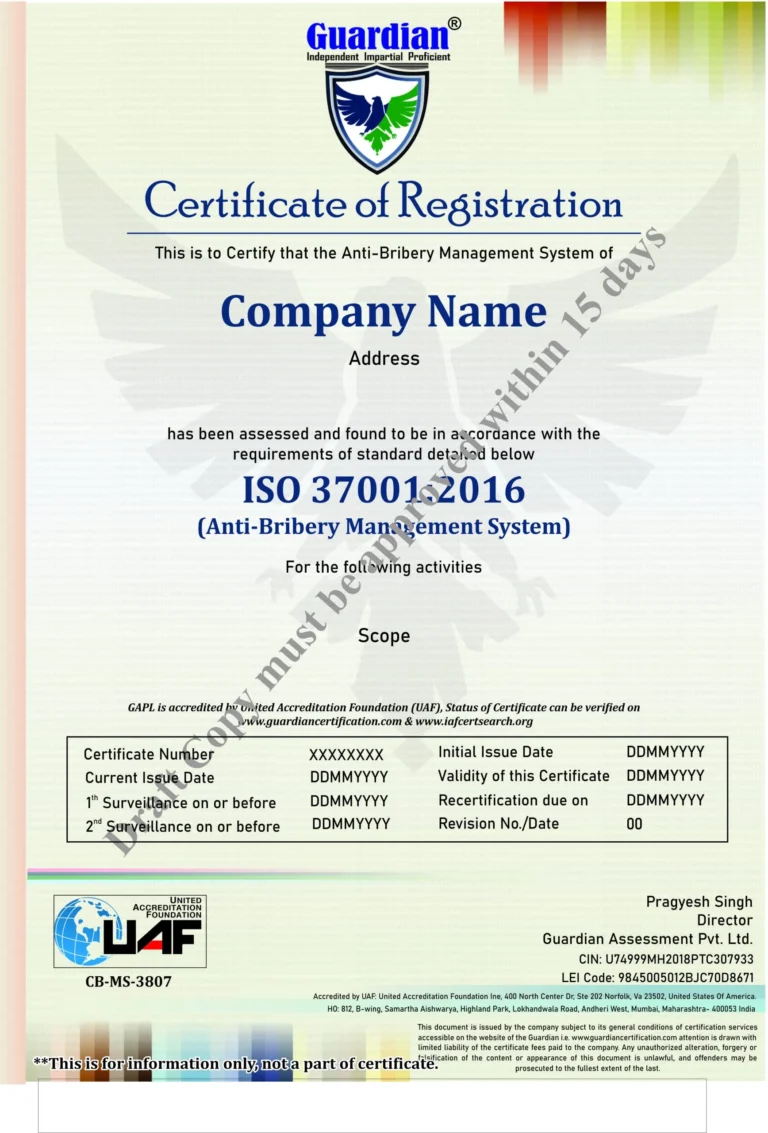
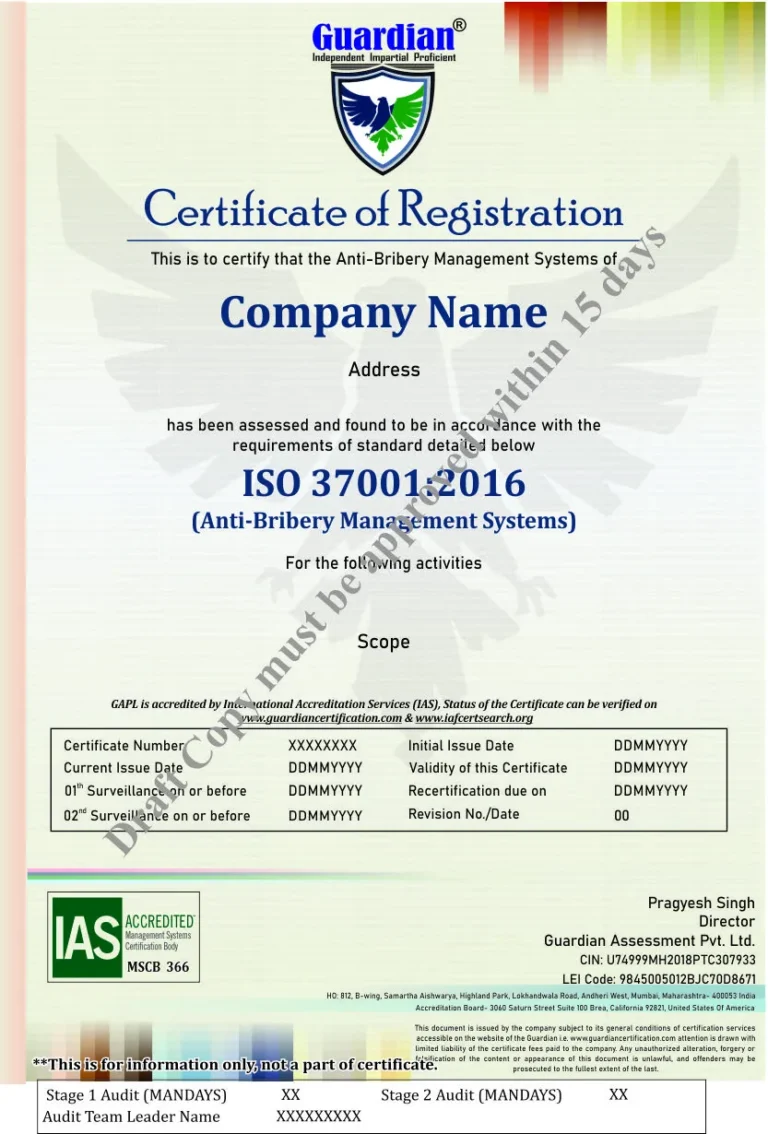
Sample Certificate


Request Quotation
Other Standards
Recognition


Sample Certificate
What Is ISO 37001 Certification?
ISO 37001:2025 is an international standard that specifies requirements for an Anti-Bribery Management System (ABMS). It helps organizations establish processes to prevent, detect and address bribery risks in their business activities. The standard provides a structured approach to identifying potential bribery situations, implementing appropriate controls and promoting ethical business practices.
ISO 37001 certification involves an independent assessment of an organization’s anti-bribery management system by a certification body. The assessment examines how the organization manages bribery risks, implements anti-bribery policies, conducts due diligence, provides employee training and monitors business relationships. Certification demonstrates that the organization’s ABMS has been assessed against the requirements of ISO 37001:2025.
The standard is applicable to organizations of different sizes and types, including private companies, government organizations and non-profit institutions. It covers bribery risks involving employees, business associates, suppliers, contractors, agents and other third parties. However, certification does not guarantee that bribery will never occur; it demonstrates that the organization has established and maintains a management system designed to address bribery risks.
What Is the Difference Between ISO and a Certification Body?
Three parties have distinct responsibilities:
- ISO (International Organization for Standardization): Develops and publishes international standards, including ISO 37001 for anti-bribery management systems. ISO does not audit individual organizations or issue ISO 37001 certificates.
- Your organization: Establishes, implements, maintains, and improves an anti-bribery management system that meets the applicable ISO 37001 requirements and helps prevent, detect, and address bribery risks.
- The certification body: Independently audits the management system and makes a certification decision based on objective evidence and applicable certification requirements.
ISO 37001 certification applies to the organization’s anti-bribery management system and the activities covered by its certification scope. It does not mean that ISO has directly certified the organization or guarantee that bribery will never occur.
Which Industries Can Get ISO 37001:2025 Certified?
ISO 37001:2025 is not limited to a particular industry or business type. Any organization that wants to prevent, detect and address bribery risks can implement an Anti-Bribery Management System (ABMS) and seek certification, provided its activities fall within the applicable certification scope. Some industries where ISO 37001 certification is particularly relevant include:
- Construction and Infrastructure: Construction companies, contractors, engineering firms and infrastructure developers can use ISO 37001 to manage bribery risks involving tenders, contracts, permits, subcontractors and project approvals.
- Manufacturing and Industrial Operations: Manufacturers and industrial businesses can establish anti-bribery controls for procurement, supplier relationships, sales transactions, distribution networks and business partnerships.
- Oil, Gas and Energy: Oil and gas companies, energy providers, mining businesses and utility operators can manage bribery risks associated with licensing, procurement, joint ventures, government interactions and large-scale projects.
- Healthcare and Pharmaceuticals: Hospitals, pharmaceutical companies, medical equipment suppliers and healthcare service providers can address bribery risks involving procurement, supplier selection, product distribution, contracts and professional relationships.
- Professional and Business Services: Consulting firms, legal practices, accounting companies, recruitment agencies and business service providers can use ISO 37001 to manage risks involving agents, client relationships, commissions, contracts and third-party payments.
- Banking and Financial Services: Banks, financial institutions, insurance companies and investment firms can use an ABMS to address bribery risks involving financial transactions, third-party relationships, intermediaries and business dealings.
ISO 37001:2025 can be applied to private, public and non-profit organizations of different sizes and sectors. The certification scope should accurately describe the organization’s activities, locations, business relationships and processes covered by the ABMS.
Benefits of ISO 37001 Certification
ISO 37001 certification can help organizations demonstrate that their anti-bribery management system has been independently assessed. The practical value depends on how effectively the organization implements and maintains its controls. Potential benefits include:
- A structured approach to bribery risks: Establishes a consistent method for identifying, evaluating, and addressing relevant risks.
- Clearer responsibilities: Defines management accountability and the responsibilities of personnel involved in the ABMS.
- More consistent business controls: Supports due diligence, approval processes, and financial and non-financial safeguards.
- Greater stakeholder confidence: Provides customers, business partners, and other interested parties with evidence of independent assessment.
- Improved tender preparedness: Can help demonstrate anti-bribery arrangements where a tender or customer specifically requests certification.
- Better awareness and reporting: Supports employee training, reporting mechanisms, and appropriate responses to concerns.
- Continual improvement: Encourages monitoring, internal audits, management reviews, and corrective action.
Certification is not a substitute for legal advice, a guarantee of ethical conduct, or proof that every bribery risk has been eliminated. Its value depends on the system’s implementation and continued effectiveness.
What do these benefits look like in practice?
Consider a business that regularly works with agents and subcontractors. Before formalizing its ABMS, different departments may conduct due diligence inconsistently, approve expenses using different criteria, and maintain incomplete records.
An effective ABMS can establish common due diligence requirements, clarify who approves higher-risk transactions, define rules for gifts and hospitality, and set out how concerns are reported and investigated. Management can then review whether these controls are being followed and whether they need improvement. For a company bidding on public or private contracts, the same system may help it organize evidence of its anti-bribery arrangements. Whether certification is accepted for a specific tender remains dependent on the tender’s actual conditions.
ISO 37001 Requirements: Clauses 4 to 10
The main auditable requirements of ISO 37001 are organized into Clauses 4 through 10. Each clause addresses a different part of the management system, from understanding the organization to improving its anti-bribery controls.
Clause | Subject | What the organization needs to address |
Clause 4 | Context of the organization | Understand internal and external issues, relevant interested parties, the ABMS scope, and the processes needed for the system. Climate change considerations should be addressed where relevant to the context. |
Clause 5 | Leadership | Establish leadership commitment, the anti-bribery policy, responsibilities, authority, and the anti-bribery function. |
Clause 6 | Planning | Address bribery risks and opportunities, establish relevant objectives, and plan actions to achieve them. |
Clause 7 | Support | Provide appropriate resources, competence, awareness, communication, and documented information. |
Clause 8 | Operation | Implement operational controls, relevant due diligence, financial and non-financial controls, reporting arrangements, and processes for addressing bribery concerns. |
Clause 9 | Performance evaluation | Monitor and evaluate the system, conduct internal audits, and carry out management reviews. |
Clause 10 | Improvement | Address nonconformities, take corrective action, and continually improve the ABMS. |
Meeting the ISO 37001 requirements involves more than preparing documents. The organization needs to implement suitable controls, assign responsibilities, maintain relevant evidence, and evaluate whether its system works as intended. The depth of implementation will depend on the organization’s risks, operations, business relationships, and defined scope.
Documents and Records Required for ISO 37001 Certification
ISO 37001 uses the term documented information to describe information an organization maintains and records it retains as evidence. The documentation needed depends on the organization’s activities, bribery risks, operational complexity, and the applicable edition of ISO 37001.
Common Documents to Maintain
Depending on the organization’s anti-bribery management system, these may include:
- Anti-bribery management system scope.
- Anti-bribery policy and objectives.
- Bribery risk assessment methodology and criteria.
- Procedures for identifying and assessing bribery risks.
- Due diligence procedures for relevant business associates, transactions, and projects.
- Procedures for gifts, hospitality, donations, sponsorships, and other benefits, where applicable.
- Reporting and investigation procedures for suspected bribery.
- Roles, responsibilities, and authority for managing anti-bribery activities.
- Procedures for monitoring, internal audits, and management reviews.
Common Records to Keep
Depending on the organization’s activities and risks, relevant records may include:
- Bribery risk assessment results.
- Employee competence, training, and awareness records.
- Due diligence results for relevant business associates and transactions.
- Records of gifts, hospitality, donations, and sponsorships, where applicable.
- Reports of suspected bribery and investigation outcomes, subject to confidentiality requirements.
- Records of internal audits and compliance monitoring.
- Management review outputs.
- Nonconformities and corrective actions.
- Records of actions taken to address identified bribery risks.
- Records of compliance function activities, where applicable.
This is a practical overview, not an exhaustive list of every documented-information requirement. The organization must maintain and retain the information required by the applicable ISO 37001 edition and needed for the effective operation of its anti-bribery management system.
ISO 37001 Certification Readiness Checklist
Before applying for certification, an organization should review whether its ABMS is sufficiently established for an independent assessment. Use this checklist to identify areas that may need attention:
- The proposed certification scope and relevant locations are defined.
- Relevant bribery risks have been assessed.
- An anti-bribery policy has been approved and communicated.
- Leadership responsibilities and the anti-bribery function are established.
- Relevant personnel understand their roles and reporting responsibilities.
- Due diligence and operational controls have been implemented where required.
- Financial and non-financial controls are operating.
- Reporting and response arrangements are established.
- Required documented information and records are available.
- Monitoring and internal audit arrangements are in place.
- Management review has considered the system’s performance.
- Identified nonconformities have been addressed through appropriate action.
This is a preparation aid, not a substitute for the full standard or a guarantee that the organization will pass its certification audit. The applicable requirements should be assessed against the organization’s actual scope and circumstances.
What is the Process of ISO 37001 Certification
The ISO 37001 certification process involves an application review, audit planning, assessment of the management system, review of audit findings, and a certification decision. The precise arrangements should follow the certification body’s approved procedures and applicable requirements. The initial certification process consists of six main stages.
Step 1: Application and scope review: The certification body reviews information about the organization, including its legal identity, activities, locations, workforce, proposed certification scope, and relevant operational factors.
Accurate information helps establish whether the application can be accepted and what assessment arrangements are appropriate. The organization should also clarify whether it requires accredited certification and verify that the requested scope is available under the applicable accreditation arrangements.
Step 2: Audit planning: The audit programme is planned using relevant information about the organization’s scope, complexity, risks, locations, and activities. The certification body determines the audit arrangements and duration in accordance with applicable requirements. The organization should receive information about the planned audit and the arrangements for the assessment.
Step 3: Stage 1 audit: Stage 1 evaluates the organization’s readiness for the main certification audit. It may include a review of the ABMS scope, organizational context, bribery risk assessment, documented information, implementation status, and readiness for Stage 2. The auditor also identifies issues that need attention and uses the available information to plan the next stage.
Step 4: Stage 2 audit: Stage 2 evaluates whether the ABMS has been implemented and is operating effectively within the proposed certification scope. Auditors gather evidence through interviews, observation, records, and sampling of relevant processes. The assessment considers whether controls are implemented and whether the system meets applicable requirements.
Step 5: Findings, corrective action, and technical review: If nonconformities are identified, the organization must address them in accordance with the certification body’s requirements. The nature of the findings determines the corrective action and any verification needed before a certification decision can be made. Audit findings and relevant information are then reviewed through the applicable technical review arrangements.
Step 6: Certification decision and certificate issuance: A certificate may be issued only after a positive certification decision based on the audit evidence and applicable certification requirements. Completing an audit does not, by itself, guarantee certification. Following certification, the organization must continue to operate and maintain its ABMS and meet the requirements for surveillance and continued certification.
For more information, review Guardian’s ISO certification process and contact the team to discuss the applicable arrangements.
ISO 37001 Audit Checklist: What Do Auditors Check?
An ISO 37001 audit checklist helps an organization prepare evidence and review whether its ABMS is operating as intended. There is no single checklist that covers every organization’s risks in exactly the same way; audit sampling and focus depend on the certification scope and relevant activities. Auditors may examine the following areas:
- Context and scope: Whether the ABMS scope and organizational context are defined and maintained.
- Bribery risk assessment: Whether relevant risks are identified, evaluated, documented, and reviewed when circumstances change.
- Leadership and policy: Whether leadership demonstrates commitment and the anti-bribery policy is communicated and applied.
- Responsibilities and anti-bribery function: Whether authority, resources, responsibilities, and reporting arrangements are appropriate.
- Due diligence: Whether relevant personnel, business associates, transactions, and relationships are assessed in line with the organization’s risks.
- Financial controls: Whether approvals, payment controls, accounting records, and other safeguards address relevant bribery risks.
- Non-financial controls: Whether procurement, sales, contracting, recruitment, and other relevant activities have suitable controls.
- Gifts, hospitality, donations, and conflicts of interest: Whether relevant benefits and conflicts are identified, evaluated, approved, and controlled.
- Competence and awareness: Whether relevant personnel receive appropriate training and understand their responsibilities.
- Reporting and response: Whether people can report concerns and whether the organization handles reports and investigations appropriately.
- Monitoring and internal audits: Whether the organization evaluates the operation and effectiveness of its controls.
- Management review: Whether leadership reviews system performance and decides on necessary actions.
- Corrective action and improvement: Whether nonconformities are addressed and actions are evaluated for effectiveness.
Auditors assess evidence rather than simply counting documents. Interviews, records, observations, and samples of transactions or processes may all be relevant to the assessment.
What Happens After ISO 37001 Certification?
Certification is part of an ongoing management-system cycle. The organization remains responsible for operating its ABMS and responding to changes in its risks, activities, and business relationships. After certification, an organization should:
- Continue applying its anti-bribery policy and operational controls.
- Review bribery risks when relevant business conditions change.
- Maintain required records and training.
- Monitor whether due diligence and other controls remain effective.
- Conduct internal audits and management reviews as required.
- Address nonconformities and implement corrective actions.
- Notify the certification body of significant changes when required by the applicable arrangements.
- Prepare for scheduled surveillance audits.
- Use certificate references and certification marks only in accordance with applicable rules.
Certification does not transfer responsibility for preventing bribery from the organization to the certification body. Management remains accountable for the operation of its ABMS.
How Long Does ISO 37001 Certification Take?
There is no single completion time that applies to every organization. The overall timeline depends on the organization’s readiness, size, scope, operational complexity, number of locations, audit planning, availability of relevant personnel, and any corrective actions required. Organizations that already have functioning anti-bribery controls and reliable records may be better prepared for assessment than organizations that are starting from the beginning. However, readiness alone does not determine the audit duration or guarantee a particular certification date.
A realistic timeline should be established after the application information has been reviewed and the applicable audit arrangements have been determined. Avoid relying on a fixed-time promise before the certification scope and readiness are understood.
How Long Is an ISO 37001 Certificate Valid?
ISO management-system certification normally operates within a three-year certification cycle, subject to the applicable certification scheme and requirements. Surveillance audits are conducted during the cycle, commonly annually, to assess continued conformity. Recertification arrangements are completed toward the end of the cycle if the organization intends to continue its certification.
The certificate’s stated dates, scope, status, and applicable certification arrangements should always be checked rather than assuming that a certificate remains valid indefinitely.
What is the Cost of ISO 37001 Certification
There is no universal fixed price for ISO 37001 certification because audit requirements vary from one organization to another. The certification cost depends on factors such as the organization’s size, number of locations, business activities, bribery risk exposure, audit duration and resources required to assess its Anti-Bribery Management System (ABMS).
Factors That Affect Certification Cost
Factor | How It Affects Cost |
|---|---|
Number of employees | Influences audit duration and the level of assessment required under applicable certification rules. |
Number of locations | Multiple sites may require additional audit activities and planning. |
Certification scope | The activities, departments and processes covered by the ABMS affect assessment requirements. |
Business activities and complexity | Complex operations and higher bribery risk exposure may require additional audit effort or technical competence. |
Business relationships | The nature and extent of relationships with suppliers, contractors, agents and other business associates may influence audit planning. |
Operating shifts | Different shifts may need to be considered when planning audit activities. |
Travel requirements | Auditor travel and accommodation may affect the overall quotation. |
What Should an ISO 37001 Certification Quote Include?
When comparing quotations, organizations should understand the costs associated with initial certification and the ongoing certification cycle.
- Initial certification: Includes the applicable application review, audit planning, Stage 1 and Stage 2 audits, technical review and certification decision activities.
- ISO Surveillance audits: Periodic surveillance audits involve further assessment activities and applicable fees during the certification cycle.
- ISO Recertification audits: A recertification audit is required before the end of the certification cycle to continue certification. Its cost should be considered separately when planning future certification expenses.
The internal cost of establishing and maintaining an ABMS is separate from the certification body’s audit fees. Organizations may also need to consider expenses related to risk assessments, employee training, documentation, internal audits and improvements to existing controls. Before selecting a certification body, review the complete quotation, audit arrangements, applicable accreditation scope and ongoing fees rather than comparing only the initial certification price.
Requirements of ISO 37001 Certification for Tenders and Suppliers
Some tenders, customer contracts, and supplier qualification programmes may request ISO 37001 certification or other evidence of anti-bribery controls. Certification may help an organization demonstrate that its ABMS has undergone independent assessment. Before relying on certification for a procurement requirement, check:
- Whether ISO 37001 certification is explicitly required or whether equivalent evidence is accepted.
- Whether the tender specifies a particular edition of the standard.
- Whether the certificate must be accredited.
- Whether the certification body’s accreditation must cover the relevant standard and scope.
- Whether the certificate’s scope, locations, and validity meet the tender conditions.
- Whether additional declarations, policies, or due diligence records are required.
Certification does not automatically qualify an organization for every tender or guarantee acceptance by a buyer. The procuring organization’s stated requirements remain decisive.
Accreditation and ISO 37001 Certificate Verification
Accreditation and certificate verification serve different purposes. Both can matter when a customer, tender authority, or business partner needs to confirm the standing of a certification.
How to check an ISO 37001 certification body
Before selecting an ISO 37001 certification body, check its current status and the scope of its accreditation, where accredited certification is required. Review the relevant official accreditation schedule to confirm that it covers the certification activity and standard in question. Do not assume that a certification body’s accreditation for other standards automatically covers ISO 37001.
You can consult Guardian’s published UAF accreditation information and IAS accreditation information. For a purchasing, tender, or contractual decision, verify the applicable scope directly with the relevant accreditation body.
How to verify an ISO 37001 certificate
An ISO 37001 certificate is only as reliable as the certification body that issued it. A certification body audits organizations against the Anti-Bribery Management System (ABMS) requirements. An accreditation body checks whether the certification body is competent and impartial. When the accreditation body is a signatory to the International Accreditation Forum (IAF) Multilateral Recognition Arrangement (MLA) for the relevant scope, it provides confidence in the recognition of accredited certifications. To check a certificate:
- Check it with the certification body. Guardian certificates can be checked through our client search (https://search.guardiancertification.com/).
- Check the certification body’s accreditation in the accreditation body’s directory. Guardian is listed by UAF and IAS for applicable certification activities.
- Check IAF CertSearch (www.iafcertsearch.org), the global database of accredited management system certifications.
Integrating ISO 37001 With Other Management System Standards (IMS)
Organizations can integrate anti-bribery management with quality, environmental, occupational health and safety, information security and educational management systems. An Integrated Management System (IMS) helps coordinate common processes, reduce duplicate documentation and simplify internal audits and management reviews. Under IAF MD 11, audit time may also be reduced when the applicable integration requirements are met. Guardian Assessment provides management system certification services for standards that can be integrated with ISO 37001, including:
Note: Guardian Assessment also provides compliance assessments for specialized frameworks, including ISO 22000 (Food Safety), ISO 13485 (Medical Devices), ISO 50001 (Energy), ISO/IEC 27701 (Privacy), ISO/IEC 20000-1 (IT Service Management), ISO 41001 (Facility Management), ISO 55001 (Asset Management), and ISO/IEC 42001 (Artificial Intelligence).
Why Consider Guardian Assessment as Your ISO 37001 Certification Body
- Accredited by UAF and IAS. UAF (United Accreditation Foundation) and IAS (International Accreditation Service) accredit Guardian for applicable management system certification activities. Confirm that ISO 37001 is included in the current accreditation scopes.
- Auditors who understand your industry. We assign auditors based on your organization’s activities, size and bribery-related risks.
- Impartial certification. We audit and certify management systems without providing consultancy on the systems we certify. Certification decisions are reviewed independently.
- Combined audits. Organizations can combine ISO 37001 audits with other applicable management system standards, helping reduce duplicated audit activities.
- Based in India. Our head office is in Lucknow, Uttar Pradesh, and we provide certification services to organizations across India.
- Certificate transfer support. If your organization holds an eligible accredited ISO 37001 certificate from another certification body, you can explore transferring it to Guardian, subject to the applicable transfer requirements and review.
Apply for ISO 37001 Certification
Get your organization certified to ISO 37001:2025 with Guardian Assessment. The certification process helps organizations establish, implement and improve an Anti-Bribery Management System (ABMS) to prevent, detect and address bribery risks.
Apply for ISO 37001:2025 certification and demonstrate your commitment to ethical business practices and transparency.
Frequently Asked Questions
What is ISO 37001:2025 (Anti-Bribery management systems)?
ISO 37001:2025 Certification establishes a framework for anti-bribery management systems (ABMS) to help organizations prevent, detect, and address bribery and corruption. This certification is crucial for demonstrating a commitment to ethical practices, enhancing organizational integrity, and mitigating the risks associated with bribery, which can lead to legal penalties and reputational damage.
Which organizations should consider ISO 37001:2025 Certification?
ISO 37001:2025 is relevant for organizations of all sizes and sectors, including private companies, public sector institutions, and non-governmental organizations. It is particularly beneficial for organizations operating in high-risk environments or those looking to reinforce their commitment to ethical business practices and compliance with anti-bribery laws.
How does ISO 37001:2025 benefit organizations?
ISO 37001:2025 benefits organizations by providing a structured approach to preventing and addressing bribery and corruption. It enhances organizational credibility, supports legal and regulatory compliance, reduces the risk of financial and reputational damage, and fosters a culture of transparency and accountability.
What documents and records are mandatory for ISO 37001:2025 Certification?
Mandatory documents include an anti-bribery policy, risk assessment procedures, bribery risk mitigation plans, records of training and communication, and evidence of due diligence activities. Mandatory records also include audit reports, management review minutes, and corrective action records.
How often are surveillance audits conducted for ISO 37001:2025 Certification?
Surveillance audits are generally conducted annually to ensure ongoing compliance with ISO 37001:2025 requirements. These audits help organizations maintain their certification status by verifying the continued effectiveness of their anti-bribery management system.
Can ISO 37001:2025 be integrated with other management standards?
Yes, ISO 37001:2025 can be integrated with other management standards such as ISO 9001 (Quality Management), ISO 14001 (Environmental Management), and ISO 45001 (Occupational Health and Safety). Integration allows for a unified approach to management systems, enhancing overall efficiency and effectiveness.
How does ISO 37001:2025 address bribery risks?
ISO 37001:2025 addresses bribery risks through a structured approach that includes conducting bribery risk assessments, implementing anti-bribery controls, providing training and communication, and establishing procedures for reporting and investigating bribery incidents. The standard emphasizes a proactive and systematic approach to identifying and managing bribery risks.
What is the difference between ISO 37001:2025 and other anti-bribery frameworks?
ISO 37001:2025 is a globally recognized standard for anti-bribery management, providing a comprehensive framework for preventing, detecting, and addressing bribery. Unlike other frameworks, ISO 37001:2025 is designed to be integrated with existing management systems and is aligned with international best practices and regulatory requirements.
Can small businesses benefit from ISO 37001:2025 Certification?
Yes, small businesses can benefit from ISO 37001:2025 Certification by establishing robust anti-bribery practices that enhance their credibility, improve risk management, and ensure compliance with legal and regulatory requirements. The standard is flexible and scalable to accommodate businesses of all sizes.
How can ISO 37001:2025 Certification help with regulatory compliance?
ISO 37001:2025 Certification helps organizations comply with anti-bribery and anti-corruption regulations by providing a structured framework for implementing effective anti-bribery measures. Certification demonstrates a commitment to compliance and helps mitigate the risk of legal and regulatory violations.
What are the benefits of implementing an anti-bribery management system?
Implementing an anti-bribery management system provides benefits such as enhanced organizational integrity, improved risk management, increased stakeholder confidence, and reduced likelihood of bribery and corruption incidents. It also supports compliance with legal and regulatory requirements and fosters a culture of ethical behavior.
How does ISO 37001:2025 Certification impact organizational culture?
ISO 37001:2025 Certification positively impacts organizational culture by promoting a strong commitment to anti-bribery and ethical behavior. It encourages transparency, accountability, and integrity, fostering a culture where bribery and corruption are actively prevented and addressed.
What is the significance of risk assessment in ISO 37001:2025?
Risk assessment is fundamental to ISO 37001:2025 as it helps organizations identify and evaluate bribery risks, enabling the implementation of effective controls and mitigation strategies. Regular risk assessments ensure that the anti-bribery management system remains relevant and effective in addressing evolving risks.
What is the process for renewing ISO 37001:2025 Certification?
To renew ISO 37001:2025 Certification, contact GAPL to schedule a recertification audit. Prepare by reviewing and updating your anti-bribery management system, conducting internal audits, and addressing any identified non-conformities. The recertification process ensures continued compliance and effectiveness of the anti-bribery measures.
How does ISO 37001:2025 impact business operations?
ISO 37001:2025 impacts business operations by introducing structured anti-bribery practices that enhance risk management, improve operational integrity, and foster a culture of ethical behavior. It helps organizations streamline processes, reduce the risk of bribery-related issues, and build trust with stakeholders.