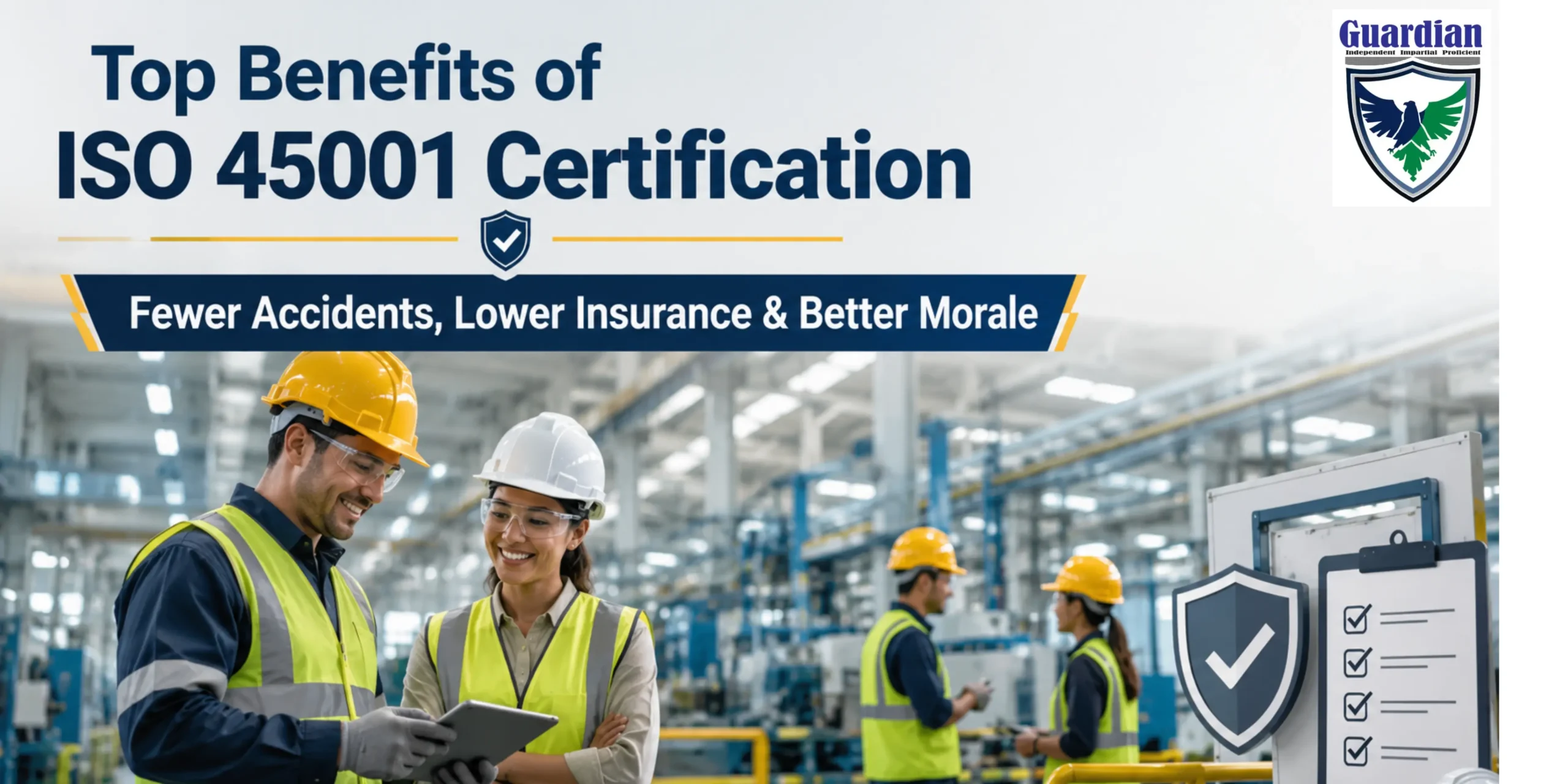
Top Benefits of ISO 45001 Certification – Fewer Accidents, Lower Insurance & Better Morale
A complete, easy-language guide to how ISO 45001 improves workplace health and safety, reduces incidents, and strengthens trust and performance.
Fewer incidents: Proactive hazard control helps prevent injuries and near-misses.
Lower cost impact: Better safety performance can reduce claims, downtime, and avoidable losses.
Better morale: People feel valued when safety is built into daily work and leadership decisions.
In today’s competitive business environment, organizations are increasingly focusing on creating safe and healthy workplaces. One of the most effective ways to achieve this is through ISO 45001 certification. This international standard for Occupational Health and Safety Management System (OH&S MS) helps businesses systematically manage risks, protect workers, and build a strong safety culture.
Whether you run a manufacturing unit, construction project, or service-based operation, implementing the ISO 45001 standard can lead to fewer workplace incidents, stronger employee trust, and improved overall performance. This comprehensive guide explores the top benefits in easy language, with practical insights to help you understand its value.
Table of Contents
- What is ISO 45001 and Why Does It Matter?
- Understanding the ISO 45001 Standard Structure
- How Does ISO 45001 Protect Workers?
- Top Benefits of ISO 45001 Certification
- ISO 45001 Certification Benefits for Different Business Sizes
- Practical Steps to Realize These Benefits
- How ISO 45001 Supports Continuous Improvement
- Common Challenges and How to Overcome Them
- Why Choose ISO 45001 Certification Now?
- Frequently Asked Questions (FAQs)
What is ISO 45001 and Why Does It Matter?
ISO 45001 is the global standard for occupational health and safety management systems. It provides a framework that organizations of all sizes can use to identify hazards, assess risks, and take preventive actions.
Unlike older approaches that reacted to problems after they occurred, ISO 45001 certification promotes a proactive mindset. It integrates safety into everyday business operations rather than treating it as a separate activity. The standard emphasizes leadership involvement, worker participation, and continuous improvement.
Key elements include
- Hazard identification and risk assessment
- Legal and regulatory compliance support through structured processes
- Worker consultation and participation
- Performance monitoring and evaluation
By adopting this Occupational health and safety management system, organizations create safer environments that benefit everyone involved.
Understanding the ISO 45001 Standard Structure
The ISO 45001 standard follows a high-level structure common to other ISO management standards, making it easier to integrate with systems like quality or environmental management. It has 10 main clauses, but the core actionable parts are Clauses 4 to 10.
Brief overview of important clauses
- Clause 4: Context of the Organization – Understand internal and external factors that affect health and safety.
- Clause 5: Leadership and Worker Participation – Top management must show commitment, and workers should actively participate.
- Clause 6: Planning – Address risks, opportunities, and set clear objectives.
- Clause 7: Support – Provide necessary resources, training, and communication.
- Clause 8: Operation – Implement controls for day-to-day activities and emergency preparedness.
- Clause 9: Performance Evaluation – Monitor, measure, and review performance regularly.
- Clause 10: Improvement – Take corrective actions and strive for continual enhancement.
This structured approach ensures safety becomes part of the organizational DNA.
How Does ISO 45001 Protect Workers?
ISO 45001 goes beyond basic requirements to genuinely protect people. It requires organizations to:
- Identify potential hazards before they cause harm
- Involve workers in safety decisions and improvements
- Provide adequate training and protective equipment
- Create clear reporting systems for incidents or near-misses
- Address both physical and mental health concerns
By focusing on prevention rather than reaction, the standard can significantly reduce the likelihood of work-related injuries and illnesses. Workers often feel more valued when they see genuine efforts to keep them safe, which supports higher engagement.
Top Benefits of ISO 45001 Certification
1. Fewer Accidents and Incidents
One of the most visible advantages of ISO 45001 certification is the reduction in workplace accidents. The standard helps organizations systematically identify hazards and implement controls. This proactive risk management approach prevents many incidents that might otherwise occur.
Many organizations see fewer lost workdays, less disruption to operations, and a safer overall environment after implementation.
2. Lower Insurance Costs and Financial Savings
Organizations with strong safety records typically attract better terms from insurers. Demonstrating effective risk management through ISO 45001 shows due diligence, which can lead to improved insurance terms over time.
Fewer claims also mean lower overall costs related to medical expenses, compensation, and downtime. These savings contribute directly to better financial health.
3. Better Employee Morale and Retention
When employees work in an environment that prioritizes their well-being, they feel more motivated and loyal. ISO 45001 encourages worker participation, making people feel heard and valued.
Higher morale often translates into:
- Increased productivity
- Lower absenteeism
- Reduced employee turnover
- Better team collaboration
A positive safety culture boosts job satisfaction and helps attract skilled talent.
4. Enhanced Reputation and Stakeholder Confidence
Certification signals commitment to excellence in safety. Clients, partners, suppliers, and investors view certified organizations more favorably. This can open new opportunities and strengthen existing relationships.
In higher-risk sectors, having ISO 45001 certification can differentiate you as a responsible and reliable operator.
5. Improved Support for Meeting Legal Requirements
A structured management system makes it easier to manage obligations related to workplace health and safety. The standard helps organizations stay updated with requirements and demonstrate strong processes during inspections or audits.
This reduces the risk of penalties, legal issues, or reputational damage.
6. Increased Operational Efficiency
A well-implemented Occupational health and safety management system streamlines processes, reduces waste, and minimizes disruptions. When safety is integrated into operations, teams work more smoothly and confidently.
7. Stronger Leadership and Organizational Culture
The standard requires active leadership involvement. This creates accountability at all levels and fosters a culture where safety is everyone’s responsibility. Over time, this leads to sustainable improvements across the organization.
ISO 45001 Certification Benefits for Different Business Sizes
Small and medium organizations can also gain significantly. The standard is flexible and scalable. It allows businesses to implement practical measures without unnecessary complexity.
Many find that starting with basic risk assessments and worker training already brings noticeable improvements. Larger organizations benefit from standardized processes across multiple sites, making safety management more consistent.
Practical Steps to Realize These Benefits
To maximize the advantages of ISO 45001, organizations typically focus on:
- Conducting thorough hazard identification and risk assessment
- Involving employees at every stage
- Providing regular training and awareness programs
- Monitoring performance with meaningful indicators
- Reviewing and updating the system regularly
Consistency and genuine commitment are key to long-term success.
How ISO 45001 Supports Continuous Improvement
The Plan-Do-Check-Act (PDCA) cycle built into the standard ensures organizations keep getting better. Regular reviews help identify new risks and opportunities for enhancement. This ongoing process keeps the safety system relevant and effective over time.
Common Challenges and How to Overcome Them
Some organizations worry about the effort required. However, breaking implementation into manageable phases and seeking professional guidance makes the process smoother. The long-term benefits often outweigh the initial investment in time and resources.
Why Choose ISO 45001 Certification Now?
In an era where workplace safety is under greater scrutiny, ISO 45001 certification offers a proven pathway to excellence. It helps reduce incidents, control costs, boost morale, and build a resilient organization ready for future challenges.
Businesses that prioritize safety through this standard often see improvements not just in health metrics but also in overall performance and sustainability.
Frequently Asked Questions (FAQs)
Ans) ISO 45001 is an international standard that specifies requirements for an occupational health and safety management system. It helps organizations improve worker safety, reduce risks, and create better working conditions.
Ans) It takes a more proactive, risk-based approach with stronger emphasis on leadership, worker participation, and integration with other business processes compared to earlier frameworks.
Ans) No, it is not mandatory, but many organizations choose it to demonstrate commitment to safety, improve compliance, and gain competitive advantages.
Ans) By involving workers in safety decisions, reducing incidents, and showing that their well-being matters, it creates a more positive and trusting workplace environment.
Ans) Key benefits include fewer accidents, potential insurance savings, better compliance, higher productivity, improved reputation, and a stronger safety culture.