How Long Does ISO 9001 Certification Take?
There is no single answer such as 7 days, 30 days, or 3 months that applies to every organisation seeking ISO 9001 certification.
Audit days are not the same as calendar days. For example, an audit requiring 3 audit days does not necessarily mean the entire certification process will be completed within 3 calendar days.
The key distinction is: QMS readiness timeline ≠ certification and audit timeline. An organisation may spend weeks or months developing and implementing its QMS, while the certification audit itself is planned separately according to factors such as effective personnel, scope, sites, shifts, and operational complexity.
Two connected timelines: how long the organisation needs to become ready, and how long the certification and audit process takes once it is ready.
Audit days are not calendar days: Stage 2 finishing does not mean the certificate is issued the moment the auditor leaves.
Evidence over speed: Fast certification means removing unnecessary waiting — not removing necessary audit activity.
A small service company operating from one office will not normally require the same audit planning as a manufacturer running several production lines across multiple shifts. Similarly, a construction company with active project sites presents a different audit situation from a textile unit, chemical plant or solar EPC business.
The time required for ISO 9001 certification depends mainly on two connected timelines:
- how long your organisation needs to become ready for certification; and
- how long the certification and audit process takes once you are ready.
Organisation size matters, but it is only one factor. Certification scope, effective personnel, number of sites, activities performed at each location, shifts, process complexity, outsourced processes, audit findings, and QMS readiness can all affect the overall timeline.
ISO 9001:2015-certified organisations have until 30 September 2029 to complete the transition, according to the ISO/TC 176 transition guidance.
Table of Contents
- How Long Does the Complete ISO 9001 Certification Process Take?
- How Long Do ISO 9001 Stage 1 and Stage 2 Audits Take?
- How Audit Days Are Determined
- How Organisation Size and Effective Personnel Affect Audit Duration
- How Multiple Sites and Branches Affect ISO 9001 Audit Duration
- How Industry Type Affects ISO 9001 Certification Time
- How Scope and Operational Complexity Affect ISO 9001 Audit Duration
- How QMS Readiness Affects the Overall Certification Timeline
- What Can Delay ISO 9001 Certification?
- What Happens After the Stage 2 Audit?
- When Is the ISO 9001 Certificate Issued?
- ISO 9001 Certification Timeline Examples for Different Organisations
- What Does a Certification Body Need to Know Before Planning the Audit?
- Can ISO 9001 Certification Be Completed Faster?
- Initial Certification vs Surveillance vs Recertification Audit Duration
- How Long Does ISO 9001 Certification Take? Final Summary
- Planning ISO 9001 Certification?
- ISO 9001 Certification with Guardian
- Frequently Asked Questions About ISO 9001 Certification Time
- Sources and Standards
How Long Does the Complete ISO 9001 Certification Process Take?
For planning purposes, it is useful to think of ISO 9001 certification as having two connected timelines rather than one fixed countdown.
Timeline 1: QMS Readiness
This is primarily controlled by the organisation.
It includes the time required to:
- establish the Quality Management System;
- define processes and responsibilities;
- implement those processes;
- generate evidence and records;
- complete the internal audit; and
- complete management review.
Timeline 2: Certification and Audit
This covers the formal certification activities, including:
- application and information review;
- audit planning;
- Stage 1 audit;
- Stage 2 audit;
- corrective action and review, where required;
- certification review and decision; and
- certificate issuance.
These timelines are connected, but they are not identical.
Certification Timeline vs Audit Duration
An organisation may spend several weeks or months preparing its QMS even though the certification audit itself is measured in audit days.
Likewise, completing Stage 2 does not automatically mean the certificate is issued the moment the auditor leaves the premises.
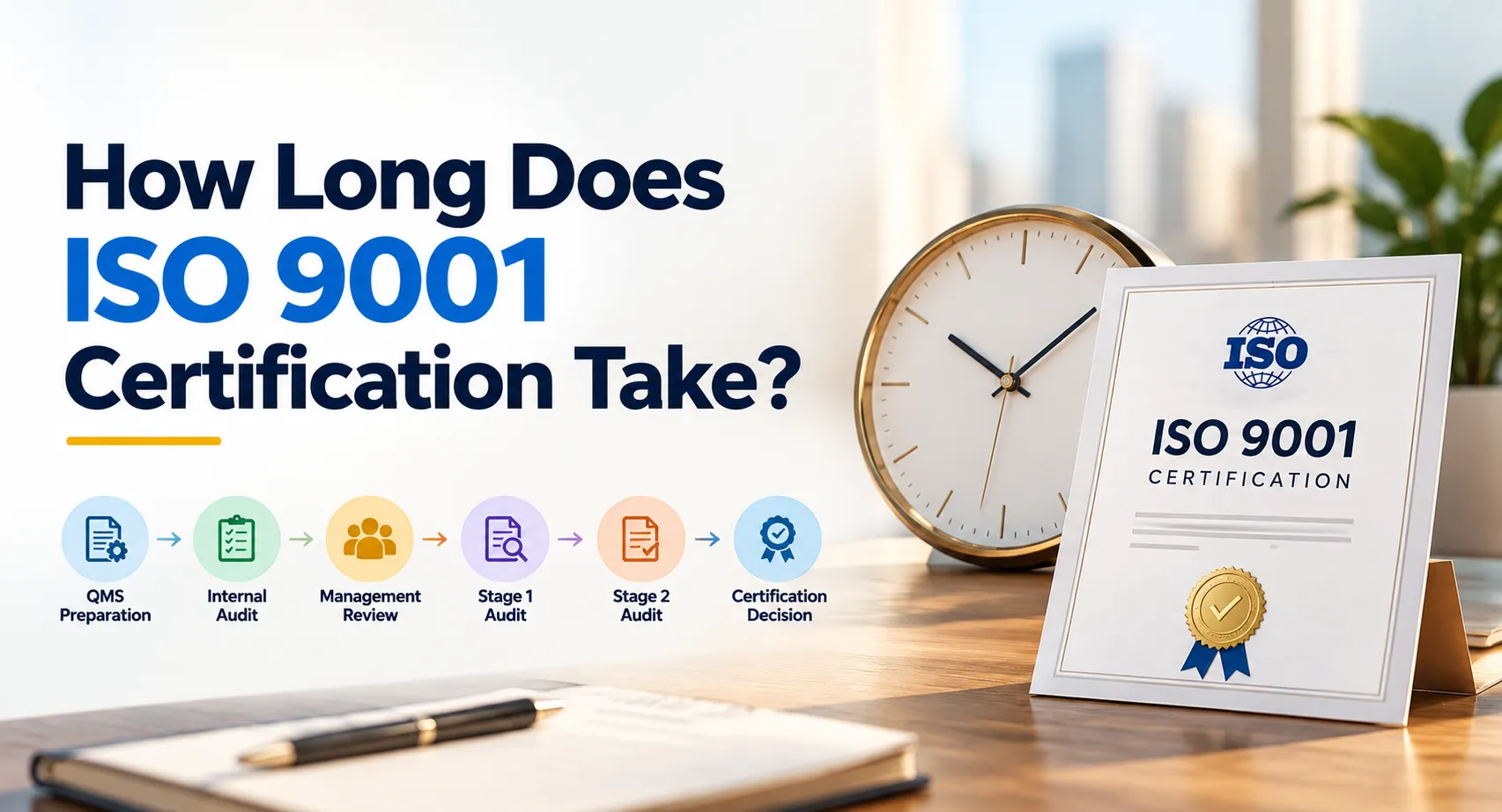
A simplified journey looks like this:
A business that already has controlled processes, inspection records, documented responsibilities, supplier controls, customer-complaint handling and regular management reviews may be much closer to certification readiness than an organisation starting without a formal management system.
The audit duration itself is determined separately according to the characteristics of the organisation being certified.
Main Steps From QMS Preparation to Certification
In practice, the process normally follows this sequence:
- The organisation defines the scope of its Quality Management System.
- Relevant processes and responsibilities are established.
- The QMS is implemented in actual operations.
- Sufficient records and evidence of implementation are generated.
- An internal audit is completed.
- Management review is completed.
- Relevant information is submitted to the certification body.
- The certification body determines the audit programme and applicable audit time.
- Stage 1 is conducted.
- Stage 2 is conducted when the organisation is ready.
- Applicable nonconformities are addressed.
- Audit documentation and required evidence are reviewed.
- The certification body’s defined review and decision process is completed.
- The certificate is issued once applicable certification requirements have been satisfactorily fulfilled.
A company starting from zero should therefore not calculate its expected certification date only from the day it contacts the certification body.
Its own QMS readiness may represent a substantial part of the total timeline.
How Long Do ISO 9001 Stage 1 and Stage 2 Audits Take?
Initial ISO 9001 certification normally includes Stage 1 and Stage 2.
The two stages serve different purposes, so their duration and depth are not identical.
Stage 1 Audit: What Happens and What Affects Its Duration?
Stage 1 is primarily used to understand whether the organisation is sufficiently prepared to proceed to the main certification audit.
The auditor may evaluate matters such as:
- the organisation and its context;
- proposed certification scope;
- locations and site-specific activities;
- key processes;
- documented QMS information;
- statutory and regulatory considerations relevant to the QMS;
- internal audit status;
- management review status;
- performance information; and
- readiness for Stage 2.
Stage 1 should therefore not be treated as a quick document-checking formality.
For example, suppose a manufacturing company has prepared procedures but has not completed its internal audit or management review. Stage 1 may identify this as a readiness issue that must be addressed before Stage 2 proceeds.
The calendar timeline can therefore become longer even though the formal Stage 1 audit itself has already been completed.
Stage 2 Audit: What Happens and What Affects Its Duration?
Stage 2 is the main certification audit.
The audit team evaluates whether the QMS is not only documented but actually implemented and effective across the certification scope.
Depending on the organisation, the audit may examine:
- leadership and responsibilities;
- quality objectives;
- customer requirements;
- design and development, where applicable;
- purchasing and supplier controls;
- production or service delivery;
- inspection and testing;
- identification and traceability;
- control of nonconforming outputs;
- competence and training;
- monitoring and measurement;
- internal audits;
- management review;
- corrective actions; and
- improvement.
For a factory, this means auditors will not spend the entire audit in a conference room.
They need to observe relevant operations, speak with responsible personnel, review records and trace evidence through the QMS.
Stage 2 therefore normally represents the more substantial part of the initial certification audit.
How Much Time Is Needed Between Stage 1 and Stage 2?
There is no universal interval that works for every organisation.
The time between the two stages should allow the organisation to address Stage 1 concerns that could affect readiness for Stage 2.
If Stage 1 confirms good readiness and no significant issues require additional preparation, the stages may be scheduled relatively close together.
If important gaps exist, more time may be necessary.
The interval should therefore be driven by readiness, not simply by how quickly the organisation wants a certificate.
Can Stage 1 and Stage 2 Be Scheduled Close Together?
Yes, they may sometimes be scheduled close together when the organisation is genuinely ready, and the certification programme allows it.
However, treating Stage 1 as a formality and fixing Stage 2 immediately afterward without allowing for possible Stage 1 findings can create unnecessary risk.
A sound certification programme should retain enough flexibility to respond to what Stage 1 actually establishes.
How Audit Days Are Determined
| Effective Personnel Baseline | Initial Audit Time* |
|---|---|
| 1–5 | 1.5 audit days |
| 6–10 | 2 audit days |
| 11–15 | 2.5 audit days |
| 16–25 | 3 audit days |
| 26–45 | 4 audit days |
| 46–65 | 5 audit days |
| 66–85 | 6 audit days |
| 86–125 | 7 audit days |
| 126–175 | 8 audit days |
| 176–275 | 9 audit days |
*These are reference audit times from IAF MD 5:2023 for the initial certification audit and should not be treated as a quotation or guaranteed audit duration. Applicable complexity, risk, scope, multi-site arrangements and other factors can affect audit time. The audit days also do not represent the complete calendar time required to obtain certification.
How Organisation Size and Effective Personnel Affect Audit Duration
Organisation size is one of the most visible factors affecting audit duration, but “size” should not be understood only as whether a company calls itself small, medium or large.
For audit-time determination, the effective number of personnel is an important starting point, but it is not the only factor.
This is also why an Indian company’s MSME or Udyam classification should not be treated as the basis for ISO 9001 audit time.
Two companies can fall into a similar business-size category and still require very different audit programmes.
Small Organisations
A small organisation may have:
- one location;
- a limited number of personnel;
- one work shift;
- a relatively narrow scope; and
- a small number of processes.
A 20-person professional service organisation working from one office may therefore present a relatively straightforward audit structure.
However, small does not automatically mean simple.
A 25-person precision engineering company involved in design, machining, outsourced heat treatment, inspection and testing can present greater process complexity than a much larger office-based organisation.
Medium-Sized Organisations
A medium-sized organisation may include:
- several departments;
- production and support functions;
- a larger workforce;
- more than one shift;
- several products or services;
- outsourced activities; or
- more than one operating location.
For example, a 200-person manufacturing company may divide employees across production, quality, maintenance, purchasing, stores, dispatch, management and administration.
That operating structure matters to audit planning.
Large Organisations
Larger organisations can involve:
- hundreds or thousands of personnel;
- several departments;
- multiple manufacturing units;
- regional offices;
- warehouses;
- multiple shifts;
- several product families;
- complex supply chains; and
- both centralised and site-specific functions.
The audit programme has to provide adequate coverage of the QMS across this structure.
The number of people alone does not tell the whole story.
Why Employee Count Alone Does Not Determine Audit Time
Consider two organisations employing 100 people.
Organisation A: an office-based service company operating from one location. Its core processes are sales, service delivery, customer management and administration.
Organisation B: a manufacturer operating two shifts with incoming inspection, machining, assembly, testing, packing, warehousing and outsourced special processes.
Both employ 100 people, but their audit requirements are not automatically identical because their processes, risks and operating structures are different.
How Organisation Characteristics Can Change ISO 9001 Audit Requirements
| Organisation Profile | Typical Operating Characteristics | Factors That Can Increase Audit Coverage |
|---|---|---|
| Small organisation | One site, fewer processes, limited personnel, often one shift | Complex products, design responsibility, specialised activities or outsourced processes |
| Medium-sized organisation | Several functions, more personnel and multiple operational activities | Additional shifts, production lines, broader scope, outsourcing and additional locations |
| Large organisation | Multiple departments, sites, shifts and functions | High effective personnel, varied site activities, broad scope, complex processes and geographically dispersed operations |
These examples help explain the relationship between organisational structure and audit planning. They are not official ISO definitions of small, medium and large organisations.
How Multiple Sites and Branches Affect ISO 9001 Audit Duration
The number of locations included in certification can materially affect the audit programme.
A single office and a company operating a corporate office, two factories, a warehouse and several project locations do not present the same auditing situation.
Single-Site Organisations
A single-site company is generally more straightforward from a location-planning perspective because activities within the certification scope are concentrated at one place.
The auditor still needs to consider personnel, processes, shifts and scope, but travel between permanent locations and multi-site selection questions are reduced.
Organisations With Multiple Branches, Factories or Units
For multi-location organisations, the certification body needs to understand:
- how many locations exist;
- which locations are included within the proposed certification scope;
- what activities occur at each location;
- how the QMS is centrally controlled;
- whether processes are similar or different between locations; and
- how the sites interact.
Consider a company with:
- a corporate office in Mumbai;
- a manufacturing plant in Pune; and
- a warehouse in Gujarat.
The corporate office may manage leadership, purchasing and sales.
The factory may perform production, testing, and final inspection.
The warehouse may control storage and dispatch.
Although all three locations belong to one organisation, each provides different audit evidence.
Does Every Branch Need to Be Audited?
Not necessarily in every certification structure.
Under applicable multi-site certification arrangements, some organisations may be eligible for site sampling.
However, sampling is not simply a way to avoid auditing locations.
Eligibility depends on factors such as:
- management-system structure;
- central control;
- activities performed at individual sites;
- similarity or differences between processes;
- certification scope; and
- applicable certification requirements.
Others may require auditing of all relevant sites or a more extensive sampling approach.
How Site Sampling Can Affect the Audit Programme
Where sampling is permitted, the certification body develops the audit programme to obtain adequate evidence across the multi-site organisation.
Site selection is not necessarily random in the everyday sense.
Factors such as:
- site size;
- process differences;
- previous performance;
- complexity;
- complaints;
- organisational changes;
- location-specific activities; and
- other relevant considerations
may influence which sites require audit attention.
The purpose is to obtain confidence in the management system across the certified organisation.
How Different Activities at Different Locations Affect Audit Planning
The number of locations tells only part of the story.
What happens at each location is equally important.
For example:
- Head office: management, sales and purchasing
- Factory: manufacturing and testing
- Warehouse: storage and dispatch
- Project site: installation or construction activity
If critical parts of the certification scope can only be observed at particular locations, those locations may need to be included in the audit programme.
Temporary and Project Sites
Temporary sites are especially relevant to:
- construction;
- infrastructure;
- engineering projects;
- installation services; and
- solar EPC.
A construction company may have a permanent head office but deliver its actual service through changing project sites.
Auditing only the head office may not provide sufficient evidence of how project controls are implemented in practice.
The audit programme therefore needs to consider relevant active project locations.
How Industry Type Affects ISO 9001 Certification Time
ISO 9001 applies across industries, but different industries organise and control their processes differently.
Industry does not determine audit duration on its own.
Instead, it affects audit planning because it influences the nature, number and complexity of the processes that need to be evaluated.
Manufacturing Companies
Manufacturing audits may need to cover:
- purchasing and supplier controls;
- incoming materials;
- stores;
- production;
- in-process inspection;
- testing;
- equipment or measurement controls;
- nonconforming outputs;
- packing; and
- dispatch.
An engineering or auto-component manufacturer operating several machines, production lines and shifts can therefore require different audit coverage from a small single-process workshop.
The same principle applies to electrical products, machinery, plastics, metal fabrication, packaging and similar manufacturing businesses.
Construction and Infrastructure Companies
Construction organisations are different because service delivery occurs through projects rather than only at a permanent facility.
Audit planning may need to consider:
- corporate or regional offices;
- project management;
- procurement;
- subcontractor controls;
- inspection and test activities;
- project documentation;
- quality plans;
- handover; and
- active project sites.
A company managing highway, building, industrial or infrastructure projects across several states can therefore require more complex site planning than a single-site office organisation.
Textile and Garment Companies
Textile businesses can range from small garment units to vertically integrated plants.
Depending on the scope, operations may include:
- spinning;
- weaving;
- knitting;
- dyeing;
- processing;
- finishing;
- garment manufacturing;
- inspection; and
- packing.
A company covering several of these activities within one certification scope presents a different audit situation from an organisation performing only garment stitching or trading.
Chemical and Process Industries
Chemical and process manufacturing often involves tightly controlled operating sequences.
From an ISO 9001 quality-management perspective, the audit may examine:
- raw-material acceptance;
- formulations or specifications;
- batch controls;
- laboratory or product testing;
- traceability;
- production records;
- storage;
- release processes; and
- supplier controls.
The ISO 9001 audit remains focused on the Quality Management System. It should not be confused with an environmental, occupational health and safety or statutory inspection audit.
However, applicable legal and customer requirements affecting product or service conformity still need to be appropriately controlled within the QMS.
Solar Manufacturing Companies
A solar manufacturing organisation may be involved in:
- module production;
- component production;
- assembly;
- testing;
- inspection;
- identification and traceability;
- handling;
- packing; and
- dispatch.
Where several production and testing stages are included within the certification scope, the auditor needs sufficient evidence across those processes.
Solar EPC and Project-Based Companies
A solar EPC company operates differently from a solar manufacturer.
Its scope may include:
- design;
- procurement;
- supplier management;
- project planning;
- installation;
- site inspection;
- testing;
- commissioning; and
- handover.
The certification audit may therefore require evidence from both office-based management processes and active project locations.
Service-Based Organisations
Service organisations often have fewer physical production activities, but they should not automatically be assumed to require minimal audit effort.
An IT, logistics, staffing, facility-management or professional-services organisation may still operate:
- multiple branches;
- complex customer contracts;
- several service-delivery processes;
- outsourced activities; or
- a large workforce.
The audit programme depends on how the service is actually delivered.
How Scope and Operational Complexity Affect ISO 9001 Audit Duration
One of the most important audit-planning questions is:
What exactly does the organisation want certified?
A narrow scope covering one activity can present a different auditing requirement from a broad scope covering design, manufacture, supply, installation and servicing.
Number and Complexity of Processes
Auditors need enough time to obtain evidence across the processes that make the QMS work.
A company operating:
- sales;
- purchasing;
- production;
- quality control;
- warehousing;
- dispatch; and
- customer service
has more process interactions to evaluate than an organisation providing one relatively straightforward service.
Complexity increases further when processes are technically specialised or highly interdependent.
Multiple Production Lines
A factory operating several production lines may produce different products, use different equipment or apply different controls.
Auditors need representative evidence rather than examining only the easiest or most convenient production activity.
Several production lines can therefore affect audit planning.
Multiple Work Shifts
Multiple shifts are common in Indian manufacturing operations.
A factory may operate:
- morning shift;
- evening shift; and
- night shift.
The certification body needs to understand whether activities and controls differ between shifts and how sufficient audit evidence will be obtained.
Three shifts do not automatically mean that audit duration is simply multiplied by three.
However, shift arrangements cannot be ignored when appropriate audit coverage is being determined.
Design and Development Activities
Compare these scopes:
“Manufacture of electrical control panels.”
and:
“Design, manufacture, supply, installation and servicing of electrical control panels.”
The second scope includes additional processes and responsibilities.
Design and development, installation and servicing create additional QMS activities that may need to be audited.
Outsourced and Subcontracted Processes
Outsourcing a process does not remove the organisation’s responsibility for controlling externally provided processes, products or services.
Examples may include:
- heat treatment;
- machining;
- calibration;
- testing;
- transportation;
- installation;
- subcontracted construction work; or
- specialised service delivery.
The audit may therefore need to examine how suppliers and subcontractors are selected, controlled, monitored and evaluated.
Narrow vs Broad Certification Scope
The broader the scope, the more important it becomes to understand which activities, products, services and locations are included.
An artificially narrow scope should not be used to create a misleading impression about what the organisation actually does.
The certification scope should accurately describe the activities covered by the certified QMS.
Multiple Products, Services and Activities Within the Scope
A business producing one standard product may operate relatively consistent processes.
Another organisation may produce ten product families, provide installation services and perform after-sales servicing.
Even if employee numbers are similar, the second organisation may require broader audit coverage because its QMS has to demonstrate control across a wider range of activities.
How QMS Readiness Affects the Overall Certification Timeline
QMS readiness often affects the calendar timeline more than organisations initially expect.
A certification body can establish an audit programme, but it cannot replace the organisation’s responsibility to implement the management system.
Organisations Starting From Scratch
A company with no structured QMS may first need to:
- understand and map its processes;
- establish responsibilities;
- identify relevant risks and opportunities;
- define operational controls;
- develop necessary documented information;
- establish quality objectives;
- train personnel;
- implement processes;
- generate records;
- conduct an internal audit; and
- conduct management review.
The organisation needs sufficient implementation evidence to demonstrate that the system is functioning.
Writing procedures on Monday and requesting certification on Tuesday is therefore not a credible substitute for implementation.
Organisations Already Operating a Quality Management System
Many established businesses are closer to ISO 9001 readiness than they initially realise.
A manufacturer may already maintain:
- purchase controls;
- approved suppliers;
- inspection plans;
- calibration records;
- production records;
- training records;
- complaint handling;
- corrective-action records; and
- periodic management meetings.
The task may therefore involve bringing existing controls into a coherent ISO 9001-based management system rather than building every process from zero.
Such organisations may reach audit readiness more efficiently.
Internal Audit and Management Review Readiness
Internal audit and management review are not optional preparation exercises performed only for the certification auditor.
They are part of the QMS itself.
Before certification, the organisation should be able to demonstrate that:
- it has evaluated its own management system; and
- top management has reviewed QMS performance.
If these activities have not been adequately completed, certification readiness can be affected.
Availability of Implementation Records and Objective Evidence
Certification is based on evidence.
An auditor may need to review records demonstrating activities such as:
- incoming inspection;
- supplier evaluation;
- production control;
- service delivery;
- training;
- complaints;
- internal audits;
- corrective actions; and
- monitoring of objectives.
The more mature and accessible this evidence is, the easier it becomes to demonstrate that the QMS exists in practice rather than only on paper.
What Can Delay ISO 9001 Certification?
Most delays fall into two broad categories:
readiness delays and certification-process delays.
Understanding the difference helps organisations focus on issues they can actually control.
Stage 1 Readiness Issues
Stage 1 may identify issues that make immediate progression to Stage 2 inappropriate.
For example:
- the certification scope is unclear;
- important processes are not implemented;
- internal audit is incomplete;
- management review is incomplete; or
- insufficient evidence exists to demonstrate QMS implementation.
Addressing these issues can move the Stage 2 date.
Incomplete QMS Implementation or Records
An organisation may have well-written procedures but little evidence that employees actually follow them.
Missing records, inconsistent controls or newly introduced processes may require further implementation time.
Internal Audit or Management Review Gaps
Incomplete internal audit programmes or ineffective management reviews may indicate that the organisation has not fully evaluated its own system.
These issues should be addressed before expecting certification to progress smoothly.
Production, Project or Site Availability
Timing matters when relevant operations are not continuously available.
For example:
- a manufacturing line may be shut down temporarily;
- a construction site may be between major project stages;
- a solar project may not yet have reached installation;
- seasonal production may not be active; or
- a temporary project site may have closed.
If the certification scope includes activities that need to be evaluated, the audit should be planned when suitable evidence is available.
Auditor and Specialist Availability
Some sectors require auditors with appropriate technical competence.
Scheduling can therefore depend on the availability of a suitable audit team, particularly for:
- technically complex industries;
- geographically dispersed organisations; or
- multi-site certification programmes.
Changes in Scope, Workforce or Locations
If an organisation substantially changes its:
- certification scope;
- employee population;
- number of sites;
- business activities; or
- operating structure
after audit planning has been completed, the certification body may need to review the programme again.
Providing accurate information at the beginning reduces avoidable replanning.
Seasonal or Project-Based Activities
Seasonal manufacturing and project-based organisations require additional planning because relevant processes may not be available throughout the year.
Certification planning should reflect how the business actually operates.
What Happens After the Stage 2 Audit?
One of the most common misunderstandings is that completing Stage 2 automatically means the certificate is issued immediately.
It does not.
The audit team gathers evidence and reports its audit conclusions, but certification normally requires additional review and decision activities.
Audit Findings and Report Completion
After the audit, findings are documented and the audit report is completed in accordance with the certification body’s process.
If no issues prevent certification, the case can proceed through the required review and decision process.
If nonconformities are raised, they require appropriate treatment.
Minor Nonconformities
A minor nonconformity does not necessarily mean the entire certification process must restart.
However, the organisation is expected to:
- analyse the issue;
- determine appropriate correction;
- identify corrective action; and
- provide the evidence required by the certification process.
The effect on the overall timeline depends on the nature of the issue and the required review.
Major Nonconformities
A major nonconformity represents a more significant breakdown or failure within the management system.
Certification cannot simply ignore such a finding to meet a requested certificate date.
Additional evidence, verification, or further audit activity may be necessary before certification can proceed.
Corrective Action and Evidence Review
A fast response is not necessarily an effective response.
For example, submitting only:
“Staff instructed.”
may not adequately address the cause of a systemic issue.
An effective corrective-action response should demonstrate that the problem has been understood, corrected where appropriate, and addressed in a way that reduces the likelihood of recurrence.
Weak responses can create avoidable back-and-forth and extend the timeline.
Certification Review and Decision
The certificate is not simply issued by the auditor at the end of Stage 2.
The audit documentation proceeds through the certification body’s defined review and decision process.
This separation supports the impartiality and integrity of certification.
When Is the ISO 9001 Certificate Issued?
The certificate is issued once the applicable certification requirements have been satisfactorily completed and the certification decision has been made.
Organisations should therefore avoid planning contractual commitments around assumptions such as:
“Our Stage 2 ends on Friday, so our certificate will definitely be available on Monday.”
A more realistic approach is to plan for the complete certification process, not only the audit dates.
ISO 9001 Certification Timeline Examples for Different Organisations
The following are illustrative scenarios, not guaranteed certification timelines.
Their purpose is to show why apparently similar organisations may require different audit planning.
Example ISO 9001 Certification Scenarios
| Example Organisation | Site Structure | Main Audit Characteristics | What May Influence the Timeline |
|---|---|---|---|
| Small service company | One office | Limited processes and straightforward service delivery | QMS readiness, scope and effective personnel |
| Small manufacturer | One factory | Production, inspection, stores and dispatch | Production complexity, outsourcing and shifts |
| Medium manufacturer | Factory with several functions | Multiple departments and production processes | Personnel, production lines, shifts and scope |
| Construction company | Office plus active project sites | Project management and temporary-site operations | Project availability, site selection and subcontracted activities |
| Textile manufacturer | Manufacturing facility | Multiple production or processing stages | Process range, shifts, scope and outsourced processing |
| Chemical manufacturer | Plant with testing/storage functions | Process-controlled operations and traceability | Process complexity, testing and product range |
| Solar EPC organisation | Office plus project sites | Design, procurement, installation and commissioning | Active sites, project stages and outsourced activities |
| Large industrial organisation | Multiple plants and support locations | Several functions, shifts and management levels | Effective personnel, site structure, process diversity and scope |
Small Single-Site Service Organisation
A small service organisation with one office, limited scope and established processes can have a relatively straightforward certification programme.
Its main challenge may not be audit complexity. It may simply need sufficient implementation evidence before entering certification.
Small Manufacturing Unit
A small factory can be more complex than its employee count suggests.
A 40-person engineering unit may perform machining, fabrication, outsourced special processes, inspection, and dispatch.
Audit planning should reflect those activities rather than assuming that “small company” automatically means a very short audit.
Medium-Sized Manufacturing Company
A 150- to 250-person manufacturer might operate two shifts with separate quality, production, maintenance, purchasing and stores functions.
Its audit programme will generally require broader coverage than that of a small single-site service organisation.
These employee numbers are illustrative examples, not official ISO size classifications.
Multi-Site Construction Company
A construction organisation may operate a permanent head office while its actual service is delivered through several temporary project sites.
The certification programme therefore needs to consider both central management processes and project implementation.
Textile Manufacturing Company
A vertically integrated textile operation covering spinning, weaving, processing and finishing will normally present broader process coverage than a garment unit performing a narrower range of activities.
Chemical Manufacturing Company
A chemical plant may require audit attention across batch processes, product testing, laboratory controls, traceability, release, and storage.
The relevant factor is the complexity of the quality processes—not merely the industry name.
Solar EPC Company
A solar EPC company’s QMS may cover design and procurement at the office while installation, inspection, testing and commissioning occur at different project locations.
The stage of active projects can therefore affect audit planning.
Large Multi-Site Industrial Organisation
A large industrial company operating multiple factories, warehouses and central corporate functions needs a coordinated audit programme.
Central processes may be evaluated at one location while site-specific manufacturing or service processes require appropriate evidence elsewhere.
What Does a Certification Body Need to Know Before Planning the Audit?
The factors discussed above explain why audit time varies.
The certification body then needs specific information from the organisation so that it can establish the appropriate audit programme.
That is why a certification application or quotation process normally asks for much more than the organisation’s name and address.

Effective Personnel
The certification body needs to understand the personnel involved in activities covered by the management system.
This may require consideration of:
- full-time personnel;
- part-time personnel;
- temporary personnel;
- shift arrangements; and
- personnel performing similar or repetitive activities.
It should not be treated as a simple request for the latest payroll number without understanding how the organisation operates.
Certification Scope
The scope tells the certification body which products, services and activities are proposed for certification.
A clear scope makes audit planning easier.
A vague statement such as “all business activities” may not provide enough information.
Number and Type of Locations
The certification body needs to know whether the organisation operates:
- one office;
- multiple branches;
- factories;
- warehouses;
- project sites;
- service locations; or
- temporary sites.
Activities Performed at Each Location
Knowing that five locations exist is not sufficient.
The certification body also needs to know whether each location performs activities such as:
- management;
- sales;
- design;
- purchasing;
- production;
- testing;
- warehousing;
- servicing; or
- project execution.
This helps establish where relevant audit evidence can be obtained.
Work Shifts and Operating Hours
Shift information matters because relevant processes may occur outside normal office hours.
A three-shift factory cannot always be properly understood by reviewing only the administrative office during the daytime.
Processes and Operational Complexity
The certification body needs enough information to understand how the organisation actually delivers its products or services.
A meaningful process description is usually more useful than simply supplying an industry code or company brochure.
Outsourced Activities
Critical outsourced processes need to be identified because they may affect the QMS and the controls the organisation must demonstrate.
Temporary or Project Sites
Construction, EPC, installation and field-service organisations should disclose the nature and number of relevant active temporary sites so that the certification programme can be planned appropriately.
Providing complete and accurate information at this stage is one of the simplest ways to avoid later changes to the audit programme.
Can ISO 9001 Certification Be Completed Faster?
The most effective way to complete certification efficiently is not to cut required audit activity.
It is to remove avoidable delays.
How Organisations Can Avoid Preventable Delays
Before requesting the certification audit, make sure that:
- the certification scope is clear;
- site information is accurate;
- personnel and shift details are current;
- the QMS has actually been implemented;
- internal audit has been completed;
- management review has been completed;
- required records are available;
- key personnel will be available during the audit;
- relevant production or service processes will be operating; and
- significant known QMS issues have been addressed.
Good preparation makes the process more predictable.
What Can Be Prepared Before the Certification Audit?
Organisations can prepare information such as:
- organisation structure;
- process map;
- certification scope;
- site list;
- shift details;
- applicable documented procedures or controls;
- internal audit results;
- management-review records;
- quality objectives;
- performance data;
- supplier information; and
- evidence of corrective actions.
The aim should not be to prepare a large pile of documents simply for the auditor.
The aim is to make sure the organisation’s actual management system is operating and can be demonstrated through objective evidence.
Why Required Audit Time Should Not Simply Be Reduced
A certification body should not shorten required audit activity merely because a customer needs a certificate urgently.
Audit time exists so that the audit team can obtain sufficient evidence to make a reliable assessment of the management system.
Speed is acceptable when unnecessary waiting has been removed.
It is not acceptable if speed is achieved by:
- removing necessary audit coverage;
- ignoring relevant locations;
- overlooking required processes; or
- skipping certification activities.
Initial Certification vs Surveillance vs Recertification Audit Duration
ISO 9001 certification is not a one-time event.
Once initial certification has been granted, the organisation enters an ongoing certification cycle.
Initial Certification Audit
Initial certification normally includes Stage 1 and Stage 2.
Its purpose is to establish whether the organisation’s QMS meets applicable certification requirements and is effectively implemented.
Because the complete management system is being evaluated for initial certification, this is the most extensive starting point in the certification cycle.
Surveillance Audit
Surveillance audits take place during the certification cycle to evaluate continued conformity and effectiveness.
They do not necessarily repeat every element of the initial certification audit on every visit.
Instead, the certification programme provides appropriate coverage across the certification cycle.
Recertification Audit
Recertification occurs before the existing certification cycle concludes.
Its purpose is to evaluate continued fulfilment of requirements and the ongoing effectiveness and relevance of the management system before another certification cycle is approved.
Audit time for surveillance and recertification is determined according to the applicable certification requirements and the organisation’s circumstances rather than simply reusing the initial audit programme.
How Long Does ISO 9001 Certification Take? Final Summary
The most accurate answer is:
For a simple single-site organisation with an established QMS, the process can move more efficiently than for a business starting from zero.
For a multi-site manufacturer, construction company, textile plant, chemical operation or solar EPC organisation, the timeline may be influenced by a wider combination of factors.
The main factors include:
- QMS readiness;
- effective personnel;
- certification scope;
- number and type of locations;
- activities performed at each location;
- working shifts;
- process complexity;
- outsourced activities;
- temporary or project sites;
- Stage 1 readiness;
- Stage 2 findings;
- corrective-action closure; and
- certification review and decision.
The important point is not to chase the shortest possible number of days.
A properly planned certification process should give the organisation enough time to demonstrate that its Quality Management System actually works—and give the certification body enough audit evidence to make a credible certification decision.
Planning ISO 9001 Certification?
If your organisation is preparing for ISO 9001 certification and you are unsure how your scope, personnel, sites, shifts or processes may affect the audit programme, provide the certification body with a complete and accurate overview of your operations.
That information allows the appropriate certification and audit requirements to be determined before the audit is scheduled.
ISO 9001 Certification with Guardian
When your organization is ready for independent third-party assessment, Guardian Certification provides ISO 9001 certification within its applicable accreditation scope and certification procedures.
Guardian Assessment Pvt. Ltd. describes itself as an independent and impartial certification body accredited by IAS and UAF. Certification decisions are based on objective audit evidence and the applicable certification process.
If you are planning ISO 9001 certification, understanding your organization’s scope, effective personnel, locations, processes, and QMS readiness can help the certification body determine the appropriate audit arrangements and timeline.
Frequently Asked Questions About ISO 9001 Certification Time
Q1) How long does ISO 9001 certification take?
Ans) There is no fixed timeline for ISO 9001 certification.
The total time depends on the organisation’s QMS readiness and factors such as effective personnel, certification scope, number of locations, operational complexity, audit findings and the certification body’s audit programme.
An organisation with an established and functioning QMS may progress more efficiently than one that still needs to develop and implement its management system.
Q2) How long does it take to prepare for ISO 9001 certification?
Ans) There is no universal preparation period.
Preparation time depends on how mature the organisation’s existing processes are. An organisation starting from scratch may need time to develop and implement its QMS, generate records, complete internal audit and conduct a management review.
An established business that already operates controlled processes and maintains relevant records may reach certification readiness sooner.
Q3) How many days do ISO 9001 Stage 1 and Stage 2 audits take?
Ans) The number of audit days varies from one organisation to another.
Certification bodies determine audit duration using factors such as effective personnel, certification scope, processes, sites, shifts, and organisational complexity.
Stage 1 primarily evaluates readiness, while Stage 2 evaluates actual implementation and effectiveness of the QMS.
Q4) Can ISO 9001 certification be completed in one week?
Ans) ISO 9001 certification should not be assumed to be achievable within one week.
Even when an organisation is fully prepared, the process may still include Stage 1, Stage 2, review of findings, corrective-action verification where required, and the certification review and decision process.
Required audit activities should not be skipped or arbitrarily shortened simply to meet an urgent certificate deadline.
Q5) Does the size of a company affect ISO 9001 audit duration?
Ans) Yes, organisation size can affect audit duration, but employee numbers alone do not determine audit time.
Effective personnel, number of processes, operating shifts, locations, certification scope and operational complexity are also important.
For example, a 100-person service company operating from one office may require a different audit programme from a 100-person manufacturer running several production processes across two shifts.
Q6) Does every branch or location need to be audited for ISO 9001 certification?
Ans) Not necessarily.
Some multi-site organisations may be eligible for site sampling when they meet the applicable requirements for multi-site certification.
The certification body considers matters such as central management control, activities performed at each location, process similarities and differences, site complexity and certification scope when establishing the audit programme.
Q7) What can delay ISO 9001 certification?
Ans) Common causes of delay include:
- incomplete QMS implementation;
- missing internal audits;
- incomplete management reviews;
- insufficient records;
- Stage 1 readiness issues;
- significant nonconformities;
- unavailable production or project activities; and
- changes in certification scope, workforce or locations.
Organisations can reduce avoidable delays by ensuring that the QMS is implemented and supported by objective evidence before certification activities progress.
Q8) How long after Stage 2 is the ISO 9001 certificate issued?
Ans) The ISO 9001 certificate is not necessarily issued immediately after Stage 2.
The audit report and findings may need to be reviewed, applicable nonconformities must be appropriately addressed, and the certification body’s review and certification decision process must be completed.
The exact time therefore depends on the audit outcome, the organisation’s response to findings and the applicable certification process.
Sources and Standards
The technical principles discussed in this article are based on the certification and audit framework associated with:
- ISO 9001:2026 — Quality management systems — Requirements
- IAF MD 5 — Determination of Audit Time of Quality, Environmental, and Occupational Health & Safety Management Systems
- IAF MD 1 — Audit and Certification of a Management System Operated by a Multi-Site Organization
- Applicable management-system certification and accreditation requirements used by the relevant certification body
These sources are particularly relevant to topics such as:
- determination of audit time;
- effective personnel;
- multiple work shifts;
- organisation-specific audit-time factors;
- multi-site certification;
- site sampling; and
- certification audit planning.