ISO certification helps organisations demonstrate that their management systems meet the requirements of internationally recognised standards. In India, businesses across manufacturing, construction, IT, healthcare, food processing, infrastructure, and other sectors pursue ISO certification to improve operational processes, meet customer expectations, and strengthen their position in domestic and international markets.
However, getting ISO certified involves more than preparing documents or submitting an application. An organisation must select the appropriate ISO standard, define its certification scope, implement the required management system, maintain relevant records, and successfully complete an independent certification audit.
Whether you operate a small business, a manufacturing facility or a large organisation, understanding the ISO certification process can help you prepare effectively and avoid unnecessary delays.
This guide explains how to get ISO certified, the steps involved in applying for certification, what ISO auditors check, the documents you may need, and how to maintain your certification after it is issued.
Step 1: Choose the Right ISO Standard for Your Organisation
The first step in obtaining ISO certification is identifying the standard that aligns with your organization’s activities, objectives, and operational requirements. Different ISO standards address different aspects of business management. Selecting the right one ensures that your management system focuses on the requirements relevant to your organization.
Some commonly selected ISO standards in India include:
| ISO Standard | What It Covers | Relevant Organisations |
| ISO 9001 | Quality Management System (QMS) | Manufacturing, construction, services and other industries |
| ISO 14001 | Environmental Management System (EMS) | Manufacturing, infrastructure, energy and other sectors |
| ISO 45001 | Occupational Health and Safety Management System (OH&S) | Construction, manufacturing, engineering and industrial operations |
| ISO/IEC 27001 | Information Security Management System (ISMS) | IT companies, financial services, data centres and organisations handling sensitive information |
| ISO 22000 | Food Safety Management System (FSMS) | Food manufacturers, processors, storage and distribution businesses |
| ISO 37001 | Anti-Bribery Management System (ABMS) | Organisations seeking to establish and improve controls against bribery |
The right standard depends on what your organization wants to achieve and the requirements applicable to its industry. Some businesses may need one management system, while others may implement multiple standards to address different operational requirements. Before choosing a standard, consider:
- Your organisation’s main products, services and activities.
- Customer, supplier and contractual requirements.
- Industry-specific risks and operational challenges.
- Applicable legal and regulatory obligations.
- The management system improvements your organisation wants to achieve.
Choosing the appropriate standard at the beginning makes the rest of the ISO certification process more focused and manageable.
Step 2: Define the Certification Scope and Assess Readiness
Once you have selected the appropriate ISO standard, define the scope of certification. The certification scope describes the activities, products, services, locations and organizational functions that the management system will cover.
For example, a manufacturing company may seek ISO 9001 certification for the design, production and supply of a particular product category at a specified facility. A company operating from multiple locations may need to determine which sites and activities will be included in its certification scope.
The next step is to assess your organization’s existing processes against the selected ISO standard. This initial evaluation is commonly called a gap analysis. A gap analysis helps identify:
- Existing processes that already meet the standard’s requirements.
- Procedures, policies or controls that need improvement.
- Responsibilities that need to be assigned.
- Resources and employee training required for implementation.
- Areas where operational practices need to be strengthened.
For example, an organization pursuing ISO 9001 may already have quality checks in place but may need to improve its customer complaint handling, supplier evaluation or process monitoring arrangements.
A clearly defined certification scope and readiness assessment help the organisation establish a practical implementation plan, allocate the necessary resources and address identified gaps before proceeding with the certification process.
Step 3: Implement the Management System
After identifying the gaps, the organisation needs to establish and implement a management system that addresses the applicable requirements of the selected ISO standard. Implementation should reflect how the organisation actually operates rather than creating procedures solely for the purpose of passing an audit. Depending on the selected standard, implementation may involve:
- Establishing management system policies and measurable objectives.
- Defining roles, responsibilities and process ownership.
- Identifying operational risks and opportunities.
- Establishing appropriate controls and procedures.
- Providing relevant employee training and awareness.
- Monitoring processes and evaluating performance.
- Maintaining records of activities and operational results.
For example, an organisation implementing ISO 14001 may need to identify its environmental aspects, evaluate associated impacts and establish controls for activities such as waste management, resource consumption and pollution prevention.
Similarly, an organisation implementing ISO/IEC 27001 needs to identify information security risks and establish appropriate controls to protect information assets.
Management involvement is essential throughout implementation. Top management should provide the necessary resources, assign responsibilities, and review whether the management system is achieving its intended objectives, while employees responsible for relevant activities should understand their roles and follow the established processes in their day-to-day work.
Step 4: Prepare the Required Documents and Records
Documented information provides evidence that the management system has been established, implemented and maintained. The exact documentation required depends on the selected ISO standard, the organisation’s size, activities, risks and operational complexity. Not every organisation needs to maintain an identical set of documents. Common examples of documented information include:
- Management system policies and objectives.
- Defined certification scope.
- Process procedures and work instructions, where required.
- Risk assessments and relevant action plans.
- Employee training and competence records.
- Monitoring and measurement records.
- Internal audit reports.
- Management review records.
- Corrective action records.
It is important to understand the difference between documents and records. Documents explain how relevant processes are intended to work, while records provide evidence of what has actually been done.
For example, a quality inspection procedure explains how products should be inspected, while completed inspection reports provide evidence that the inspections were carried out. The organisation should ensure that its documented information is accurate, accessible to relevant personnel, and consistent with its actual operations.
Step 5: Conduct an Internal Audit and Management Review
Before proceeding to the external certification audit, the organisation should evaluate whether its management system is implemented effectively and meets the applicable requirements. Two important activities are involved.
1. Internal Audit
An internal audit is a planned and systematic evaluation of the management system. It helps identify gaps, inconsistencies, and areas that need corrective action before the external certification audit. An internal audit should:
- Cover relevant processes within the certification scope.
- Evaluate conformity with applicable ISO requirements.
- Check whether established procedures are being followed.
- Identify nonconformities and opportunities for improvement.
- Be conducted by competent personnel who can maintain appropriate impartiality.
For example, during an ISO 9001 internal audit, an organisation may review its customer complaint records, supplier evaluation process, production controls and inspection records.
2. Management Review
A management review is conducted by top management to evaluate the continuing suitability, adequacy and effectiveness of the management system. It may include reviewing:
- Internal audit results.
- Progress towards management system objectives.
- Customer feedback and complaints.
- Process performance.
- Risks and opportunities.
- Nonconformities and corrective actions.
- Resource requirements.
- Opportunities for improvement.
The organisation should document the outcomes of the management review and address any issues that require action. Completing internal audits and management reviews helps establish whether the management system is ready for an independent certification assessment.
Step 6: Select a Certification Body and Submit an Application
After preparing the management system, the organisation can approach a certification body to begin the certification process.
A certification body is an independent organization that evaluates whether a management system meets the requirements of the relevant ISO standard. ISO itself does not audit organizations or issue management system certificates. Certification is performed by external certification bodies.
Selecting the right certification body is important because the credibility and acceptance of a certificate may depend on the certification body’s competence, accreditation status, and applicable certification scope. When selecting a certification body, organisations should consider:
- Whether it holds accreditation for the relevant ISO standard, where accredited certification is required.
- Whether its accreditation covers the proposed certification scope.
- Its technical competence and relevant industry experience.
- Its audit process and certification arrangements.
- The clarity of its fees, terms and conditions.
- Whether the resulting certificate will meet customer, contractual or tender requirements.
How to Verify an Accredited ISO Certification Body in India
Before choosing a certification body, organisations should verify its accreditation rather than relying only on claims made in advertisements, websites or brochures. The following checks can help:
1. Check the accreditation body’s official website: Visit the official website of the accreditation body named by the certification provider. Look for its directory of accredited certification bodies or other official accreditation records.
2. Verify the certification body’s accreditation status: Check whether the certification body’s legal name and accreditation details match the information provided by the organisation.
3. Confirm the relevant ISO standard: Accreditation is not automatically applicable to every ISO standard. A certification body may hold accreditation for one management system standard but not another.
4. Check the accreditation scope: Review whether the accreditation scope covers the relevant standard and the business activities for which certification is being sought.
5. Confirm that the certificate will be issued under the applicable accredited activity: Ask the certification body to clarify whether the proposed certification will be issued under its accredited scope. If accreditation is important for a tender, customer or contract, confirm that the certificate will satisfy those specific requirements.
An accredited certificate and a non-accredited certificate are not necessarily interchangeable for every commercial or contractual purpose. The organisation should verify what its customer or tender actually requires.
Once you have identified a suitable certification body, review its certification requirements and submit your application. The organisation generally provides details about its legal identity, activities, locations, employee strength, selected standard, and proposed certification scope. The certification body reviews this information to determine the applicable certification requirements and audit arrangements.
You can also review the ISO certification process before submitting your application.
Step 7: Complete the Certification Audit
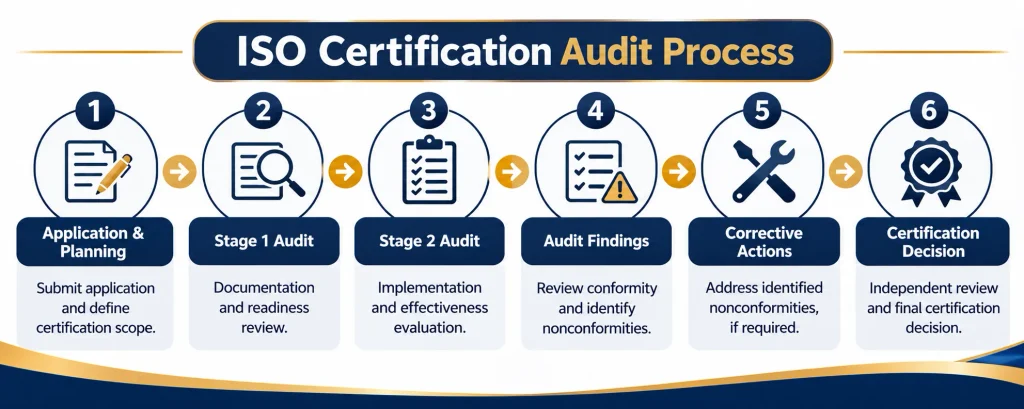
The certification audit is an independent evaluation of the organisation’s management system. For many management system certification schemes, the initial certification audit follows a two-stage approach. The exact arrangements depend on the applicable certification requirements and the selected standard.
Stage 1 Audit: Documentation and Readiness Review
The Stage 1 audit evaluates the organisation’s readiness for the main certification audit. The auditor reviews relevant documented information and examines whether the management system is sufficiently established for the Stage 2 audit. The review may cover:
- The defined certification scope.
- Management system documentation.
- Understanding of the applicable standard.
- Site-specific conditions and processes.
- Internal audit and management review arrangements.
- Readiness for the Stage 2 audit.
The auditor may also identify areas that need further attention before the next audit stage. Any concerns identified during Stage 1 should be addressed as required before proceeding.
Stage 2 Audit: Implementation and Effectiveness Review
The Stage 2 audit evaluates whether the management system has been implemented and is effective in practice. Auditors may:
- Examine relevant documents and records.
- Observe operational activities.
- Interview employees and responsible personnel.
- Review whether established procedures are being followed.
- Evaluate process performance and controls.
- Check whether applicable requirements are being met.
For example, an auditor assessing an organization’s quality management system may examine how customer requirements are reviewed, how products are inspected and how complaints are handled. The purpose is to establish whether the organization meets the applicable requirements of the selected ISO standard within the proposed certification scope.
Knowing the two audit stages is only part of preparing for certification. Organizations should also understand what auditors may examine during those stages. The assessment looks beyond the presence of documents to determine whether employees follow established procedures, operational controls work as intended, and the management system produces the required results.
What Do ISO Auditors Actually Check During a Certification Audit?
An ISO audit is not limited to checking whether documents exist. Auditors evaluate whether the management system is established, implemented, and operating effectively. The specific audit activities depend on the selected standard, certification scope, industry, operational risks, and applicable certification requirements.
1. Employee Awareness and Competence: Auditors may speak with employees to understand whether they know their responsibilities and follow the relevant management system procedures.
For example, a production employee may be asked about inspection procedures, product identification, or how to report a quality issue. In an information security audit, employees may be asked how they handle confidential information, report security incidents or follow access-control requirements.
2. Actual Operations and Process Controls: Auditors may observe work activities to determine whether actual practices match the organisation’s documented procedures.
For example, in a manufacturing facility, the auditor may observe production controls, equipment use, product handling and inspection activities. In a construction organisation, the auditor may examine how workplace hazards are identified and controlled during site activities.
3. Documentation and Record Maintenance: Auditors may review records to establish whether the organisation can demonstrate that its management system processes are being followed. Depending on the standard, these records may include:
- Training and competence records.
- Inspection and testing reports.
- Supplier evaluation records.
- Risk assessment documents.
- Equipment maintenance records.
- Customer complaint records.
- Internal audit and management review records.
4. Risk Identification and Control: Auditors may evaluate whether the organisation has identified relevant risks and established appropriate controls.
For example, a manufacturing company may need to demonstrate how it manages production defects, equipment failures, or supplier-related risks. An IT company may need to demonstrate how it identifies information security risks and applies relevant controls.
5. Process Performance and Effectiveness: Auditors may examine whether the management system is achieving its intended results. This can involve reviewing performance indicators, monitoring records, customer feedback, process results and progress towards management system objectives. Having a documented procedure is not sufficient if the organization cannot demonstrate that the process is operating effectively.
6. Nonconformities and Corrective Actions: Auditors may review how the organisation identifies, records and addresses nonconformities. They may examine whether the organisation has investigated the underlying causes, implemented appropriate corrective actions and evaluated whether those actions were effective.
How Auditors Select What to Examine
Auditors typically use a sampling approach. They select relevant records, employees, processes and operational activities based on the certification scope, applicable requirements and identified risks. This means an auditor may examine selected transactions, interview particular employees or review specific operational records rather than checking every activity individually.
The examples above are illustrative. Actual audit activities vary according to the ISO standard, organisation and certification scope.
ISO Certification Audit Preparation Checklist
Before the external audit, organisations can use this checklist to review their readiness:
- The appropriate ISO standard has been selected.
- The certification scope has been clearly defined.
- The management system has been implemented.
- Required documents and records are available.
- Employees understand their relevant responsibilities.
- Operational controls are being followed.
- Internal audits have been completed.
- Management review has been conducted.
- Identified nonconformities have been addressed.
- Relevant evidence is available for the certification assessment.
Step 8: Address Nonconformities and Complete the Certification Decision
During the certification audit, auditors may identify nonconformities where the organization does not meet an applicable requirement. A nonconformity does not automatically mean that the organization can never obtain certification. It means that the identified issue must be addressed in accordance with the applicable certification requirements. The process generally involves:
- Reviewing and understanding the identified nonconformity.
- Determining its underlying cause.
- Implementing appropriate corrections and corrective actions.
- Providing relevant evidence to the certification body.
- Completing any required follow-up or verification.
For example, if an organisation does not maintain required inspection records, it may need to investigate why the records were not maintained, correct the immediate issue, and implement measures to prevent recurrence. The certification body reviews the audit findings and corrective action evidence before making an independent certification decision.
Successful completion of the audit alone does not automatically mean that a certificate will be issued. Certification is granted only when the certification body determines that the applicable requirements have been fulfilled.
Step 9: Receive and Verify the ISO Certificate
Once the certification decision is positive, the certification body issues the ISO management system certificate. The certificate generally identifies:
- The certified organisation’s name.
- The applicable ISO standard and edition.
- The certification scope.
- The relevant site or locations.
- The certificate number.
- The issue and expiry dates.
- The certification body’s details.
- Applicable accreditation information, where relevant.
Organisations should check these details carefully to ensure that the certificate accurately represents the certified activities and locations.
How to Verify an ISO Certificate
For eligible accredited management system certificates, organisations can use IAF CertSearch to check available certification information.
However, the absence of a certificate from IAF CertSearch does not automatically mean that it is invalid. Database coverage and publicly available information may vary. Organisations should also:
- Verify the certificate directly with the issuing certification body.
- Check the certification body’s accreditation details, where applicable.
- Confirm that the standard and certification scope match the organisation’s requirements.
- Review the certificate’s validity status and relevant dates.
If the certificate is intended for a government tender, customer approval, or contractual requirement, verify its acceptability against the specific conditions before relying on it.
Step 10: Maintain Certification Through Surveillance and Recertification
ISO certification is not a one-time activity. Organisations must continue operating and improving their management systems to maintain certification. The certification body conducts periodic surveillance audits to check whether the management system continues to meet the applicable requirements. During the certification cycle, the organisation should:
- Continue following established procedures and controls.
- Monitor performance against management system objectives.
- Conduct internal audits at planned intervals.
- Hold management reviews.
- Address nonconformities and implement corrective actions.
- Maintain relevant documents and records.
- Review changes that may affect the management system.
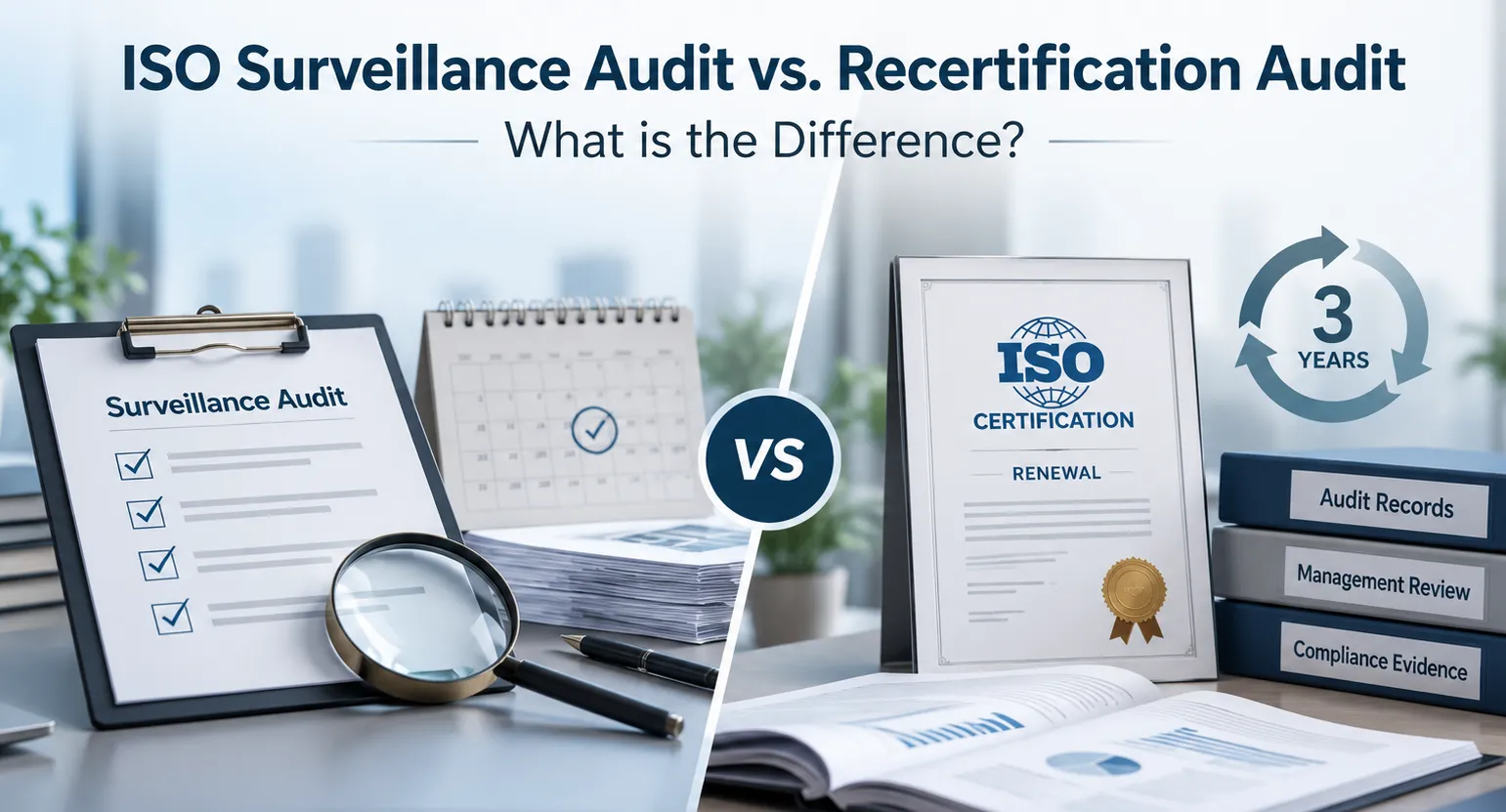
Management system certificates are generally issued within a three-year certification cycle under commonly applicable accredited certification arrangements. Surveillance audits take place during this period, followed by a recertification audit to evaluate continued conformity.
The applicable certification requirements and arrangements determine the audit frequency and certification-cycle details. Maintaining certification requires ongoing management involvement rather than preparing only when the next external audit is approaching.
Important: ISO Certification and Indian Legal Requirements Are Not the Same
ISO certification demonstrates conformity of a management system to the requirements of a particular ISO standard. It does not automatically replace statutory licences, registrations, approvals or industry-specific permissions required under Indian law. For example:
| Requirement | What Organisations Should Understand |
| BIS certification and Quality Control Orders (QCOs) | Certain products may require mandatory BIS certification under applicable product regulations. ISO certification does not replace this requirement. |
| FSSAI licence or registration | Food businesses must meet applicable FSSAI licensing and regulatory requirements. ISO 22000 certification does not replace an FSSAI licence. |
| Environmental permissions | Depending on the activity and location, businesses may need Consent to Establish, Consent to Operate or other environmental approvals. ISO 14001 does not replace these permissions. |
| Labour and workplace requirements | Organisations must meet applicable Indian labour, employment and workplace safety requirements. ISO 45001 does not replace statutory obligations. |
| Industry-specific approvals | Sectors such as pharmaceuticals, petroleum, construction and financial services may have additional regulatory or licensing requirements. |
Businesses should identify the legal and regulatory requirements applicable to their activities separately from their ISO certification requirements.
The relevant requirements can vary depending on the organisation’s industry, location, products and activities. Organisations should consult the appropriate authorities or qualified advisers where necessary.
How Much Does ISO Certification Cost in India?
There is no single fixed price for ISO certification in India. The cost depends on the organisation’s management system, certification scope, and audit requirements. Common factors affecting ISO certification cost include:
- The selected ISO standard.
- The organisation’s size and number of employees.
- The number of locations included in the certification scope.
- The complexity of products, services and processes.
- The level of risk and operational complexity.
- The audit duration and applicable certification arrangements.
Organisations should request a written quotation that clearly explains what is included in the quoted price. Confirm whether it covers application and audit fees, travel or accommodation expenses, surveillance audits, recertification and applicable taxes. Also ask whether any additional charges may apply if the certification scope or audit arrangements change.
When comparing quotations, consider the certification body’s competence, accreditation scope where required, audit arrangements and certificate requirements rather than selecting a provider based on price alone.
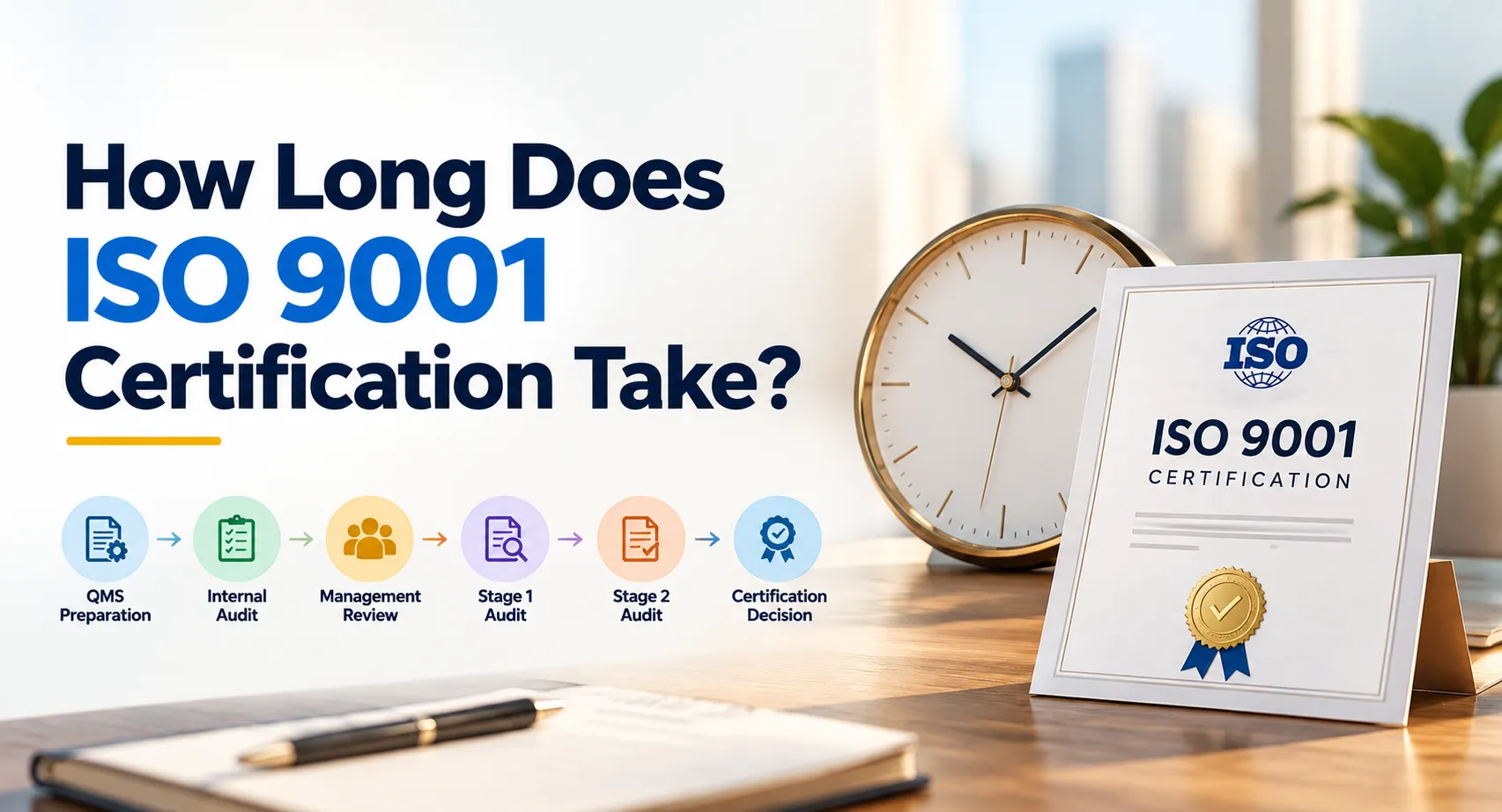
How Long Does It Take to Get ISO Certified?
The time required to get ISO certified depends on the organisation’s readiness and the complexity of its management system. A business with established processes may be able to prepare more quickly than an organisation that needs to develop and implement a management system from the beginning.
The overall timeline depends on activities such as selecting the appropriate ISO standard, assessing readiness, implementing the management system, preparing documented information, conducting internal audits and management reviews, completing the external certification audit, and addressing any identified nonconformities.
The certification body determines the audit arrangements based on the applicable requirements. Organisations should avoid relying on a fixed timeline before their scope and readiness have been evaluated.
Ready to Move Forward with ISO Certification in India?
Choosing the right ISO standard, defining the certification scope, and understanding the audit requirements are important first steps towards strengthening your organisation’s management systems and building confidence among customers, business partners and stakeholders.
At Guardian Assessment Private Limited, we support organisations seeking management system certification through our applicable certification activities. Accreditation and certification scope depend on the relevant standard and activity, so organisations can contact our team to confirm the applicable details for their requirements.
Whether your organisation is pursuing ISO 9001 certification to address customer or tender requirements, ISO 27001 to strengthen information security, or another management system certification, understanding the certification process helps you make an informed decision.
Get in Touch with Guardian Certification:
- Phone: +91 98380 70227
- Email: guardianassessment@gmail.com
- Apply Online: Schedule Your Certification Assessment
Contact our team to discuss your organisation’s certification scope and the applicable assessment requirements.
Frequently Asked Questions
2. Which ISO certification is best for a small business?
The appropriate standard depends on the business’s activities and objectives. ISO 9001 may be relevant for organisations seeking to establish a quality management system, while ISO/IEC 27001 may be suitable for businesses managing information security risks. The choice should be based on actual business requirements.
3. What documents are required for ISO certification?
Common documented information includes the management system scope, policies, objectives, procedures where required, risk assessments, training records, monitoring records, internal audit reports, and management review records. The exact requirements depend on the selected standard and the organisation’s operations.
4. Can a small business or startup obtain ISO certification?
Yes. Small businesses and startups can obtain ISO certification if they establish and implement a management system that meets the applicable standard’s requirements. The scope and audit arrangements should reflect the organisation’s actual activities.
5. Can an organisation obtain more than one ISO certification?
Yes. An organisation can obtain certification against multiple ISO management system standards. Where appropriate, compatible management systems may be integrated to reduce duplication in documentation, audits and management activities.
6. What happens if an organisation fails the ISO certification audit?
If nonconformities are identified, the organisation must address them through appropriate corrections and corrective actions. The certification body reviews the evidence and determines whether the organisation has met the certification requirements. The certification body does not grant certification until the applicable requirements are fulfilled.
7. How long is an ISO certificate valid?
Management system certificates are generally issued within a three-year certification cycle under commonly applicable accredited certification arrangements. Surveillance audits are conducted during this period, followed by a recertification audit to evaluate continued conformity. The applicable certification requirements determine the specific arrangements.
8. How do I apply for ISO certification?
To apply for ISO certification, select the relevant ISO standard, define the certification scope, and approach a suitable certification body. Submit the organisation’s details, complete the required management system implementation and documentation, and undergo the certification audit. The certification body issues the certificate after a successful evaluation and positive certification decision.