Achieving your initial ISO certification is a massive milestone that proves your organization’s commitment to global standards. However, an ISO certificate is not a lifetime award—it is a continuous, three-year commitment to operational excellence.
Once your certificate is issued, you enter the mandatory ISO Certification Cycle. To ensure your management system does not stagnate and continues to deliver genuine value, your organization must undergo ongoing assessments. This is where many newly certified businesses get confused: What exactly happens after year one?
As an internationally recognized, accredited Certification Body, Guardian Assessment Private Limited frequently guides organizations through their post-certification journey. In this comprehensive guide, we will break down the exact differences between an ISO Surveillance Audit and an ISO Recertification Audit, including their timing, depth, and what your team needs to prepare.
The 3-Year ISO Certification Cycle Explained
Before comparing the specific audits, it is essential to understand the standard 3-year lifecycle of an ISO certificate (such as ISO 9001, ISO 14001, or ISO 45001).
Following the initial ISO certification process, your compliance timeline looks like this:
- Year 1: Initial Certification Audit. A rigorous, two-stage audit where your system is evaluated from the ground up, resulting in the issuance of your certificate.
- Year 2: First Surveillance Audit. Conducted roughly 12 months after the initial certification decision.
- Year 3: Second Surveillance Audit. Conducted roughly 24 months after the initial certification.
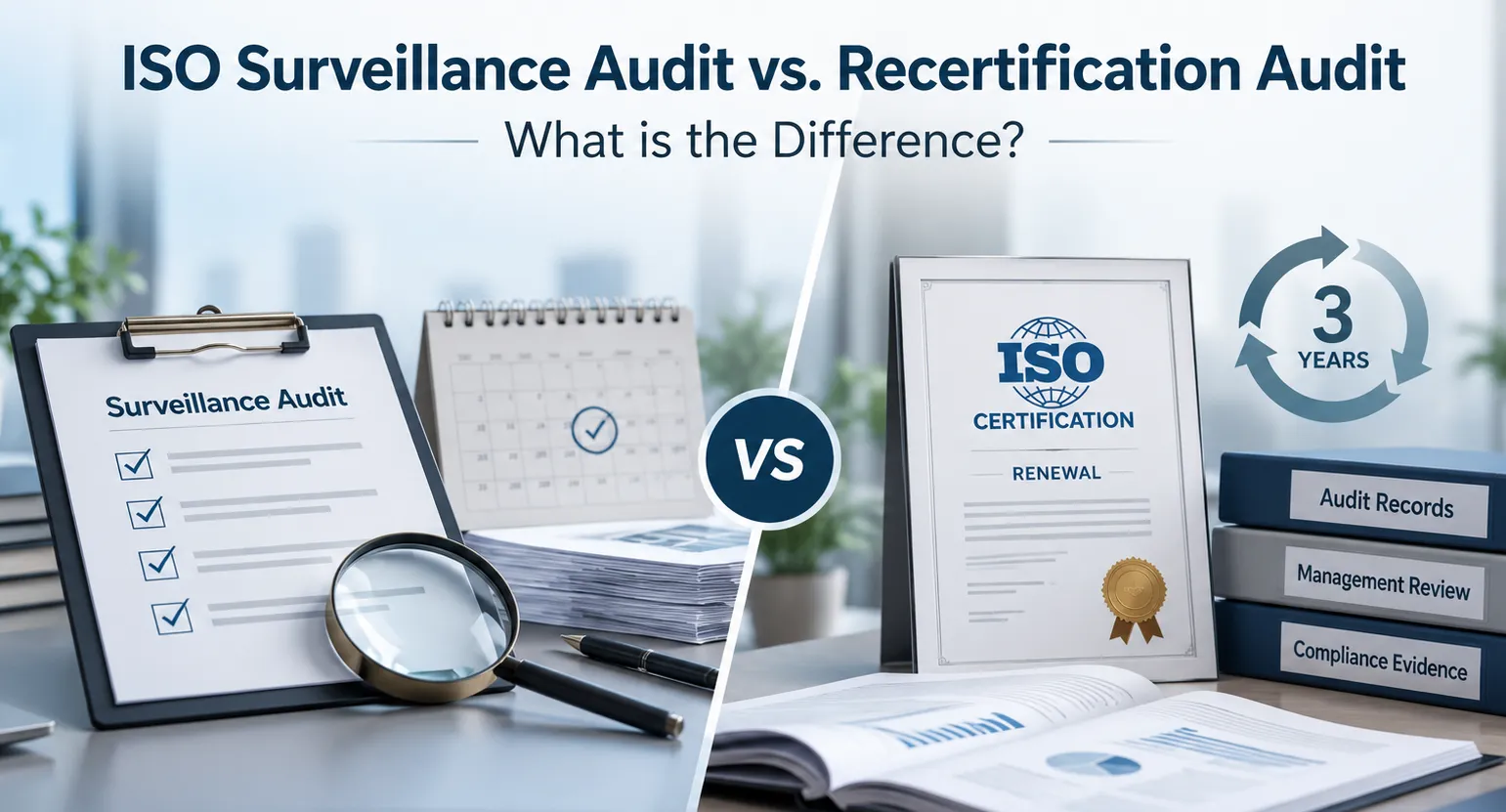
- End of Year 3: Recertification Audit. Conducted before your certificate’s expiration date (usually around month 34) to renew the certificate for another full three-year cycle.
What is an ISO Surveillance Audit?
Think of a Surveillance Audit as an annual “health check” for your management system. The goal is not to re-audit every single process in your company from scratch, but rather to verify that the system is actively being maintained, improved, and utilized in daily operations.
Key Characteristics of a Surveillance Audit:
- Audit Depth & Scope: Partial. The auditor will not review every single department. Instead, they will sample specific operational areas. However, certain mandatory elements are checked every time, including:
- Internal audit results and schedules.
- Management review meeting minutes.
- Corrective actions taken for previous non-conformities (NCRs).
- Customer complaints and satisfaction tracking.
- Continual improvement initiatives.
- Duration: Generally shorter than an initial or recertification audit, requiring fewer auditor days.
- Outcome: If the audit is successful and any non-conformities are addressed, the auditor recommends the continuation of your active certification.
What is an ISO Recertification Audit?
A Recertification Audit is the formal renewal process. Because your ISO certificate legally expires after three years, this audit evaluates the overall performance, effectiveness, and strategic alignment of your management system over the entire past certification cycle.
Key Characteristics of a Recertification Audit:
- Audit Depth & Scope: Comprehensive. Just like your Initial Stage 2 audit, the auditor will examine your entire management system from top to bottom. They will evaluate whether the system has achieved your company’s long-term strategic goals and policies.
- Handling Changes: The auditor will heavily focus on any major changes that occurred over the last three years (e.g., shifts in top management, new facility locations, new product lines, or updated legal registries).
- Duration: Longer than a surveillance audit. It requires an in-depth review of all departments and processes covered within your certification scope.
- Outcome: If successful, the independent Technical Review committee will approve the issuance of a brand-new ISO certificate, successfully resetting your 3-year cycle.
Comparison Summary: Surveillance vs. Recertification
| Feature | Surveillance Audit | Recertification Audit |
|---|---|---|
| Primary Purpose | Verify ongoing maintenance of the system. | Renew the expiring certificate and evaluate 3-year performance. |
| Timing | Annually (End of Year 1 and Year 2). | Every 3 years (Before certificate expiration). |
| Audit Depth | Partial (samples specific processes + mandatory elements). | Comprehensive (evaluates the entire management system). |
| Duration | Shorter (fewer audit days). | Longer (similar to an initial certification audit). |
| Handling Non-Conformities | Minor NCRs are typically verified at the next audit; Major NCRs require immediate action. | All Major NCRs must be fully closed before the new certificate can be issued. |
How to Maintain Compliance Between Audits
A common mistake businesses make is ignoring their ISO system until a month before the certification body arrives. To ensure stress-free Surveillance and Recertification audits, maintain these habits year-round:
- Stick to Your Internal Audit Schedule: Do not skip your internal checks. External auditors look closely at whether you are identifying and fixing your own gaps.
- Hold Regular Management Reviews: Top management must consistently review KPIs, risk assessments, and resource needs.
- Close Out Corrective Actions: If a mistake happens, document the root cause analysis and the steps taken to prevent recurrence.
- Update Your Legal Register: Ensure your systems continuously reflect new regulatory requirements, whether it’s a new environmental mandate or updated data privacy laws for your ISO 27001 ISMS.
Can I Transfer My Certification During This Cycle?
Yes. If you are dissatisfied with your current certification body due to hidden fees, lack of industry expertise, or poor communication, you do not have to wait for your Recertification Audit to switch.
Under international accreditation guidelines, you can legally transfer your active, accredited ISO certificate to Guardian Assessment Private Limited at any point during your surveillance cycle without disrupting your business operations.
Partner with Guardian Assessment
Whether you are preparing for your first Annual Surveillance or require a rigorous Recertification Audit, your commitment to global standards deserves a reliable, impartial partner.
Guardian Assessment Private Limited holds prestigious global accreditations from internationally recognized IAF signatory boards. By utilizing our transparent, impartial ISO certification process, we provide assessments that add genuine, measurable value to your business.
Schedule Your Next Audit with Guardian
Frequently Asked Questions (FAQs)
You do not strictly “fail” an audit. If the auditor finds gaps, they will issue Non-Conformities (NCRs). You will be given a specific timeframe to identify the root cause and implement corrective actions. If you fail to address Major NCRs, your certificate may be suspended.
Yes, depending on your industry risk level and the specific ISO standard, portions of the surveillance audit (such as document review and management interviews) can often be conducted using secure Information and Communication Technology (ICT).
Typically, a Recertification Audit only requires a comprehensive Stage 2 assessment. However, if your organization has undergone massive changes (like moving headquarters or merging with another company), a Stage 1 readiness review may be required.
We recommend initiating the recertification process at least 3 to 4 months before your certificate’s expiration date. This allows ample time to conduct the audit and close any potential non-conformities before the current certificate lapses.