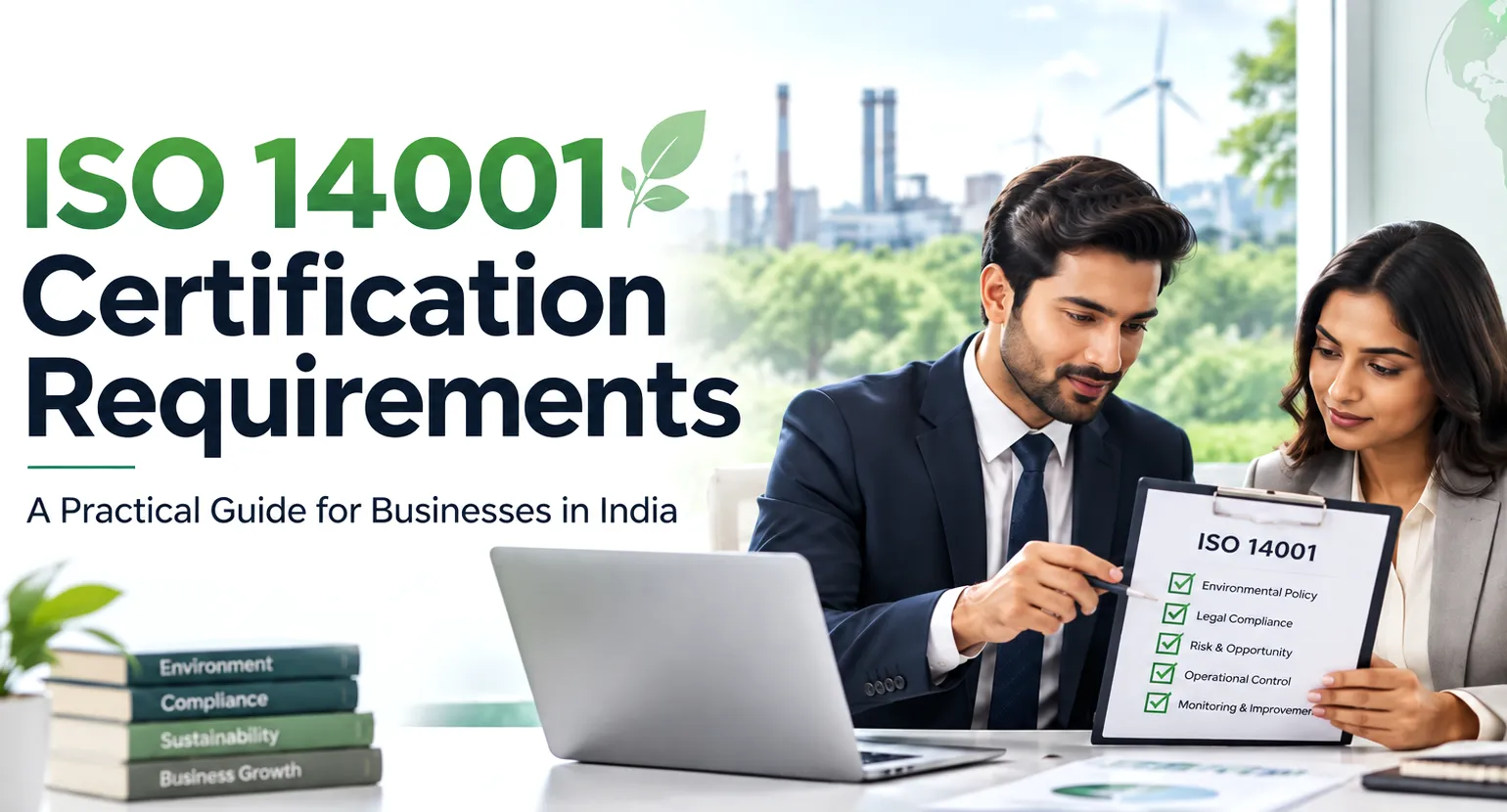
ISO 14001 Certification Requirements: Complete Guide for Businesses in India
A practical guide to what an organisation needs to establish, implement and demonstrate to achieve ISO 14001:2026 certification, including India-specific compliance context.
Current edition: ISO 14001:2026, published on 15 April 2026, replaces ISO 14001:2015.
Generally voluntary: Certification is usually voluntary, but customers, tenders and supply chains may require it.
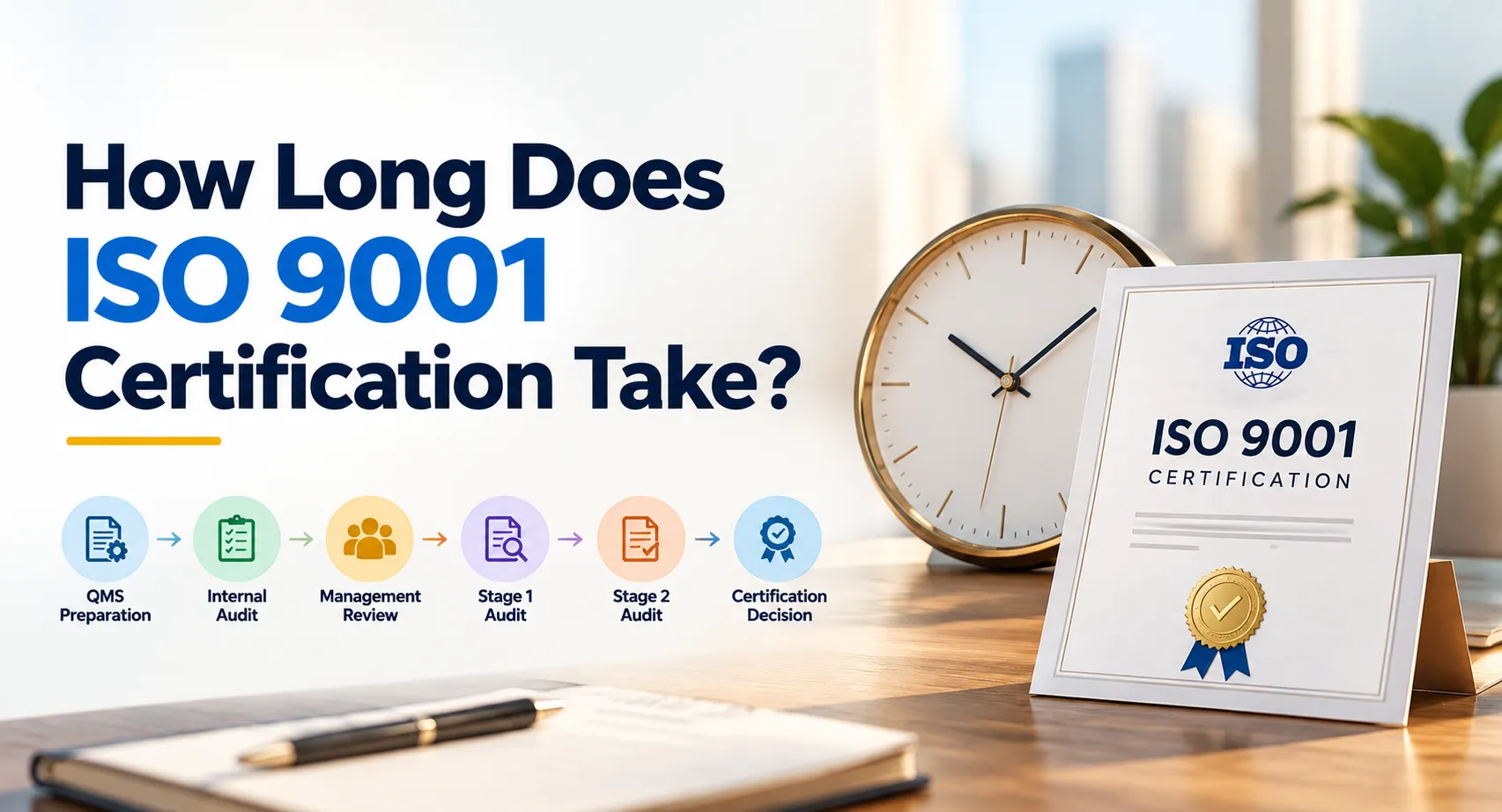
Two-stage audit: Initial certification involves a Stage 1 and a Stage 2 audit by an independent certification body.
ISO 14001 certification requirements cover much more than preparing an environmental policy and a set of procedures. An organisation seeking certification needs to establish, implement, maintain and continually improve an Environmental Management System (EMS) that reflects its actual activities, environmental impacts, applicable obligations, risks, operational controls and environmental performance.
The current edition is ISO 14001:2026, the fourth edition of the international Environmental Management System standard. ISO published it on 15 April 2026, replacing ISO 14001:2015. ISO describes the 2026 revision as a targeted update rather than a complete redesign. The established EMS framework remains, while expectations are clearer around environmental context, leadership accountability, risks and opportunities, value-chain considerations, and measurable environmental outcomes.
ISO also reports more than 670,000 certified organisations worldwide, based on its 2024 Survey.
Table of Contents
- ISO 14001 Certification Requirements
- What Is ISO 14001:2026?
- What Is an Environmental Management System?
- ISO 14001 Requirements vs Certification Requirements
- What Changed With ISO 14001:2026?
- What Are the Main ISO 14001 Certification Requirements?
- What Documents and Records Are Needed?
- How Do the Requirements Work Together?
- How Is ISO 14001 Implemented Within a Business?
- Which Industries Is ISO 14001 Relevant To?
- ISO 14001 Requirements and Environmental Compliance in India
- Is ISO 14001 Certification Mandatory in India?
- How to Prepare for ISO 14001 Certification
- What Happens During the Certification Audit?
- What Does an ISO 14001 Auditor Actually Check?
- Common ISO 14001 Gaps That Can Delay Certification
- ISO 14001 Certification Requirements Checklist
- Final Takeaway
- Frequently Asked Questions (FAQs)
ISO 14001 Certification Requirements
To achieve ISO 14001 certification, an organisation should have an implemented Environmental Management System that can demonstrate how environmental responsibilities are identified, controlled, monitored, reviewed, and improved.
In practical terms, the organisation should be able to demonstrate that it has:
- Defined the scope of its EMS.
- Understood relevant environmental and organisational context.
- Identified relevant interested parties.
- Identified environmental aspects and impacts.
- Determined applicable legal and other compliance obligations.
- Identified environmental risks and opportunities.
- Established an environmental policy.
- Established environmental objectives.
- Assigned responsibilities and resources.
- Ensured relevant competence and awareness.
- Established operational controls.
- Considered relevant life-cycle stages.
- Prepared for environmental emergencies.
- Monitored environmental performance.
- Evaluated fulfilment of compliance obligations.
- Conducted internal audits.
- Completed management review.
- Managed nonconformities and corrective actions.
- Demonstrated continual improvement.
The most important principle is:
ISO develops the standard but does not certify organisations itself. Certification is performed by an independent certification body.
Table 1: ISO 14001 Certification Requirements at a Glance
| Requirement Area | What the Organisation Needs to Demonstrate | Typical Evidence |
|---|---|---|
| EMS scope and context | Where the EMS applies and which environmental conditions matter | Scope statement, context analysis |
| Environmental aspects | How activities interact with the environment | Aspect-impact register |
| Compliance obligations | Which legal and other requirements apply | Legal register, permits, conditions |
| Leadership | Management involvement, resources and responsibilities | Policy, roles, decisions |
| Risks and opportunities | Environmental issues requiring action | Risk and opportunity assessment |
| Objectives | Defined environmental improvement priorities | Objectives, KPIs, action plans |
| Competence | Relevant personnel can perform their responsibilities | Training and competence records |
| Operational control | Significant environmental activities are controlled | SOPs, operating criteria, records |
| Emergency preparedness | Credible emergencies are addressed | Plans, drills, response records |
| Performance evaluation | Environmental results are monitored | Monitoring data and KPIs |
| Compliance evaluation | Applicable obligations are periodically checked | Evaluation records |
| Internal audit | EMS implementation is independently checked internally | Audit programme and reports |
| Management review | Top management reviews performance and decides actions | Review minutes and decisions |
| Improvement | Problems are corrected, and recurrence addressed | NCRs and corrective actions |
What Is ISO 14001:2026?
ISO 14001:2026 is the internationally recognised standard for Environmental Management Systems. It provides a structured framework that organisations can use to:
- Understand environmental impacts.
- Control environmental risks.
- Fulfil relevant obligations.
- Improve environmental performance.
- Set environmental objectives.
- Monitor results.
- Integrate environmental management into normal business operations.
ISO 14001 does not prescribe one fixed environmental target or emission limit for every organisation. Those requirements depend on:
- The organisation’s activities.
- Environmental aspects.
- Applicable legislation.
- Regulatory permits.
- Customer requirements.
- Contractual commitments.
- Other relevant obligations.
What Is an Environmental Management System?
An Environmental Management System is the structured part of the organisation’s management system used to manage environmental responsibilities. For example, in a manufacturing company:
- Procurement may control environmental requirements for suppliers and materials.
- Production may control emissions, waste and resource use.
- Maintenance may prevent leaks and equipment failures.
- Utilities may control electricity, water and fuel.
- Warehousing may control chemical storage.
- HR may support competence and awareness.
- Top management may review environmental performance and allocate resources.
This is why ISO 14001 should operate as a management system, rather than as a separate environmental file maintained only by the EHS department.
What Does ISO 14001 Help an Organisation Manage?
Depending on the organisation, an EMS may address:
- Air emissions.
- Wastewater.
- Water use.
- Electricity and fuel.
- Hazardous waste.
- Solid waste.
- Chemicals.
- Packaging.
- Raw materials.
- Noise.
- Soil contamination risk.
- Groundwater risk.
- Transportation.
- Product end-of-life.
- Biodiversity-related issues.
- Climate-related environmental conditions.
- Resource availability.
The relevant issues differ by organisation. A chemical factory, hotel, hospital and IT company may all implement ISO 14001, but the environmental aspects and controls for each will be very different.
Who Can Implement ISO 14001?
ISO 14001 can be implemented by organisations of any size and sector, including:
- Manufacturing.
- Construction.
- Healthcare.
- Hospitality.
- Logistics.
- Mining.
- Energy.
- Waste management.
- Food processing.
- Engineering.
- Information technology.
- Education.
- Public-sector organisations.
- Other service businesses.
ISO 14001 Requirements vs Certification Requirements
These terms are related but different. ISO 14001 requirements define what the Environmental Management System should address. Certification independently evaluates whether those requirements have actually been implemented and whether the EMS is functioning effectively.
What Changed With ISO 14001:2026?
ISO states that the 2026 edition builds on the existing framework rather than replacing it entirely. Important areas highlighted by ISO include:
- Broader consideration of environmental conditions such as climate change, pollution, biodiversity, ecosystem health and resource availability.
- Stronger leadership accountability.
- Clearer links between environmental aspects, compliance obligations, risks and actions.
- Greater emphasis on measurable environmental outcomes.
- More structured consideration of organisational change.
- Greater oversight of externally provided processes, products and services.
- Clearer interpretation of life-cycle perspective.
- Stronger internal-audit governance.
- More structured management review.
What Are the Main ISO 14001 Certification Requirements?
For practical implementation and certification preparation, the requirements can be grouped into the following 15 management areas. This grouping is designed to make the standard easier to understand and does not replace ISO 14001’s official clause structure.
1. Understand the Organisation and Define the EMS Scope
Before controlling environmental impacts, the organisation needs to understand what its EMS covers and which environmental conditions are relevant. This can include:
- Nature of operations.
- Site location.
- Local environmental conditions.
- Water availability.
- Climate conditions.
- Resource dependency.
- Supply-chain issues.
- Regulatory conditions.
- Customer expectations.
- Organisational changes.
Relevant interested parties may include:
- Regulators.
- Customers.
- Employees.
- Communities.
- Suppliers.
- Contractors.
- Investors.
- Parent companies.
- Industry bodies.
The EMS scope should clearly define which sites, processes, activities, products, services and supporting functions are covered.
Practical Example: Consider a company manufacturing industrial coatings. It may not be reasonable to include only the mixing process while ignoring:
- Chemical storage.
- Boilers.
- Wastewater treatment.
- Maintenance.
- Hazardous-waste storage.
- Loading and unloading.
If those activities support the certified operations and create relevant environmental impacts, they need appropriate consideration within the EMS.
2. Identify Environmental Aspects and Impacts
Environmental aspects and impacts determine what the organisation actually needs to manage. A simple way to understand the relationship is:
Example: Metal cleaning → Chemical wastewater → Potential water pollution
The organisation should consider environmental aspects associated with:
- Routine activities.
- Non-routine activities.
- Start-up and shutdown.
- Maintenance.
- Abnormal conditions.
- Foreseeable emergencies.
- New processes.
- Modified activities.
- Products and services.
- Activities it controls.
- Activities it can influence.
It should then determine which environmental aspects are significant. ISO does not prescribe one universal scoring formula. An organisation may consider:
- Severity.
- Frequency.
- Quantity.
- Toxicity.
- Probability.
- Duration.
- Legal relevance.
- Stakeholder concern.
- Ability to control the impact.
Table 2: Environmental Aspect, Impact and Control Examples
| Activity | Environmental Aspect | Potential Environmental Impact | Typical Control |
|---|---|---|---|
| Boiler operation | Fuel combustion | Air emissions and resource use | Maintenance and monitoring |
| Metal cleaning | Chemical wastewater | Water pollution | Collection and wastewater treatment |
| Chemical storage | Potential leak or spill | Soil/groundwater contamination | Bunding, inspections, spill response |
| Painting | VOC-containing materials | Air emissions | Extraction and controlled application |
| DG operation | Diesel use and noise | Air and noise impact | Maintenance and operating controls |
| Construction | Dust and debris | Air pollution and waste | Dust suppression and segregation |
| Hospital activities | Biomedical waste | Contamination risk | Segregation and authorised handling |
| Office activities | Electricity and e-waste | Resource use and waste | Energy controls and authorised disposal |
A useful aspect-impact register therefore helps answer: Which environmental issues are important enough to require systematic control?
3. Identify Compliance Obligations
The organisation should determine which legal and other environmental obligations apply. These may arise from:
- Environmental legislation.
- Regulatory permits.
- Consent conditions.
- Environmental Clearance conditions.
- Waste authorisations.
- Customer requirements.
- Contracts.
- Corporate requirements.
- Voluntary commitments.
A useful compliance register should answer:
- What requirement applies?
- Why does it apply?
- Which activity or site does it affect?
- What must be done?
- Who is responsible?
- What evidence proves fulfilment?
- How often is it reviewed?
Legal Register vs Compliance Evaluation is an important distinction. The legal register answers: What requirements apply to us? Compliance evaluation answers: Are we actually meeting those requirements?
Simply listing the Water Act, Air Act, or waste rules in a spreadsheet does not demonstrate compliance. The detailed India-specific regulatory context is covered separately later in this guide.
4. Establish Environmental Policy and Leadership Responsibilities
Environmental management should not be delegated entirely to the environment manager. Top management should ensure the EMS is integrated into the organisation. This includes:
- Establishing environmental policy.
- Providing resources.
- Assigning responsibilities.
- Supporting environmental objectives.
- Considering environmental issues in business decisions.
- Reviewing environmental performance.
ISO 14001:2026 strengthens the emphasis on leadership accountability and environmental decision-making.
5. Identify Environmental Risks and Opportunities
An EMS should consider both current environmental issues and future risks. Possible risks may include:
- Significant environmental aspects.
- Regulatory changes.
- Water scarcity.
- Energy dependency.
- Flooding.
- Extreme temperatures.
- Chemical spills.
- Equipment failure.
- Supplier risks.
- Contractor activities.
- Community complaints.
- Process changes.
Opportunities may include:
- Water reuse.
- Energy efficiency.
- Cleaner technologies.
- Reduced packaging.
- Material substitution.
- Recycling.
- Renewable energy.
- Reduced hazardous waste.
- Improved supplier requirements.
Relevant environmental implications should also be considered when significant organisational or operational changes are planned.
6. Establish Environmental Objectives and Action Plans
Environmental objectives turn policy into measurable action. Compare these two objectives:
- Weak objective: Reduce water consumption.
- Better objective: Reduce process-water consumption from 8.5 KL per tonne to 7.5 KL per tonne by March 2027.
The second objective has a baseline, a target, a measurable indicator and a deadline. A useful objective should answer:
- What will be achieved?
- What is the baseline?
- How will it be measured?
- Who is responsible?
- What resources are needed?
- What is the target date?
Typical KPIs can include:
- kWh per unit produced.
- KL of water per tonne.
- Hazardous waste per tonne.
- Percentage waste recycled.
- Percentage water reused.
- Fuel consumption per shipment.
7. Provide Resources, Competence, Training and Awareness
Personnel performing work that can affect environmental performance should be competent for their responsibilities. This can include:
- ETP/STP operators.
- Boiler operators.
- Chemical handlers.
- Maintenance teams.
- Waste handlers.
- Environmental personnel.
- Laboratories.
- Emergency teams.
- Procurement personnel.
- Contractors.
- Internal auditors.
Competence may come through education, experience, qualifications, training or demonstrated ability. One important distinction is: Training completed ≠ competence demonstrated.
For example, a person responsible for hazardous-waste storage should understand:
- Segregation.
- Identification.
- Storage controls.
- Spill precautions.
- Relevant records.
- Emergency response.
8. Control Required Documents and Records
ISO 14001 uses the concept of documented information. The purpose is not to create paperwork for its own sake. Documentation should help the organisation:
- Operate processes consistently.
- Communicate requirements.
- Preserve organisational knowledge.
- Demonstrate results.
Document control should address:
- Identification.
- Approval.
- Revision.
- Version control.
- Availability.
- Access.
- Protection.
- Retention.
- Disposal.
- Obsolete information.
The detailed list of EMS documents and records is covered separately so that this requirement remains focused on document control, not document quantity.
9. Establish Operational Controls
Operational controls turn environmental planning into day-to-day practice. Relevant controls may cover:
- Waste and Hazardous Waste: segregation, identification, storage, movement, disposal, vendor control.
- Chemicals: storage, compatibility, secondary containment, inspections, spill response.
- Water and Wastewater: water use, wastewater routing, ETP/STP operations, treatment, sampling, reuse or discharge.
- Air Emissions: pollution-control equipment, fuel management, preventive maintenance, monitoring.
- Energy and Resources: electricity, fuel, steam, raw materials, packaging.
Suppliers and Contractors: Relevant environmental requirements may also need to apply to waste contractors, transporters, maintenance contractors, construction contractors, suppliers and outsourced processes. ISO’s 2026 guidance gives clearer attention to externally provided processes, products and services.
10. Apply a Life-Cycle Perspective
Life-cycle thinking asks the organisation to consider relevant environmental impacts beyond the factory gate. A simple sequence is:
The organisation should consider stages it can control or influence. This may affect:
- Material selection.
- Procurement.
- Product design.
- Packaging.
- Transportation.
- Supplier requirements.
- End-of-life arrangements.
A life-cycle perspective does not automatically mean every organisation must conduct a formal Life Cycle Assessment.
11. Prepare for Environmental Emergencies
The organisation should identify credible environmental emergencies. Examples include:
- Chemical spills.
- Oil leaks.
- Tank overflow.
- Pipeline failure.
- Fire.
- Contaminated firefighting water.
- ETP failure.
- Accidental discharge.
- Hazardous-material release.
Emergency arrangements may include:
- Defined responsibilities.
- Response procedures.
- Appropriate equipment.
- Spill kits.
- Communication arrangements.
- Training.
- Exercises.
- Post-event review.
A useful environmental drill should test whether the organisation can actually control the environmental consequence—not merely whether people can evacuate.
12. Monitor, Measure and Evaluate Environmental Performance
The organisation should collect reliable information about whether environmental controls are working. Depending on the activity, monitoring may include:
- Water consumption.
- Electricity.
- Fuel.
- Waste.
- Hazardous waste.
- Recycling.
- Wastewater.
- Air emissions.
- Noise.
- Incidents.
- Complaints.
- Objective achievement.
The key question is: Which information tells us whether our significant environmental aspects, controls, and objectives are being managed effectively?
Performance Monitoring vs Compliance Evaluation: Performance monitoring asks, “How are we performing?” Compliance evaluation asks, “Are we fulfilling applicable obligations?” These are related but different activities.
13. Conduct an ISO 14001 Internal Audit
Internal audit checks whether the EMS has been implemented and whether it is functioning as intended. A meaningful audit may include:
- Document review.
- Interviews.
- Site observation.
- Record sampling.
- Process tracing.
Practical Example: For hazardous-waste management, the internal auditor might:
- Review the procedure.
- Visit the storage area.
- Check segregation and identification.
- Sample records.
- Trace disposal evidence.
- Interview responsible personnel.
- Compare practice against established controls.
This produces better evidence than completing a checklist entirely from a meeting room.
14. Conduct Management Review
Top management should periodically review whether the EMS remains suitable, adequate, and effective. Relevant information may include:
- Environmental performance.
- Objectives.
- Compliance status.
- Audit findings.
- Incidents.
- Corrective actions.
- Risks.
- Changes.
- Resources.
- Improvement opportunities.
A meaningful management review should lead to decisions. Examples include:
- Upgrading pollution-control equipment.
- Improving containment.
- Introducing water reuse.
- Revising environmental objectives.
- Increasing resources.
15. Manage Nonconformities, Corrective Actions and Continual Improvement
When a problem occurs, the organisation should address more than the immediate symptom. A useful sequence is:
Practical Example: Suppose hazardous-waste containers are repeatedly found without correct identification. The immediate correction may be to label the containers. But the organisation should then determine why the issue occurred. Possible causes may include:
- Labels unavailable.
- Responsibility unclear.
- Waste moved before identification.
- Training insufficient.
- Inspections ineffective.
Corrective action should address the actual cause and later be checked for effectiveness.
What Documents and Records Are Needed for ISO 14001 Certification?
There is no identical document pack for every organisation. The amount of documented information should reflect organisation size, EMS scope, environmental complexity, compliance obligations, significant aspects and operational control needs. A chemical factory and an IT office will not need identical documentation.
The practical question is: What information is needed to operate our EMS effectively, and what records prove that it works?
Table 3: ISO 14001 Documents and Records Checklist
| Document / Record | Purpose | Typical Evidence | Applicability |
|---|---|---|---|
| EMS scope | Defines system boundaries | Approved scope | All organisations |
| Environmental policy | Defines commitments | Approved policy | All organisations |
| Context/interested parties | Supports planning | Context analysis | As relevant |
| Aspect-impact register | Identifies interactions | Significance evaluation | All organisations |
| Compliance register | Identifies obligations | Legal register | All organisations |
| Risks and opportunities | Supports planning | Risk assessment | All organisations |
| Objectives | Drives improvement | KPIs and plans | All organisations |
| Operational controls | Controls significant activities | SOPs and criteria | Where needed |
| Competence records | Demonstrates capability | Training/evaluation records | Relevant personnel |
| Monitoring records | Shows performance | Water, energy, emissions data | According to aspects |
| Compliance evaluation | Shows obligation checks | Evaluation records | All organisations |
| Emergency records | Demonstrates preparedness | Plans and drills | According to risk |
| Internal audit | Evaluates EMS | Programme and reports | Certification preparation |
| Management review | Shows leadership evaluation | Review records | Certification preparation |
| Corrective action | Demonstrates response | NCR and effectiveness evidence | When issues occur |
Producing more procedures does not automatically create a stronger Environmental Management System. The strongest documentation is usually: lean enough to be used + detailed enough to control the activity + complete enough to demonstrate evidence.
Understand Your ISO 14001 Certification Requirements
Guardian Assessment Private Limited operates as an independent conformity assessment body providing management system certification services. Its current company information and applicable accreditation arrangements are published on its official website. About Guardian Assessment Private Limited
How Do the ISO 14001 Requirements Work Together?
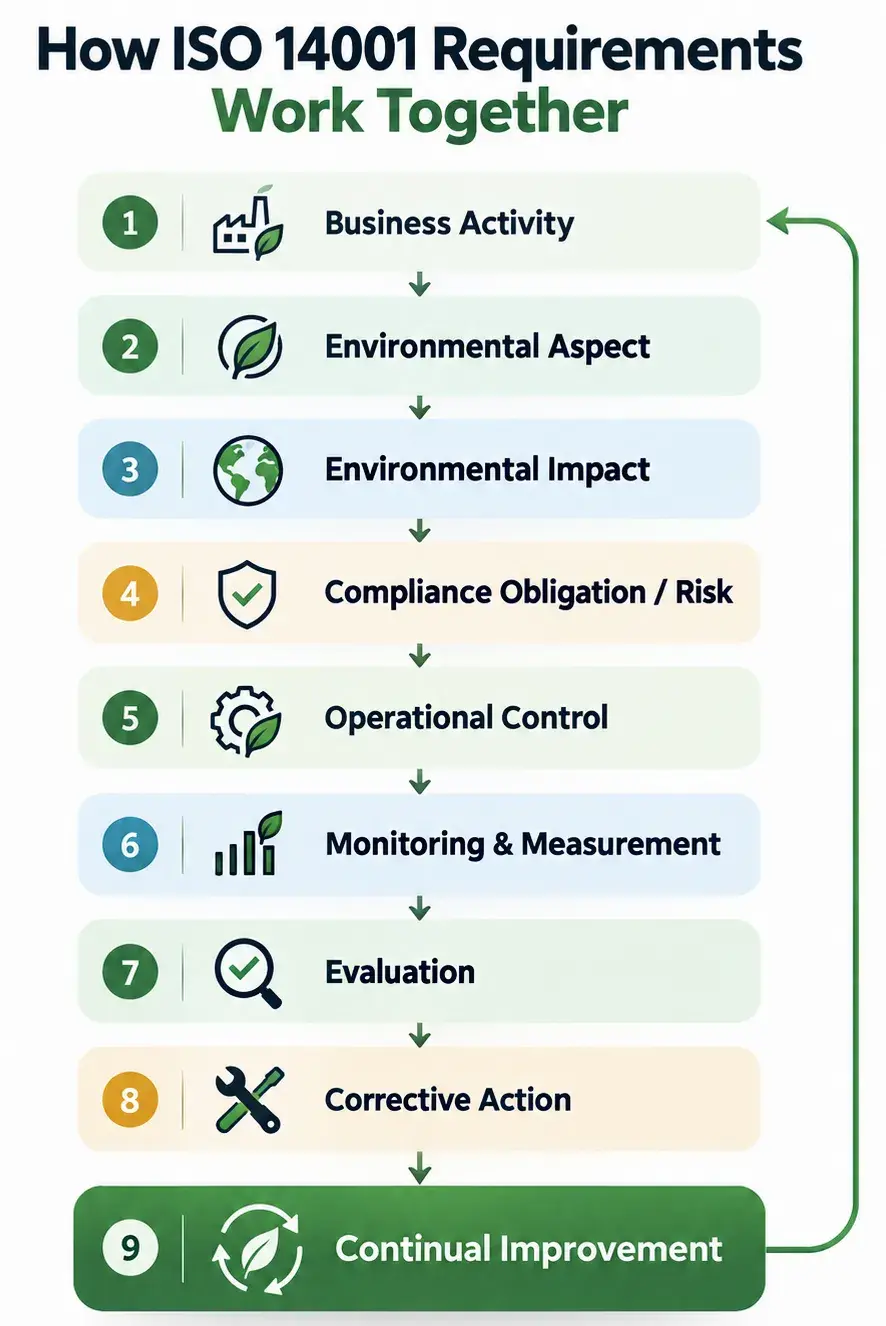
ISO 14001 works best when the requirements operate as one connected management system. The practical relationship is:
Consider a metal-treatment process.
- Activity: metal treatment.
- Aspect: chemical wastewater.
- Potential impact: water contamination.
- Relevant obligation: applicable consent/discharge conditions.
- Control: wastewater collection and ETP operation.
- Monitoring: treated-effluent results.
- Evaluation: comparison against applicable requirements.
- Corrective action: investigation of deviations.
- Improvement: reduction of water or chemical load.
An auditor should be able to follow the connection between:
environmental issue → responsibility → control → evidence → result.
How Is ISO 14001 Implemented Within a Business?
ISO 14001 is not implemented only by the environment department. Environmental responsibility follows the activity—not the department name. Relevant areas may include:
- Top management: policy, resources, objectives, and review.
- EHS/environment: EMS coordination and monitoring.
- Production: emissions, waste and resource use.
- Maintenance: leak prevention and equipment condition.
- Utilities: boilers, DG sets, energy and water.
- ETP/STP: wastewater-treatment controls.
- Warehousing: material and chemical storage.
- Hazardous-waste areas: segregation and storage.
- Procurement: suppliers and material requirements.
- HR: competence and awareness.
- Projects: environmental impacts from change.
- Logistics: transport and loading/unloading.
- Contractors: controls for externally provided activities.
- Administration: electricity, water and office waste.
The EMS works when each relevant function understands its own environmental responsibilities.
Which Industries Is ISO 14001 Relevant To?
ISO 14001 can apply to any organisation, but its practical relevance is particularly high where businesses have:
- Significant environmental aspects.
- Complex regulatory obligations.
- High water or energy consumption.
- Hazardous materials.
- Significant waste streams.
- Large supply chains.
- Customer environmental requirements.
CPCB material continues to refer to the 17 categories of highly polluting industries, alongside other industrial classification systems such as Red, Orange and Green categories. This does not mean ISO 14001 certification is automatically mandatory for those industries.
Table 4: Industry, Environmental Issues and Typical EMS Focus
| Industry | Main Environmental Issues | Typical EMS Focus |
|---|---|---|
| Chemical & pharmaceutical | Chemicals, effluent, hazardous waste | Production, ETP, chemical storage |
| Textile & dyeing | Water, chemicals, dyes, effluent | Process control, ETP, water |
| Cement | Dust, emissions, fuel | Kiln, handling, air controls |
| Iron & steel | Energy, emissions, slag | Production, utilities, waste |
| Oil & petrochemical | Spills, VOCs, effluent | Process areas and emergency controls |
| Automotive | Paint, oil, chemicals, energy | Paint shop, machining, utilities |
| Construction | Dust, C&D waste, water | Site and contractor controls |
| Healthcare | Biomedical waste, chemicals | Segregation and storage |
| Food processing | Water, organic waste, effluent | Production, cleaning and ETP |
| Logistics | Fuel, spills, packaging | Fleet and warehouse controls |
ISO 14001 Requirements and Environmental Compliance in India
For Indian organisations, one principle is especially important: ISO 14001 requirements are international, while environmental legal obligations are activity- and location-specific. An Indian organisation therefore needs to identify which regulatory obligations actually apply and integrate them into its EMS.
ISO 14001 Certification vs Environmental Legal Compliance
ISO 14001 certification does not replace environmental licences, consents or statutory approvals. Depending on the activity, relevant obligations may arise from:
- Pollution-control legislation.
- Consent requirements.
- Environmental Clearance.
- Waste-management rules.
- Sector-specific environmental conditions.
- Monitoring requirements.
- Reporting requirements.
Environmental Permissions and Authorisations That May Apply
Depending on the organisation, requirements may include:
- Consent to Establish.
- Consent to Operate.
- Environmental Clearance.
- Hazardous-waste authorisation.
- Waste-related registrations.
- EPR requirements.
- Permit conditions.
- Mandatory environmental returns.
These are not universal ISO 14001 requirements. Applicability depends on the relevant law and the organisation’s actual activities.
CTE, CTO and Pollution-Control Requirements
India’s Control of Water Pollution (Grant, Refusal or Cancellation of Consent) Guidelines, 2025 establish the current central framework for consent processes under the Water Act. The guidelines were notified on 30 January 2025 and address Consent to Establish, Consent to Operate, and related consent administration.
Official source: CPCB – Control of Water Pollution Consent Guidelines, 2025
Where such conditions apply, they should feed into:
- The compliance register.
- Operational controls.
- Monitoring.
- Responsibility assignment.
- Compliance evaluation.
A consent condition should not sit forgotten inside a licence file.
Environmental Clearance
Environmental Clearance is separate from ISO 14001 certification. Projects covered by India’s EIA framework may require prior Environmental Clearance depending on:
- Project type.
- Capacity.
- Category.
- Applicable thresholds.
- Other regulatory conditions.
The PARIVESH portal maintains the Environmental Impact Assessment Notification, 2006 and related amendments and guidance.
Official source: PARIVESH – Environmental Clearance and EIA Notification 2006
Government guidance also makes clear that Consent to Establish and Environmental Clearance are separate legal requirements where both apply.
Waste, Emissions and Wastewater Obligations
Depending on the organisation, relevant rules may include those concerning:
- Hazardous and other wastes.
- E-waste.
- Batteries.
- Plastic waste.
- Biomedical waste.
- Construction and demolition waste.
- Other sector-specific waste streams.
For example, the E-Waste (Management) Rules, 2022 define their own scope and applicability and came into force on 1 April 2023.
Official source: MoEFCC – E-Waste (Management) Rules, 2022
MoEFCC also maintains its current environmental rules and amendments in a central rules repository.
Official source: MoEFCC – Environmental Rules & Regulations
The Battery Waste Management Rules, 2022 operate under a separate regulatory framework for waste batteries, with subsequent amendments. For construction-related activities, CPCB currently publishes the Construction and Demolition Waste Management Rules, 2025 in its rules repository.
Official source: CPCB – Construction and Demolition Waste Rules
The key lesson is: Do not copy every environmental rule into every legal register. First establish whether the rule applies and which obligations within it are relevant.
Why ISO 14001 Does Not Replace Legal Approvals
Environmental law defines what the organisation must legally do. ISO 14001 provides a management framework for identifying, controlling, monitoring, and evaluating those applicable environmental responsibilities. One does not replace the other.
How Indian Legal Requirements Become Part of the EMS
A practical process is:
- Identify applicable legislation, permits and conditions.
- Determine the specific obligation.
- Assign responsibility.
- Establish operational controls.
- Monitor relevant conditions.
- Maintain evidence.
- Evaluate compliance.
- Correct failures.
- Update the register when laws or operations change.
Is ISO 14001 Certification Mandatory in India?
ISO 14001 certification is generally voluntary: ISO states that organisations can implement ISO 14001 without seeking third-party certification. However, certification may become commercially or contractually important.
When ISO 14001 Is Voluntary: An organisation may choose certification to:
- Strengthen environmental management.
- Improve environmental governance.
- Structure objectives.
- Support customer confidence.
- Improve resource management.
- When Customers May Require It: Customers may include ISO 14001 certification in supplier qualification criteria.
- Tender and Contract Requirements: A tender or contract may require ISO 14001 certification as an eligibility condition, a contractual requirement or a supplier-evaluation criterion. That is different from a general statutory requirement.
- Supply-Chain Requirements: OEMs and multinational organisations may require certified environmental management systems from suppliers.
- Corporate or Group Requirements: A parent organisation may require group companies or sites to maintain ISO 14001 certification.
How to Prepare for ISO 14001 Certification
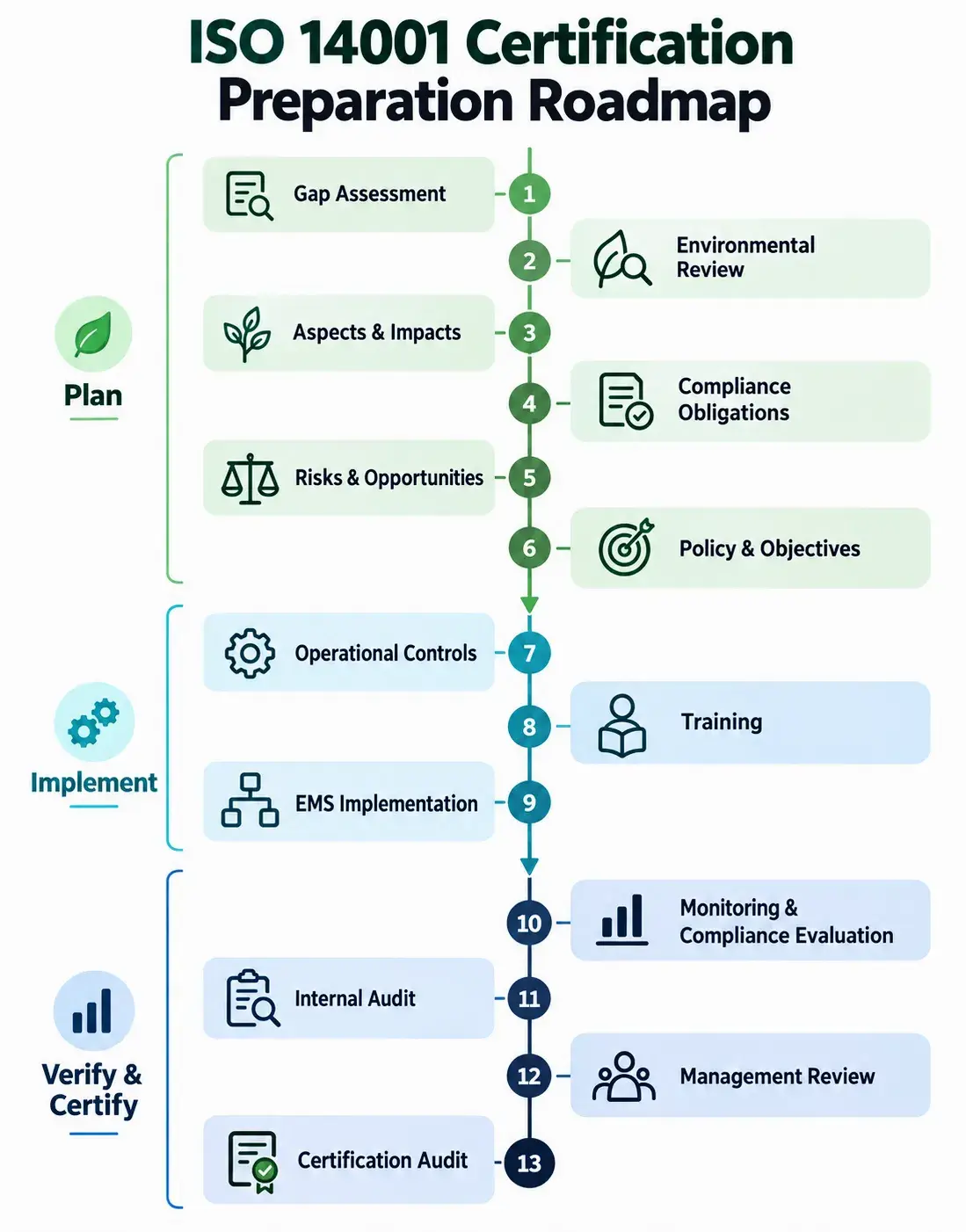
This section converts the requirements into an implementation sequence rather than repeating the full explanations above.
Step 1 — Define the EMS Scope and Conduct a Gap Assessment
Determine sites, activities, services, functions and EMS boundaries. Then compare the current system against ISO 14001:2026.
Step 2 — Conduct an Initial Environmental Review
Review actual environmental conditions and practices, including:
- Processes.
- Materials.
- Energy.
- Water.
- Waste.
- Emissions.
- Effluent.
- Chemicals.
- Existing permissions.
- Monitoring.
- Environmental incidents.
Step 3 — Identify Environmental Aspects and Impacts
Map environmental interactions and determine significant aspects.
Step 4 — Identify Applicable Compliance Obligations
Create a site-specific compliance register showing:
- What applies.
- Why it applies.
- Who owns it.
- How fulfilment will be demonstrated.
Step 5 — Assess Risks and Opportunities
Connect environmental aspects, obligations, environmental conditions and business changes.
Step 6 — Establish Policy, Objectives and Responsibilities
Top management should establish:
- Policy.
- Objectives.
- Responsibilities.
- Resources.
Step 7 — Develop Operational Controls
Implement controls according to actual environmental risk.
Step 8 — Train Employees and Contractors
Training should reflect responsibilities rather than relying on one generic awareness programme.
Step 9 — Implement the EMS and Generate Operating Evidence
Certification assesses an implemented system. Useful evidence may include:
- Monitoring records.
- Inspections.
- Training records.
- Waste records.
- Operating logs.
- Objectives data.
- Compliance evaluations.
Step 10 — Monitor Performance and Evaluate Compliance
Confirm whether:
- Controls work.
- Objectives are progressing.
- Monitoring occurs.
- Applicable obligations are being evaluated.
Step 11 — Conduct the Internal Audit
Audit the relevant EMS scope and address findings.
Step 12 — Conduct Management Review
Top management should review meaningful information and make decisions.
Step 13 — Close Gaps Before the Certification Audit
Verify outstanding:
- Audit findings.
- Compliance issues.
- Monitoring gaps.
- Corrective actions.
- Operational inconsistencies.
- Missing evidence.
Apply for ISO 14001 Certification
What Happens During the ISO 14001 Certification Audit?
Initial management-system certification normally involves a two-stage audit process. Guardian Assessment Private Limited’s published audit information also states that initial management-system certification audits are conducted through Stage 1 and Stage 2.
Stage 1 Audit — Readiness and System Review: Stage 1 helps the certification body understand:
- The organisation.
- EMS scope.
- Activities.
- Locations.
- Significant environmental issues.
- Relevant obligations.
- EMS documentation.
- Internal-audit status.
- Management-review status.
The purpose is to determine readiness and plan Stage 2.
Stage 2 Audit — Implementation and Effectiveness: Stage 2 evaluates whether the EMS is operating effectively across the certification scope. Audit methods may include:
- Interviews.
- Site observation.
- Record sampling.
- Process tracing.
- Document review.
- Verification of operational controls.
- Monitoring review.
- Compliance-evaluation review.
The important question is not “Do you have a procedure?” It is: Is the control implemented and effective?
What Happens If a Nonconformity Is Identified?
The organisation may need to:
- Correct the immediate issue.
- Investigate the cause.
- Establish corrective action.
- Provide evidence.
- Demonstrate closure according to the certification process.
Certification Review and Decision
The audit and certification decision are related but distinct activities. A certification decision should be based on objective evidence and controlled certification procedures.
Guardian Assessment Private Limited describes itself as an independent management system certification body and publishes separate information on its UAF and IAS accreditation arrangements.
What Does an ISO 14001 Auditor Actually Check?
An auditor is primarily looking for: Conformity + Implementation + Effectiveness. Typical areas include:
- EMS Scope: Does the scope accurately represent the activities and sites?
- Environmental Context: Has the organisation understood relevant environmental conditions?
- Interested Parties: Have relevant obligations and expectations been identified?
- Environmental Aspects: Do the identified aspects reflect actual operations?
- Compliance Obligations: Does the organisation know what requirements apply?
- Permits and Approvals: Where required, are applicable permits and conditions controlled?
- Risks and Opportunities: Are relevant environmental risks being addressed?
- Environmental Objectives: Are objectives meaningful and monitored?
- Operational Controls: Are controls followed in practice?
- Competence: Can employees explain and perform relevant responsibilities?
- Emergency Preparedness: Can the organisation respond to credible environmental emergencies?
- Monitoring: Does data support claimed performance?
- Compliance Evaluation: Has the organisation evaluated whether applicable obligations are being met?
- Internal Audit: Has the EMS been meaningfully audited?
- Management Review: Has top management reviewed performance and made decisions?
- Corrective Action: Are recurring problems addressed at their cause?
- Continual Improvement: Can the organisation demonstrate improvement in EMS effectiveness and environmental performance?
Common ISO 14001 Gaps That Can Delay Certification
- EMS Scope Is Unclear: Activities or supporting processes are excluded without proper consideration. Better approach: map actual operations first.
- Significant Environmental Aspects Are Missed: Maintenance, contractors, emergencies, or abnormal conditions may be overlooked. Better approach: assess the complete operational process.
- The Aspect-Impact Register Is Generic: The document contains issues copied from another organisation. Better approach: build the register from actual activities.
- The Legal Register Is Only a List of Law Names: Listing the Water Act or waste rules does not explain what the organisation must actually do. Better approach: identify specific applicable obligations.
- Permissions Are Poorly Controlled: Relevant permits may be expired or their conditions poorly monitored. Better approach: assign responsibility and track conditions.
- Compliance Evaluation Is Missing: The organisation knows what applies but cannot demonstrate whether it is complying.
- Objectives Have No Baseline: “Reduce waste” is not enough. Use measurable baselines and targets.
- Procedures Do Not Match Operations: The written procedure and actual site practice differ.
- Contractors Are Ignored: External activities may still create environmental impacts within the EMS.
- Monitoring Records Are Incomplete: Missing or abnormal results are not followed up.
- Employees Memorise the Policy but Do Not Understand Their Role: Awareness should be job-specific.
- Emergency Drills Exist Only on Paper: The practical response capability is weak.
- Internal Audits Check Documents Only: Auditors should also verify operations and interview personnel.
- Management Review Produces No Decisions: “System satisfactory” is not meaningful analysis.
- Root-Cause Analysis Is Weak: “Human error” is often a symptom rather than a root cause.
- Documents Are Created Immediately Before the Audit: Fresh templates cannot replace evidence from an operating management system.
ISO 14001 Certification Requirements Checklist
EMS Foundation
- ☐ EMS scope is defined.
- ☐ Organisational context is understood.
- ☐ Relevant interested parties are identified.
- ☐ Environmental policy is established.
Environmental Planning
- ☐ Environmental aspects and impacts are identified.
- ☐ Significant aspects are determined.
- ☐ Applicable compliance obligations are identified.
- ☐ Environmental risks and opportunities are evaluated.
- ☐ Relevant changes are considered.
Objectives and Responsibilities
- ☐ Environmental objectives are established.
- ☐ KPIs or indicators are defined where appropriate.
- ☐ Responsibilities are assigned.
- ☐ Resources are available.
Competence and Documentation
- ☐ Relevant personnel are competent.
- ☐ Awareness is appropriate.
- ☐ Documents are controlled.
- ☐ Records are retained.
Operational Control
- ☐ Significant environmental activities are controlled.
- ☐ Relevant contractor activities are addressed.
- ☐ Life-cycle considerations are evaluated.
- ☐ Waste and chemical controls are implemented where applicable.
Emergency Preparedness
- ☐ Relevant emergencies are identified.
- ☐ Response arrangements exist.
- ☐ Personnel are trained.
- ☐ Arrangements are tested where appropriate.
Performance Evaluation
- ☐ Environmental performance is monitored.
- ☐ Monitoring equipment is controlled where relevant.
- ☐ Compliance obligations are evaluated.
- ☐ Objectives are reviewed.
Internal Assurance
- ☐ Internal audit is completed.
- ☐ Findings are addressed.
- ☐ Management review is completed.
- ☐ Management decisions are recorded.
Improvement
- ☐ Nonconformities are controlled.
- ☐ Causes are investigated where required.
- ☐ Corrective actions are implemented.
- ☐ Effectiveness is checked.
- ☐ Continual improvement can be demonstrated.
Final Takeaway
ISO 14001 certification readiness can be understood through one simple management chain:
When that chain is visible in day-to-day operations and supported by objective evidence, the EMS is functioning as a real management system rather than as a collection of documents.
About Guardian Assessment Private Limited
Guardian Assessment Private Limited (GAPL) is an independent conformity assessment body providing management system certification and other conformity assessment services. For certification work, organisations should always confirm that the required standard, accreditation route and certification activity fall within the applicable current scope. Learn more about us.
Frequently Asked Questions (FAQs)
Q1) What are the main requirements for ISO 14001 certification?
Ans) An organisation needs an implemented EMS covering environmental context, leadership, aspects and impacts, compliance obligations, risks and opportunities, objectives, competence, operational controls, emergency preparedness, monitoring, internal audit, management review, corrective action and continual improvement.
Q2) What documents are needed for ISO 14001 certification?
Ans) Typical evidence includes the EMS scope, environmental policy, aspect-impact register, compliance register, objectives, operational controls, training records, monitoring data, compliance evaluations, emergency records, internal audits, management review and corrective actions. The exact documentation depends on the organisation.
Q3) What are the main ISO 14001:2026 requirements?
Ans) ISO 14001:2026 retains the established EMS framework while strengthening clarity around environmental context, leadership, risks and opportunities, externally provided activities and measurable environmental performance.
Q4) Is ISO 14001 certification mandatory in India?
Ans) Generally, no. ISO 14001 certification is voluntary, although customers, tenders, supply chains or corporate requirements may make it commercially necessary.
Q5) Does a company need environmental permits before ISO 14001 certification?
Ans) If permits, consents, or Environmental Clearance are legally applicable to the organisation’s operations, those obligations should be identified and managed through the EMS. ISO 14001 itself does not make CTE, CTO, or Environmental Clearance universally mandatory.
Q6) Which industries commonly implement ISO 14001?
Ans) ISO 14001 is used across manufacturing, chemicals, pharmaceuticals, automotive, engineering, energy, construction, healthcare, logistics, hospitality, IT, food processing, mining, and waste management.
Q7) Is an internal audit required before ISO 14001 certification?
Ans) Yes. Internal audit and management review form part of the EMS and should be completed before the independent certification audit.
Q8) What evidence does an ISO 14001 auditor look for?
Ans) Auditors look for objective evidence that the EMS is actually implemented. The strongest evidence is when documents, employee explanations, site conditions and operating records all tell the same story.