
People often use the words “accreditation” and “certification” to mean the same thing. But in the ISO world, they are two very different things — and knowing the difference helps you understand what your certificate actually represents, and why it is trusted globally.
This page breaks down both terms clearly, explains the full chain of international recognition, and answers the most common questions we get from businesses and professionals.
Quick Clarity: Certification and Accreditation
In simple terms, your company becomes ISO certified when a certification body audits your management system and confirms that it meets an ISO standard. The certification body itself becomes accredited when a national accreditation body evaluates it and confirms that it is competent, impartial and qualified to issue ISO certificates.
Request Quotation
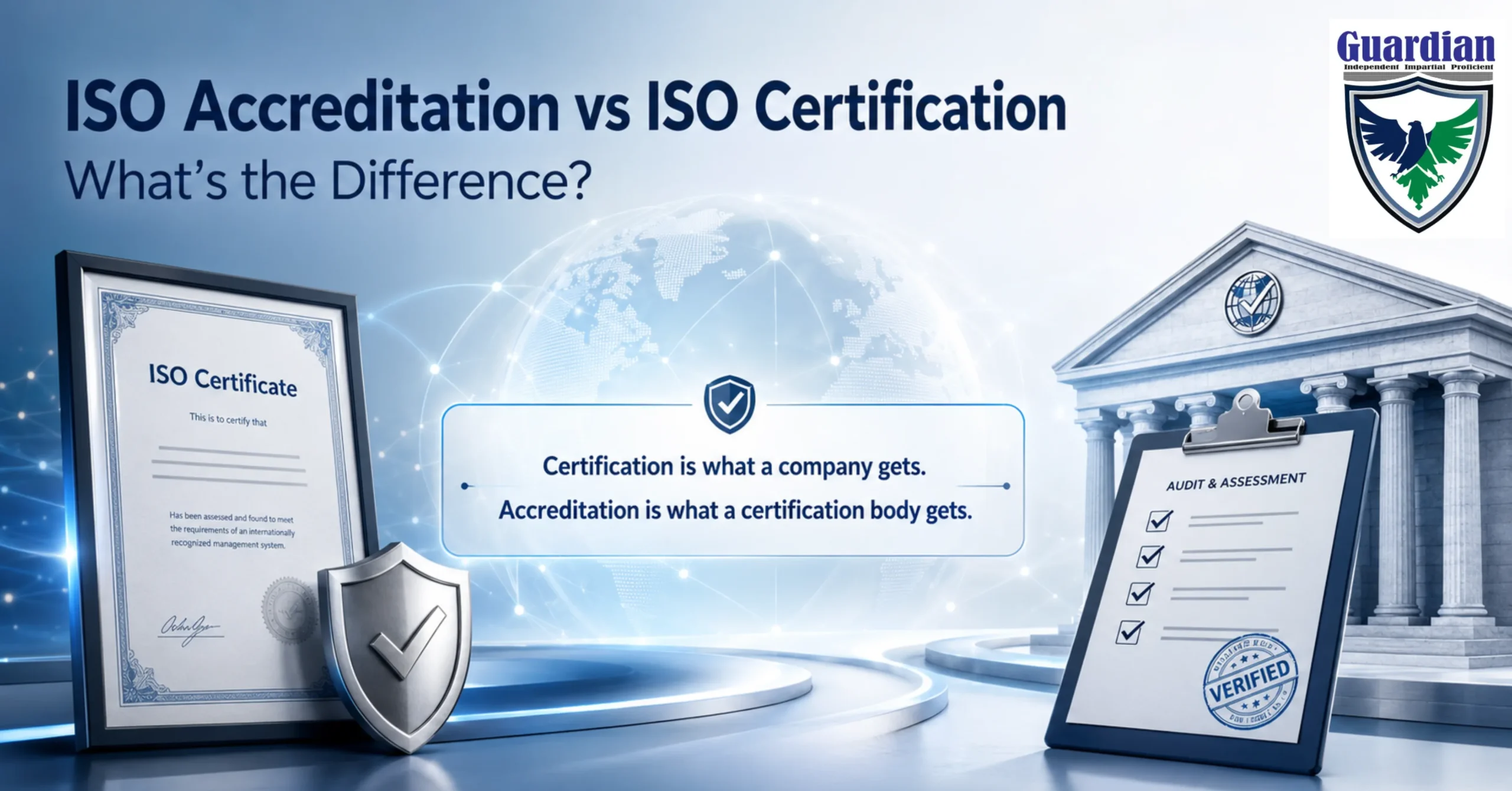
Certification vs Accreditation in Simple Terms
Certification is what a company gets.
Accreditation is what a certification body gets.
That is the core difference. Certification applies to the organization being audited against an ISO standard. Accreditation applies to the certification body, laboratory, or inspection body that is being assessed for competence and impartiality.
What is ISO Certification?
When a company wants to show that its processes meet a certain standard — say ISO 9001 for quality management — it applies to a certification body. The certification body sends trained auditors to assess the company’s systems. If the company meets the requirements of the standard, the certification body issues a certificate.
That certificate is what we call ISO certification.
The company holds the certificate. The certificate has a validity period — usually three years — and requires annual surveillance audits to remain active.
Common ISO certifications companies hold:
| Standard | What it covers |
|---|---|
| ISO 9001 | Quality Management Systems |
| ISO 14001 | Environmental Management Systems |
| ISO 45001 | Occupational Health & Safety |
| ISO 27001 | Information Security Management |
| ISO 22000 | Food Safety Management |
| ISO 50001 | Energy Management |
| ISO 42001 | AI Management Systems |
Each of these certifications tells a buyer, client, or regulator that the company’s processes have been independently assessed and found to meet an internationally recognized standard.
What is Accreditation?
Now here is the important question: how do you know the certification body that issued your certificate is actually competent and trustworthy?
That is where accreditation comes in.
Accreditation is the process by which a certification body, laboratory, or inspection body is evaluated by an independent national accreditation body. The accreditation body checks whether the certification body follows the right standards, has qualified auditors, uses fair and consistent processes, maintains impartiality, and manages conflicts of interest properly.
If the certification body passes this rigorous evaluation, it gets accredited — meaning it is officially recognized as competent to issue certifications.
Accreditation is essentially oversight of the overseers. It is what stops any company from calling itself a certification body and issuing ISO certificates without any checks.
Examples of accreditation bodies:
| Accreditation Body | Country |
|---|---|
| NABCB (National Accreditation Board for Certification Bodies) | India |
| UKAS (United Kingdom Accreditation Service) | UK |
| DAkkS (Deutsche Akkreditierungsstelle) | Germany |
| ANAB (ANSI National Accreditation Board) | USA |
| JAS-ANZ | Australia / New Zealand |
| CNAS (China National Accreditation Service) | China |
| JAB (Japan Accreditation Board) | Japan |
These bodies do not issue ISO certificates to companies. They evaluate and accredit the certification bodies that issue those certificates. It is a different layer of the system entirely.
The Full Chain — How It All Connects
Here is the complete picture from top to bottom:
International recognition chain
Global ACI
↓ manages the international accreditation recognition framework and the Global ACI MRA
National Accreditation Body such as NABCB
↓ evaluates and accredits
Certification Body such as Guardian Assessment Private Limited
↓ audits and certifies
Your Company for ISO 9001, ISO 14001, ISO 45001, and other standards
Each level depends on the one above it. Since January 2026, IAF and ILAC have merged into Global ACI, which now carries the former IAF and ILAC roles under one unified accreditation recognition framework through the Global ACI MRA. Those accreditation bodies evaluate and accredit certification bodies. Certification bodies then audit and certify companies.
This chain is why your ISO certificate is trusted not just in India, but in export markets, international tenders, and regulatory submissions around the world.
Why the Accreditation Recognition Chain Matters
Because this chain is what gives your ISO certificate its international value.
If there were no accreditation system, any company could call itself a certification body and start issuing ISO certificates. There would be no way to distinguish a competent, impartial CB from one that issues certificates without doing real audits.
Accreditation solves this problem. When your certificate comes from an accredited certification body, it means:
- The certification body has been independently evaluated and approved.
- It follows international standards, specifically ISO/IEC 17021-1 for management systems.
- Its auditors are qualified, trained, and regularly assessed.
- Its processes are consistent, fair, and documented.
- The certificate it issued is backed by a credible chain of oversight.
This is why buyers, procurement teams, government tender committees, and international partners trust ISO certificates issued by accredited bodies — and why certificates from non-accredited bodies are often rejected.
What is the Standard Behind Certification Bodies?
Certification bodies that issue management system certifications, such as ISO 9001, ISO 14001, and ISO 45001, must comply with ISO/IEC 17021-1 — the standard for bodies providing audit and certification of management systems.
This standard sets out requirements for:
- Competence of auditors.
- Impartiality and conflict of interest management.
- The audit process itself, including Stage 1, Stage 2, surveillance, and recertification.
- Document and record management.
- Complaints and appeals handling.
When a CB is accredited by NABCB, UKAS, or any other Global ACI Full Member accreditation body, it means they have been evaluated against ISO/IEC 17021-1 and found to meet those requirements.
You, as a company, do not need to know the details of ISO/IEC 17021-1. But knowing it exists tells you that the certification process is not arbitrary — it follows a published, auditable standard.
What About Labs and Inspection Bodies?
Accreditation is not only for certification bodies. The same logic applies to:
- Testing and Calibration Laboratories: These are accredited against ISO/IEC 17025. An accredited lab’s test reports are recognized internationally. A non-accredited lab’s results may not be accepted by regulators or buyers in other countries.
- Medical Laboratories: Accredited against ISO 15189. Medical lab results from accredited facilities are more widely accepted in cross-border healthcare and insurance contexts.
- Inspection Bodies: Accredited against ISO/IEC 17020. An accredited inspection body’s reports carry greater credibility in trade, customs, and regulatory contexts.
Under the old system, laboratories and inspection bodies were covered by ILAC, the International Laboratory Accreditation Cooperation. Management system certification bodies were covered by IAF. Since January 2026, both are covered by Global ACI under one unified MRA.
How to Tell if Your Certification Body is Accredited
Look at your ISO certificate. It should carry:
- The accreditation body’s mark — the logo of the national accreditation body, such as the NABCB mark for India.
- The MRA mark — previously the IAF MLA mark, now transitioning to the Global ACI MRA mark by 2029.
If your certificate carries both marks, you are in good shape. The certification body is accredited, and its accreditation body is internationally recognized.
If your certificate does not carry an accreditation mark, that is worth investigating. Ask your certification body directly: “Which accreditation body accredits you?”
What Happens If a Certification Body Loses Accreditation?
This is rare, but it happens. A certification body can lose accreditation if:
- It fails a peer evaluation or surveillance by the accreditation body.
- It is found to have issued certificates without proper audits.
- It fails to maintain the requirements of ISO/IEC 17021-1.
When a CB loses accreditation, the certificates it has previously issued may lose their international recognition. The Global ACI framework requires countries and buyers to recognize only certificates from currently accredited bodies.
This is one more reason to choose a CB with a solid accreditation history — not just one that offers the cheapest price.
Common Confusion: “I Got Accredited”
Sometimes business owners say they “got accredited” when they mean they received an ISO certificate. This is understandable — both words sound formal and authoritative — but technically:
- Companies get certified.
- Certification bodies get accredited.
The only time a company might use the word “accredited” is in a non-ISO context — for example, a hospital getting accredited by a healthcare body, or a training institution getting accredited by an education authority. In those contexts, the word is used differently.
In the ISO world, if you hold an ISO 9001, ISO 14001, ISO 45001, or similar management system certificate, you are certified, not accredited.
Correct wording
Saying “we are accredited to ISO 9001” is technically incorrect. The right phrasing is: “We are certified to ISO 9001 by an accredited certification body.”
This distinction matters in tender submissions, regulatory filings, and contracts — especially where the procurer specifically asks for accredited certification.
Accreditation vs Certification at a Glance
| Accreditation | Certification | |
|---|---|---|
| Who gets it | Certification bodies, labs, inspection bodies | Companies and organizations |
| Issued by | National accreditation bodies such as NABCB, UKAS, and others | Accredited certification bodies such as Guardian Assessment Private Limited |
| What it confirms | The body is competent to assess and certify | The company meets a specific ISO standard |
| International recognition | Through Global ACI MRA signed by the accreditation body | Through the accredited CB’s certificate |
| Governing standard | ISO/IEC 17021-1, ISO/IEC 17025, ISO/IEC 17020, and related standards | ISO 9001, ISO 14001, ISO 45001, and related standards |
| Validity period | Ongoing — reviewed through peer evaluations | 3 years with annual surveillance audits |
| Example | NABCB accredits Guardian Assessment Private Limited | Guardian Assessment Private Limited certifies your company |
Why Unaccredited Certification is a Risk
Some companies choose to get certified by non-accredited certification bodies, usually because the cost is lower. This is technically possible — no law prevents a non-accredited body from calling itself a certification body.
But the risks are real:
- The certificate will not be recognized in international markets.
- It may not be accepted in government tenders that require accredited certification.
- Buyers and importers in the EU, US, and other markets specifically look for the IAF MLA or Global ACI MRA mark.
- If the body itself is not credible, the audit process may not be rigorous — meaning you are not really being evaluated against the standard.
For a company that wants its ISO certification to actually mean something — not just as a piece of paper, but as a recognized signal of quality — accredited certification is not optional.
About Guardian as an Accredited Certification Body
Guardian Assessment Private Limited is an accredited certification body. We have been evaluated by a recognized national accreditation body and found to be competent to issue ISO management system certificates.
When you get certified by Guardian, your certificate comes with the full backing of this chain — from Global ACI at the international level, through our accreditation body, to the certificate in your hands.
We do not just issue certificates. We conduct genuine, rigorous audits based on ISO/IEC 17021-1. Our auditors are qualified and our processes are consistent. That is what makes our certificates credible — not just the logo on them.
If you would like to know more about our accreditation, our audit process, or what getting certified with us looks like, our team is happy to walk you through it.
Frequently Asked Questions
Ans) Technically yes — there is no law that prevents it. But an unaccredited certification body's certificates are not internationally recognized and are often rejected by buyers, regulators, and tender committees.
Ans) ISO (International Organization for Standardization) publishes the standards — like ISO 9001, ISO 14001, and so on. ISO does not issue certificates or accredit bodies. NABCB is India's national accreditation body — it accredits certification bodies to ensure they are competent to issue ISO certificates. They operate at different levels of the system.
Ans) Yes. NABCB was a signatory of the IAF MLA, which means its accreditations were recognized internationally. It is now in the process of aligning with the Global ACI MRA. Once confirmed, NABCB-accredited certification bodies will issue certificates recognized under the Global ACI framework.
Ans) No — fees vary. However, price should not be the only factor. The quality of the audit, the credibility of the CB's accreditation, and the recognition of their certificates all matter significantly.
Ans) Accreditation bodies typically evaluate CBs through initial accreditation, followed by annual surveillance visits and a full re-accreditation evaluation every four to five years — similar to how ISO certification works for companies.
Ans) Ask for a copy of their ISO certificate and check the accreditation mark on it. You can then verify the accreditation body's status at global-aci.org. If the accreditation body is a Global ACI Full Member, the certificate is internationally recognized.
Contact
Guardian Assessment Private Limited | Andheri West, Mumbai | +91 92199 75790 | guardianassessment@gmail.com | www.guardiancertification.com
Request ISO Certification Guidance
Need help understanding whether your ISO certificate is backed by proper accreditation? Submit your details below and Guardian Assessment can guide you through certification, accreditation, recognition, and verification requirements.