
The chemical industry functions within highly complex manufacturing processes, dangerous materials, stringent quality requirements, environmental obligations, and extensive supply chain networks. Chemical manufacturers, distributors, importers, exporters, storage facilities, and other businesses have to maintain consistency in processes while managing risks that may pose threats to people, consumers, the environment, business operations, etc.
Guardian Assessment Private Limited provides you with dependable certification services for your chemical business organization. Our auditors evaluate your management system according to international standards for certification.
The ISO certification for Chemical Industry ensures that you have a system of management in place that enables the organization to manage its processes, associated risks, perform better, and prove its commitments to quality, environmental obligations, and occupational safety and health. Depending upon various factors, including the organization’s operations, products, and risks, among others, there is the most suitable ISO certification for any business.
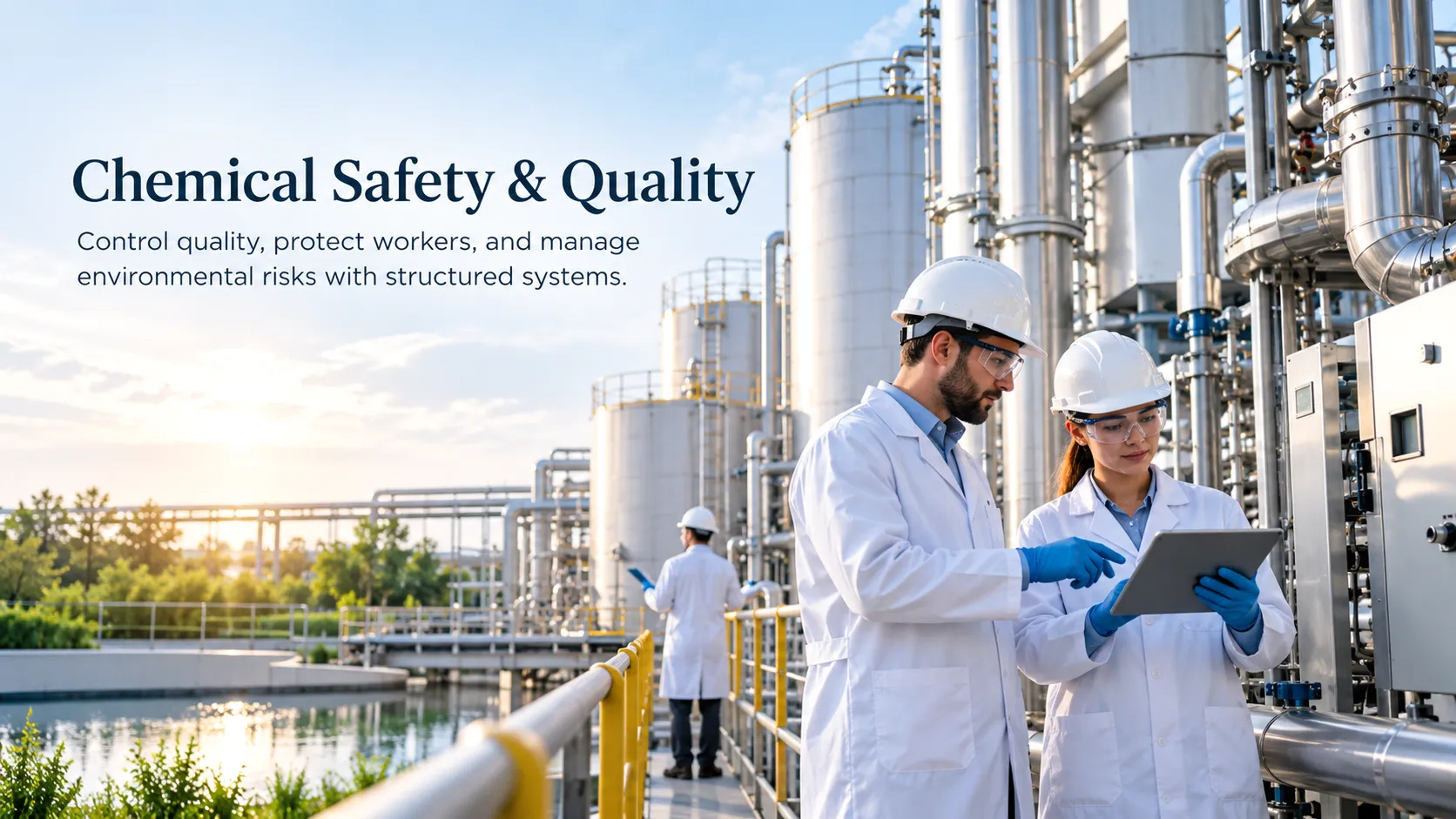
Why Is ISO Certification Important for the Chemical Industry?
Chemical organizations need reliable management systems to maintain product quality and protect workers and the environment. Even a small process failure can disrupt production or delay supplies. ISO standards help organizations establish consistent controls across activities such as production and storage while supporting safe handling and quality checks.
1. Maintaining Consistent Chemical Product Quality: Chemical products often need to meet defined specifications for purity, composition, performance, concentration, physical properties, packaging, and other customer or regulatory requirements. Variations in raw materials, production conditions, testing methods, or handling processes can affect the final product and lead to complaints, rejected batches, returns, or additional costs.
ISO 9001 helps organizations establish a systematic approach to controlling processes, monitoring performance, managing nonconformities, evaluating suppliers, and continually improving the quality management system. This can help chemical businesses maintain greater consistency across their operations and provide customers with confidence in their ability to meet defined requirements.
2. Managing Occupational Health, Chemical Handling, and Operational Safety Risks: Chemical operations can involve hazardous substances, high temperatures and pressures, flammable or reactive materials, toxic exposures, specialized equipment, and other workplace hazards. Effective risk identification and operational controls are therefore important for protecting employees and maintaining safe operations.
ISO 45001 provides a framework for identifying occupational health and safety hazards, assessing risks, establishing controls, preparing for emergencies, investigating incidents, and improving safety performance. For chemical organizations, this approach can support stronger control over workplace risks when it is applied to the organization’s actual operations and hazards.
3- Controlling Environmental Impact and Chemical Waste: Chemical manufacturing and related activities can involve emissions, wastewater, hazardous and non-hazardous waste, energy consumption, resource use, spills, and other environmental aspects. Customers, regulators, investors, and supply-chain partners are also placing greater emphasis on measurable environmental performance.
ISO 14001 provides a structured framework for identifying environmental aspects, managing relevant environmental risks, establishing objectives, controlling operations, monitoring performance, and continually improving environmental management. This can help chemical organizations manage their environmental responsibilities more systematically while identifying opportunities to improve resource efficiency and reduce environmental impacts.
4- Managing Supplier and Supply-Chain Risks: Chemical organizations often depend on suppliers for raw materials, packaging, equipment, laboratory services, transportation, storage, and other critical activities. Problems within these external processes can affect product quality, delivery schedules, safety, and regulatory responsibilities. A structured management system helps organizations establish appropriate supplier evaluation, purchasing controls, specifications, incoming inspection, monitoring, and performance review processes. These controls can become particularly important when an organization operates across multiple suppliers, locations, countries, or distribution channels.
ISO Standards for the Chemical Industry
Choosing the applicable standard is an important part of planning ISO certification for chemical industry organizations because different management systems address different operational risks, business objectives, and stakeholder expectations. The appropriate certification depends on the organization’s activities, products, risks, customer requirements, and intended certification scope. Below are some of the most relevant ISO standards for the chemical industry.
ISO 9001 – Quality Management System
ISO 9001 certification provides a framework for managing processes that affect product and service quality, customer requirements, supplier controls, operational consistency, performance evaluation, nonconformity management, and continual improvement.
For chemical organizations, ISO 9001 certification can support consistent production and service processes, stronger supplier management, controlled documentation, customer requirement management, and systematic handling of quality issues.
ISO 14001 – Environmental Management System
ISO 14001 certification is particularly relevant to chemical organizations because environmental performance can be closely connected to manufacturing processes, waste generation, emissions, resource consumption, chemical handling, and emergency situations.
The standard provides a systematic approach to identifying environmental aspects, managing environmental risks, establishing objectives, controlling relevant operations, monitoring performance, and improving environmental outcomes.
ISO 45001 – Occupational Health and Safety Management System
ISO 45001 certification helps organizations establish a structured approach to managing occupational health and safety risks. It covers areas such as hazard identification, risk assessment, operational controls, worker participation, emergency preparedness, incident investigation, and continual improvement.
For chemical businesses, ISO 45001 certification can be particularly relevant where employees work with hazardous substances, production equipment, storage facilities, laboratories, transport operations, or other higher-risk activities.
ISO/IEC 27001 – Information Security Management System
Chemical businesses increasingly manage sensitive information such as product formulations, research and development data, customer specifications, supplier information, laboratory results, production information, and commercially sensitive business records.
ISO/IEC 27001 certification can help organizations establish a structured approach to identifying information-security risks and protecting information through appropriate controls, responsibilities, monitoring, and continual improvement. It can be especially relevant to chemical organizations with significant research, digital operations, or interconnected supply chains.
Changing Chemical Industry Requirements and Global Expectations
Chemical organizations are operating in an environment where expectations are extending beyond product quality and production efficiency. Regulatory developments, environmental concerns, hazardous-substance controls, customer requirements, and supply-chain transparency are increasingly influencing how chemical businesses manage their operations.
1- Chemical Safety and Lifecycle Management: Chemical safety increasingly requires organizations to consider risks across the lifecycle of a chemical, from raw-material sourcing and manufacturing to storage, transportation, use, and disposal. Depending on the substance and jurisdiction, organizations may need to manage classification, labelling, safety information, worker protection, emergency response, and other applicable requirements.
A management system can help chemical organizations establish responsibilities, documented processes, training requirements, operational controls, and monitoring mechanisms that support more consistent chemical-risk management.
2- Hazardous Substances and Regulatory Changes: Chemical regulations vary significantly between countries and can change as governments introduce new restrictions, reporting requirements, product controls, or safety measures. Organizations operating internationally therefore need processes for monitoring regulatory developments and determining which requirements apply to their products and activities.
For example, chemical businesses supplying the European market may need to address frameworks such as REACH and CLP, while organizations operating in the United States may encounter requirements under frameworks such as TSCA and process-safety regulations. India also applies chemical-specific controls, including Quality Control Orders for certain chemicals, while other countries maintain their own requirements for chemical safety, storage, transportation, and environmental protection. These requirements are separate from ISO certification, but a structured management system can help organizations maintain responsibilities, records, controls, supplier information, and processes for monitoring applicable requirements.
3- PFAS and Substances of Concern: The growing regulatory focus on PFAS and other substances of concern is increasing the importance of knowing what substances are present in products, raw materials, formulations, and supply chains. Chemical organizations may need to work with suppliers to obtain reliable information and monitor changing restrictions in the markets they serve.
Effective supplier controls, product information management, documented processes, and regulatory monitoring can therefore become increasingly important for organizations that manufacture, distribute, import, or export chemicals.
4- Environmental and Carbon Expectations: Chemical organizations are also facing increasing expectations around emissions, energy consumption, resource efficiency, waste reduction, pollution prevention, and environmental performance. These expectations can come from regulators, customers, investors, supply-chain partners, and local communities.
ISO 14001 can provide a structured framework for environmental management, while ISO 50001 can support organizations that need a more focused approach to energy performance. The appropriate approach depends on the organization’s environmental aspects, energy use, objectives, and business requirements.
5- Supply-Chain Traceability and Product Information: Chemical customers increasingly need reliable information about products, specifications, safety characteristics, supplier controls, and other relevant information. Maintaining accurate records and traceability can become more complex when products move through multiple suppliers, manufacturers, warehouses, distributors, and countries.
A structured management system can help organizations establish clearer responsibilities for documentation, supplier information, product identification, process controls, and record management throughout the defined scope of operations.
ISO Certification for Chemical Industry Regulations
Chemical businesses may be subject to national and international requirements covering hazardous substances, environmental protection, occupational health and safety, transportation, product information, emergency preparedness, waste management, and other activities. The specific requirements depend on the organization’s products, processes, locations, and markets.
For example, chemical businesses operating in or supplying different markets may encounter requirements under frameworks such as the European Union’s REACH and CLP systems, U.S. chemical and process-safety regulations, India’s hazardous-chemical and product-specific requirements, and other national chemical-safety frameworks.
ISO certification does not replace chemical manufacturing licences, environmental approvals, hazardous-substance permits, product registrations, transportation requirements, customs requirements, or other legal obligations. Instead, an appropriate ISO management system can provide a structured framework for identifying applicable requirements, assigning responsibilities, controlling processes, maintaining documented information, monitoring performance, and supporting continual improvement. Organizations should therefore evaluate their legal and regulatory obligations separately from their decision to implement or obtain ISO certification.
1. ISO Certification for International Buyer Requirements: Chemical products are often supplied across borders, making customer confidence and supplier qualification important parts of international business. Buyers may evaluate suppliers based on product consistency, technical specifications, quality controls, environmental performance, occupational safety, supply-chain controls, traceability, and the ability to maintain reliable processes. ISO certification can provide independent evidence that a management system has been assessed against the requirements of a recognized international standard.
Depending on the buyer and sector, certification may support supplier qualification or form part of a customer’s procurement requirements. However, ISO certification does not automatically satisfy every buyer requirement. Chemical companies may still need to provide product-specific documentation, testing evidence, regulatory information, licences, approvals, or other qualifications requested by the customer.
2. ISO Certification for Government Tenders: Government procurement requirements vary by country, authority, product, and tender. Chemical-sector tenders may specify ISO certification alongside product standards, testing requirements, manufacturing licences, environmental approvals, safety documentation, and other technical or commercial qualifications.
Where a tender specifically requests or recognizes an applicable ISO certification, certification can support supplier qualification or technical evaluation. However, ISO certification does not guarantee tender eligibility or contract award, and organizations must meet all applicable tender-specific and legal requirements.
Benefit of ISO Certification in the Chemical Industry?
ISO certification can be relevant to a wide range of organizations involved in chemical production, handling, distribution, and related activities.
- Chemical Manufacturers: Chemical manufacturers can use ISO management systems to strengthen quality, environmental, safety, supplier, and operational controls across their production activities.
- Specialty Chemical Manufacturers: Organizations producing specialty chemicals often need consistent formulations, controlled processes, reliable testing, and strong customer and supplier requirement management.
- Petrochemical and Downstream Chemical Companies: Petrochemical and downstream operations can benefit from structured systems for quality, environmental performance, occupational health and safety, energy management, and operational risk control.
- Industrial and Manufacturing Chemical Suppliers: Organizations supplying chemicals to manufacturing, engineering, construction, pharmaceutical, and other industrial sectors can use ISO certification to strengthen management processes and demonstrate their ability to maintain consistent operations.
- Chemical Importers and Exporters: Importers and exporters can benefit from systematic controls over suppliers, product information, documentation, storage, distribution, customer requirements, and applicable market requirements.
- Chemical Distributors and Trading Companies: Distributors and trading organizations can use appropriate management systems to strengthen supplier controls, product traceability, customer requirements, documentation, and operational consistency.
- Chemical Storage and Warehousing Organizations: Organizations involved in chemical storage can benefit from structured controls for handling, storage operations, emergency preparedness, worker safety, environmental risks, and relevant documentation.
- Industrial Gas Companies: Industrial gas organizations can use appropriate ISO management systems to address quality, occupational safety, environmental performance, energy management, and supply-chain controls relevant to their operations.
- Chemical Testing and Laboratory Organizations: Laboratories may use management-system standards such as ISO 9001, ISO 14001, ISO 45001, or ISO/IEC 27001 where relevant to their operations. Where technical competence for testing or calibration needs to be demonstrated, ISO/IEC 17025 accreditation is a separate consideration from management-system certification.
Cost and Process of ISO Certification in the Chemical Industry
Implementing structured management systems can help chemical businesses improve process control, manage operational risks, maintain consistent quality, and address environmental and workplace safety responsibilities. Understanding the potential certification costs and audit process is an important first step before starting certification.
The cost of ISO certification for chemical industry businesses can vary depending on factors such as the number of employees, operational locations, activities, certification scope, selected ISO standard, and applicable audit requirements. Read our complete guide on How Much Does ISO Certification Cost? Want to understand the steps involved in certification? Read our detailed ISO Certification Process guide to learn how the audit process works and what your business may need to prepare.
Why Choose Guardian Assessment for Chemical Industry Certification?
Chemical businesses need reliable management systems to maintain product quality, control operational risks, manage environmental impacts, and support workplace safety. Businesses looking for ISO certification for the chemical industry can evaluate Guardian Assessment Private Limited based on its applicable accreditation scope, audit approach, and understanding of industrial operations.
- Understanding of Chemical Industry Operations: Our auditors consider relevant activities such as chemical handling, production processes, storage, quality control, supplier management, and environmental responsibilities.
- Impartial & Objective Audits: Guardian Assessment Private Limited conducts independent third-party certification audits against the requirements of the applicable ISO management-system standard.
- Global Recognition: Guardian Assessment’s certifications are issued within its applicable accredited scope under the United Accreditation Foundation (UAF) and IAS. Recognition and acceptance depend on the applicable accreditation scope, certification standard, and requirements of the customer or target market.
- IAF CertSearch: Verify the validity of eligible accredited ISO management system certificates through the IAF CertSearch database
Build Confidence in Your Chemical Operations
Whether you manufacture chemicals, supply industrial materials, distribute chemical products, manage storage facilities, or operate across international chemical supply chains, an appropriate ISO management system can help strengthen process control, manage relevant risks, improve performance, and demonstrate confidence to customers and other stakeholders.
Guardian Assessment Private Limited can support organizations seeking ISO certification within its applicable certification scope. Contact us to discuss your organization’s activities, requirements, and certification needs.
Request an ISO Certification Quote
Frequently Asked Questions
There is no single ISO certification that is suitable for every chemical organization. ISO 9001 is commonly relevant to quality management, while ISO 14001 focuses on environmental management and ISO 45001 addresses occupational health and safety. Depending on the organization's activities and objectives, ISO 50001, ISO 28000, or ISO/IEC 27001 may also be relevant.
The appropriate standard should be selected based on the organization's products, processes, risks, customer requirements, and intended certification scope.
ISO 9001 helps chemical manufacturers establish a structured quality management system covering customer requirements, process controls, supplier management, nonconformity management, performance evaluation, and continual improvement.
It can help organizations improve consistency and demonstrate that their quality-management processes are systematically controlled.
ISO 14001 provides a structured framework for managing environmental aspects and improving environmental performance. It can help chemical organizations address areas such as waste, resource consumption, emissions, environmental risks, operational controls, and continual improvement.
Yes. ISO 45001 provides a framework for identifying occupational health and safety hazards, assessing risks, establishing controls, preparing for emergencies, investigating incidents, and continually improving safety performance.
Its application should reflect the organization's actual chemical processes, workplace hazards, employees, contractors, and operational activities.
No. ISO certification does not by itself demonstrate compliance with every chemical, environmental, safety, transportation, product, or other legal requirement applicable to an organization.
An ISO management system can help an organization establish processes for identifying applicable requirements, assigning responsibilities, maintaining records, monitoring performance, and improving controls, but the organization remains responsible for meeting its legal and regulatory obligations.
ISO certification can support supplier qualification or technical evaluation where a government tender specifically requests or recognizes the applicable ISO certification. However, tender requirements vary, and ISO certification does not guarantee eligibility or contract award.
Organizations must meet all applicable technical, legal, commercial, licensing, product, and tender-specific requirements.
The cost of ISO certification depends on factors such as the selected standard, organization size, number of employees, number of locations, certification scope, operational complexity, existing management-system maturity, and audit requirements.
A certification body can provide a more accurate quotation after reviewing the organization's activities and intended certification scope.