

Updated: 20 August 2026
ISO 9001 certification is an independent third-party assessment of an organization’s Quality Management System (QMS) against the applicable requirements of ISO 9001. It helps organizations establish consistent processes, meet applicable customer and statutory or regulatory requirements, monitor performance, address risks and opportunities, correct problems, and continually improve.
The International Organization for Standardization (ISO) develops and publishes ISO 9001, but ISO itself does not audit organizations or issue ISO 9001 certificates. Certification is performed by independent certification bodies. ISO 9001 can be used by organizations of any size and in almost any sector.
As of 20 August 2026, ISO 9001:2015 remains the current published edition. A revised edition is in the final publication stage and is expected in September 2026. Organizations certified to ISO 9001:2015 will receive a transition period after the revised standard is published.
Quick links:
Requirements ·
Certification Process ·
Cost ·
Validity ·
Verification ·
FAQs
Request Quotation
ISO 9001 Certification at a Glance
| Question | Quick Answer |
|---|---|
| What is ISO 9001? | An international standard that specifies requirements for a Quality Management System (QMS). |
| Who can use it? | Organizations of any size and in almost any industry. |
| Who gets certified? | Organizations and their defined management-system scope, not individual people. |
| Current edition | ISO 9001:2015, including Amendment 1:2024 on climate action changes. |
| Who issues the certificate? | An independent certification body, not ISO itself. |
| Initial certification audit | Normally Stage 1 followed by Stage 2. |
| Certification cycle | Typically three years, subject to surveillance and continued conformity. |
| Surveillance audits | Normally conducted annually during the certification cycle. |
| What affects cost? | Size, employee numbers, locations, scope, complexity, shifts, risk, audit duration and travel. |
| Can a certificate be verified? | Yes. Check the issuing certification body, applicable accreditation body and relevant certification databases. |
What Is ISO 9001 Certification?
ISO 9001 is the internationally recognized management-system standard for quality management. It specifies requirements for establishing, implementing, maintaining and continually improving a Quality Management System.
A QMS is not simply a collection of documents. It is the structured way an organization controls how work is planned, performed, checked and improved. It connects customer requirements, processes, responsibilities, resources, objectives, performance measurement, corrective action and continual improvement.
ISO 9001 certification provides independent confirmation that the organization’s QMS, within its defined certification scope, has been assessed against the applicable requirements of ISO 9001. Certification relates to the management system and scope shown on the certificate; it should not be presented as certification of every individual product or service.
What does an ISO 9001 certificate normally show?
- Certified organization and relevant location(s)
- Applicable ISO standard and edition
- Defined certification scope
- Certificate number
- Issue and expiry information
- Certification body
- Applicable accreditation information
For official background on ISO 9001, see the ISO 9001 standard page.
ISO 9001 Status in 2026
ISO 9001:2015 remains the current published edition as of 20 August 2026. The current edition also has ISO 9001:2015/Amd 1:2024, which added climate-change considerations to management-system context and interested-party requirements.
The revised edition of ISO 9001 is in the final publication stage and is expected in September 2026. Until the revised International Standard is formally published, organizations should not describe an unpublished draft as the active certification standard.
Organizations already certified to ISO 9001:2015 are expected to receive a transition period after publication of the revised edition. If you are considering certification now, there is normally no reason to stop preparing your QMS while waiting for the new edition; confirm the applicable audit and transition arrangements with your certification body.
For Guardian’s transition updates, see the ISO 9001 revision and transition guide.
Why ISO 9001 Certification Matters
Organizations pursue ISO 9001 certification for operational, customer and commercial reasons. A well-implemented QMS can improve consistency, clarify responsibilities, strengthen corrective action, improve supplier control and provide management with better evidence for decisions.
Potential Benefits of ISO 9001 Certification
- More consistent products and services: Defined processes reduce avoidable variation and help teams work in a controlled way.
- Greater customer confidence: Independent certification can demonstrate that the QMS has been assessed against recognized requirements.
- Improved process efficiency: Organizations can identify waste, duplication, bottlenecks and recurring failures.
- Better risk and opportunity management: Risk-based thinking encourages proactive planning instead of only reacting after problems occur.
- Clearer responsibilities: Process ownership, competence and accountability are easier to define and monitor.
- Stronger corrective action: Nonconformities are analyzed and addressed to reduce recurrence.
- Support for tenders and supply chains: Some customers, procurement teams and contracts request independent ISO 9001 certification.
- Continual improvement: Internal audits, management reviews, objectives and performance monitoring create a structured improvement cycle.
The greatest value comes from using the QMS as part of normal business operations rather than treating certification as a paperwork exercise.
Who Can Get ISO 9001 Certification?
ISO 9001 can be applied by organizations of virtually any size or sector, including manufacturing, construction, engineering, technology, healthcare, education, logistics, professional services, trading, government and non-profit organizations.
The complexity of the QMS should reflect the organization’s actual processes, risks, competence needs and operating environment. A small service organization does not need to copy the documentation system of a complex multi-site manufacturer.
Can an Individual Get ISO 9001 Certified?
No. ISO 9001 certification applies to an organization’s Quality Management System. Individuals may complete ISO 9001 awareness, internal-auditor or lead-auditor training, but those are personal training or competence credentials and are different from certification of an organization’s QMS.
The 7 Quality Management Principles
- Customer focus: Understand applicable customer needs and work consistently to meet them.
- Leadership: Establish direction and ensure quality is integrated into business activities.
- Engagement of people: Competent and engaged people contribute to effective processes.
- Process approach: Manage activities as connected processes that work together as a system.
- Improvement: Continually strengthen performance, controls and outcomes.
- Evidence-based decision making: Use reliable data and information when making important decisions.
- Relationship management: Manage relationships with suppliers and other relevant interested parties.
Sample Certificate
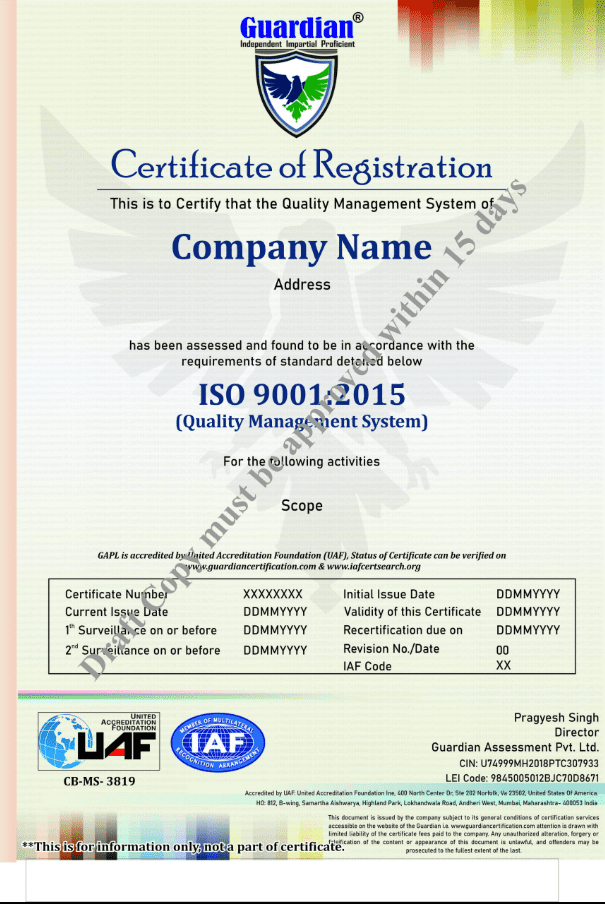
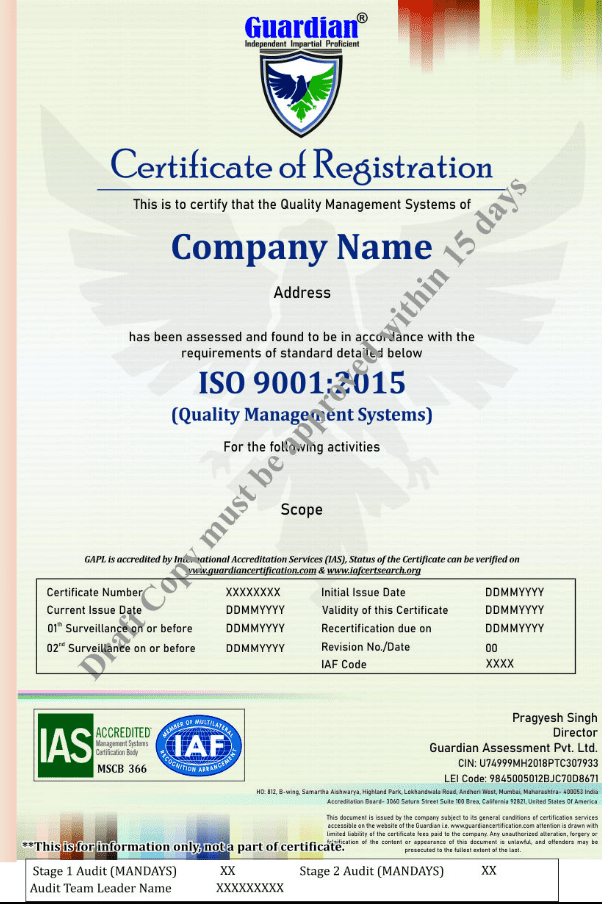
Request Quotation
Other Standards
Recognition
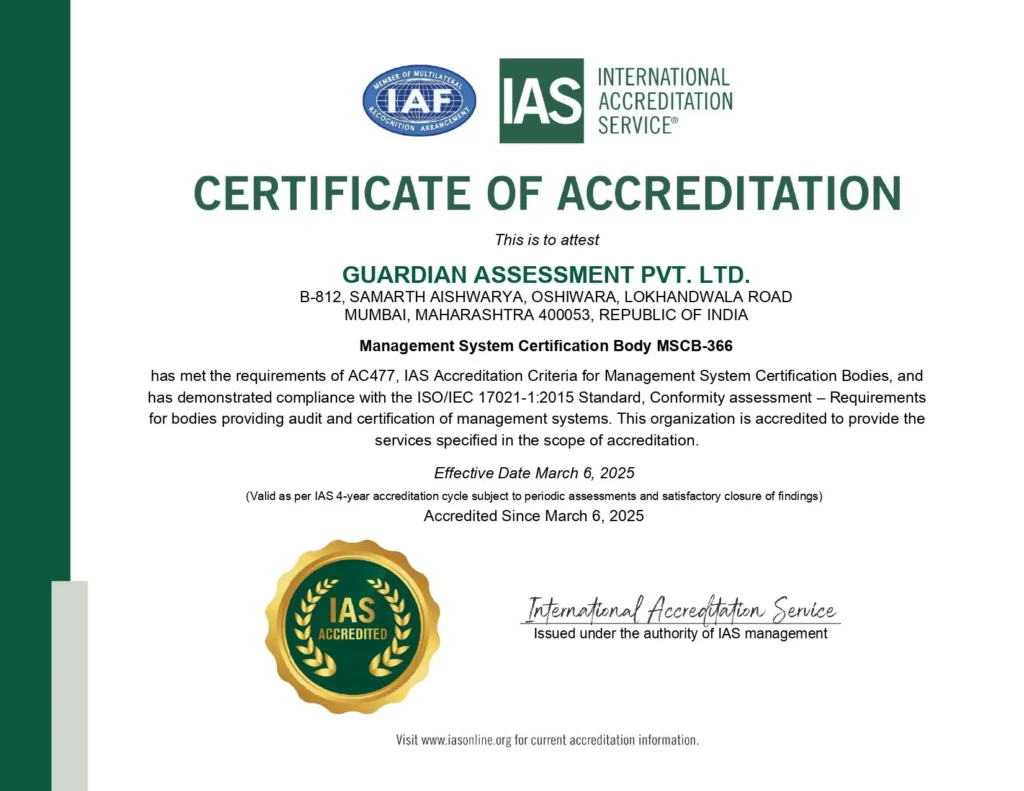
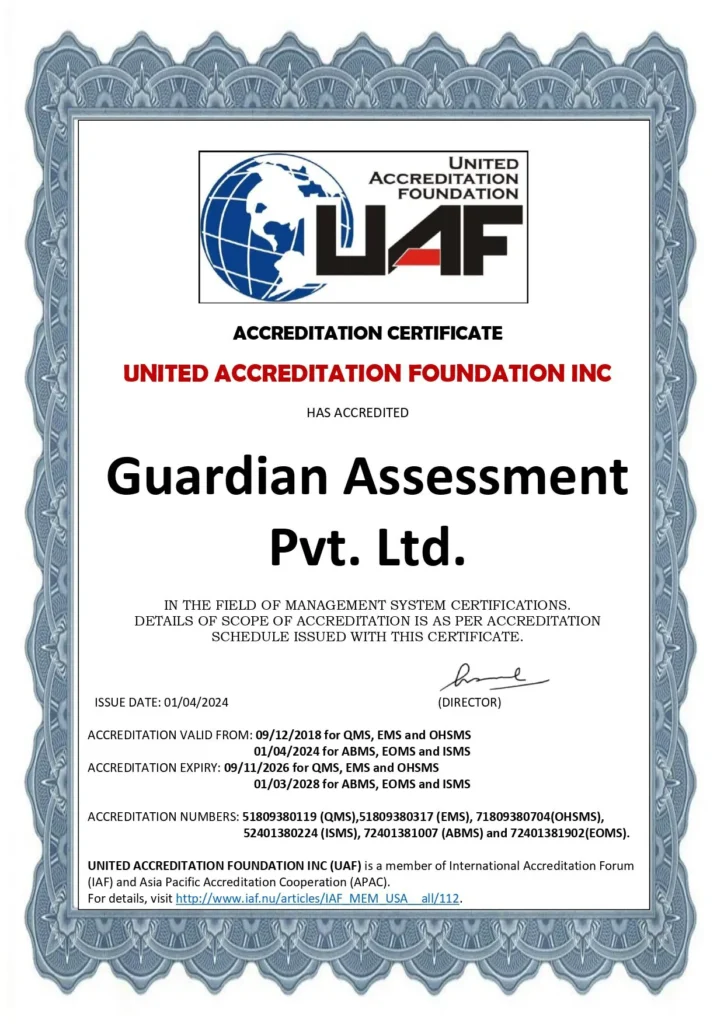
Sample Certificate
ISO 9001 Requirements: Clauses 4–10
ISO 9001 follows a structured management-system framework. Clauses 1–3 provide introductory information; the principal management-system requirements are contained in Clauses 4–10.
| Clause | Main Requirement |
|---|---|
| Clause 4 – Context of the Organization | Internal and external issues, interested parties, QMS scope and processes. |
| Clause 5 – Leadership | Leadership commitment, customer focus, quality policy, roles and responsibilities. |
| Clause 6 – Planning | Risks and opportunities, quality objectives and planning of changes. |
| Clause 7 – Support | Resources, competence, awareness, communication and documented information. |
| Clause 8 – Operation | Operational planning, customer requirements, design where applicable, external providers, production/service delivery and nonconforming outputs. |
| Clause 9 – Performance Evaluation | Monitoring, measurement, analysis, customer satisfaction, internal audit and management review. |
| Clause 10 – Improvement | Nonconformity, corrective action and continual improvement. |
Organizations should use an authorized copy of ISO 9001 when determining their detailed applicable requirements. This page is an explanatory guide and does not reproduce or replace the standard.
PDCA Cycle, Process Approach and Risk-Based Thinking
How the PDCA Cycle Works
ISO 9001 follows the logic of the Plan-Do-Check-Act (PDCA) cycle:
- Plan: Understand context and interested parties, identify risks and opportunities, establish objectives and determine the processes and resources needed.
- Do: Implement and control the processes used to deliver products and services.
- Check: Monitor and measure performance, review customer satisfaction, conduct internal audits and perform management review.
- Act: Address nonconformities, implement corrective actions and continually improve the QMS.
The process approach and PDCA help organizations manage the QMS as an interconnected system rather than as separate departments or isolated documents.
What Is Risk-Based Thinking?
Risk-based thinking means considering factors that could affect the QMS’s ability to achieve intended results and planning proportionate actions before problems occur. Risks can relate to suppliers, competence, equipment, regulatory changes, customer requirements, process failures, logistics, data or business continuity. Organizations should also identify opportunities that could improve performance.
ISO 9001:2015 Amendment 1:2024 – Climate Change
ISO published Amendment 1:2024 to ensure that climate change is specifically considered when an organization evaluates its context and relevant interested-party requirements. The organization must determine whether climate change is a relevant issue for its QMS and, where relevant, address it through appropriate management-system processes.
This does not mean every organization needs a separate climate-management programme. The response should be relevant to the organization’s context—for example, supply-chain disruption, extreme weather, material availability, customer requirements or applicable regulatory obligations.
ISO 9001 Certification Process
A typical ISO 9001 certification process follows these stages:
- Application: Provide information about activities, workforce, locations, shifts and proposed certification scope.
- Application review and quotation: The certification body evaluates the request, confirms capability and determines an appropriate audit programme.
- QMS implementation by the organization: Establish and operate the QMS, generate evidence, conduct internal audits and complete management review.
- Stage 1 audit: Evaluate readiness for the Stage 2 certification audit.
- Stage 2 audit: Evaluate actual implementation and effectiveness of the QMS.
- Corrective action: Address applicable nonconformities identified during the certification process.
- Independent certification decision: Audit information is reviewed through the certification body’s decision process.
- Certificate issuance: Following a positive decision, the certificate is issued for the approved organization, locations and scope.
- Surveillance audits: Periodic audits confirm continued conformity during the certification cycle.
- Recertification: A recertification audit is conducted toward the end of the cycle before certification continues into a new cycle.
Guardian publishes its certification procedure separately so applicants can understand the audit and decision process before proceeding.
Stage 1 and Stage 2 ISO 9001 Audits
What Happens During Stage 1?
Stage 1 is primarily a readiness assessment. The auditor reviews information about the organization, certification scope, key processes, applicable requirements, documented information and level of implementation. The auditor also considers whether important activities such as internal audit and management review have been sufficiently completed to proceed to Stage 2.
What Happens During Stage 2?
Stage 2 evaluates the actual implementation and effectiveness of the QMS. Auditors gather evidence through interviews, process observation, records and sampling. The purpose is not simply to confirm that documents exist; the auditor evaluates whether planned arrangements are followed and whether processes can achieve intended results.
What Does an ISO 9001 Auditor Check?
- QMS scope and organizational context
- Relevant interested parties
- Quality policy and objectives
- Process responsibilities and interactions
- Risks and opportunities
- Competence, awareness and training
- Customer and contract requirements
- Supplier and external-provider controls
- Production or service delivery controls
- Monitoring and measuring resources
- Customer feedback and complaints
- Performance indicators
- Internal audit and management review
- Nonconformities, root-cause analysis and corrective action
- Evidence of continual improvement
Documents and ISO 9001 Certification Readiness
What Documents Are Needed?
ISO 9001:2015 does not require unnecessary paperwork or one universal documentation format. The organization needs enough documented information to support effective process operation and retain evidence where required.
Depending on the organization, useful QMS information may include:
- QMS scope, quality policy and quality objectives
- Process maps, procedures or work instructions where needed
- Competence and training evidence
- Monitoring and measurement records
- Supplier evaluation information
- Customer and contract review records
- Design and development records where applicable
- Nonconformity and corrective-action records
- Internal audit results
- Management review outputs
Is a Quality Manual Mandatory?
No. ISO 9001:2015 does not universally require a traditional document specifically titled “Quality Manual.” An organization may still use one if it is useful. What matters is that required documented information exists and the QMS is effectively implemented.
Practical Readiness Checklist
| QMS scope defined | ✓ | Key processes and interactions understood | ✓ |
| Quality policy established | ✓ | Measurable quality objectives established | ✓ |
| Roles and responsibilities defined | ✓ | Risks and opportunities considered | ✓ |
| Competence and awareness managed | ✓ | Operational processes implemented | ✓ |
| Supplier controls operating | ✓ | Monitoring and measurement taking place | ✓ |
| Internal audit completed | ✓ | Management review completed | ✓ |
| Corrective actions controlled | ✓ | Evidence of QMS operation available | ✓ |
This checklist is a readiness aid and does not replace the actual requirements of ISO 9001.
ISO 9001 Certification Cost
There is no single fixed fee for ISO 9001 certification because audit requirements vary between organizations. Accredited certification quotations are normally based on the organization’s actual scope and audit needs.
| Cost Factor | Why It Matters |
|---|---|
| Number of employees | Can influence required audit duration. |
| Number of sites | Multiple locations may require additional audit activity. |
| Certification scope | Broader or more complex activities can require more audit time. |
| Industry/process complexity | Technical complexity affects audit planning and auditor competence needs. |
| Shift patterns | Additional shifts may need to be sampled. |
| Existing certifications | May influence opportunities for integrated audit planning. |
| Auditor travel | Travel and accommodation may affect overall cost. |
| Surveillance and recertification | Ongoing certification-cycle audits should be included in budgeting. |
Organizations should distinguish certification-body audit fees from their own internal costs of establishing and operating the QMS.
For an accurate Guardian quotation, provide your organization name, activities, employee numbers, shifts, locations and proposed certification scope.
Validity, Surveillance, Suspension and Recertification
How Long Does Certification Take?
There is no universal timeline. An organization with an established, effectively operating QMS may be ready much sooner than an organization beginning implementation from the start. Readiness, size, number of locations, complexity, auditor availability and the time required to close nonconformities can all affect the overall timeline.
How Long Is an ISO 9001 Certificate Valid?
ISO 9001 certification normally operates within a three-year certification cycle, subject to successful surveillance and continued conformity. Surveillance audits are generally conducted during the cycle, commonly annually, and recertification is completed before the end of the cycle.
Can Certification Be Suspended or Withdrawn?
Yes. Depending on applicable certification rules, certification may be suspended or withdrawn where an organization seriously or persistently fails to meet certification requirements, does not permit required surveillance, fails to resolve significant nonconformities, or misuses certification claims or marks.
For this reason, customers and procurement teams should verify the current certificate status rather than relying only on a saved image or PDF.
Certificate Verification, Accreditation and Choosing a Certification Body
How to Verify an ISO 9001 Certificate
Before relying on a certificate, check:
- Legal name of the certified organization
- Certified location(s)
- ISO standard and edition
- Certification scope
- Certificate number
- Certification body
- Applicable accreditation information
- Issue, expiry and current status
Accredited certifications can be checked through the issuing certification body, applicable accreditation body and relevant recognized certification databases such as IAF CertSearch, where applicable.
Certification vs Accreditation
Certification is the independent assessment of an organization’s management system against specified requirements such as ISO 9001. Accreditation evaluates the certification body and provides independent confirmation of competence for defined certification activities and scopes.
How to Choose an ISO 9001 Certification Body
- Confirm the certification body’s accreditation status.
- Check whether ISO 9001 is included in the applicable accredited scope.
- Confirm competence for your technical sector.
- Check customer, tender or contractual acceptance requirements.
- Confirm how certificates can be independently verified.
- Review the audit, certification-decision, surveillance and recertification process.
- Confirm impartiality and separation from prohibited consultancy activities.
- Review complaints and appeals procedures.
- Understand the full certification-cycle cost, not only the initial audit fee.
- Avoid selecting a provider solely because it promises an unrealistically fast certificate.
ISO’s official certification guidance is available at ISO – Certification.
ISO 9001 in India and Related Management-System Standards
ISO 9001 Certification in India
Organizations in India can obtain ISO 9001 certification through an independent certification body. Before signing a contract, confirm whether your customer, tender, regulator or international buyer requires a particular accreditation or recognition arrangement. This is especially important for export supply chains and procurement requirements.
ISO 9000 vs ISO 9001
| ISO 9000 | ISO 9001 |
|---|---|
| Quality-management fundamentals and vocabulary. | Requirements for a Quality Management System. |
| Helps explain concepts and terminology. | Can form the basis of QMS certification. |
ISO 9001 vs ISO 14001
| ISO 9001 | ISO 14001 |
|---|---|
| Quality Management System (QMS) | Environmental Management System (EMS) |
| Quality, customer requirements and process effectiveness | Environmental aspects, obligations and performance |
ISO 9001 vs ISO 45001
ISO 9001 focuses on quality management; ISO 45001 focuses on occupational health and safety management. Organizations may integrate the standards where appropriate.
Why Choose Guardian Assessment for ISO 9001 Certification?
Guardian Assessment Private Limited provides independent management-system certification services. For an ISO 9001 application, Guardian reviews the organization’s activities, locations, workforce and proposed certification scope before establishing the audit programme and quotation.
- Independent Certification: Guardian’s role as a certification body is to independently assess conformity and make certification decisions. The client organization remains responsible for designing, implementing and maintaining its own QMS. Keeping certification separate from management-system implementation consultancy protects impartiality and confidence in the certification process.
- Structured Audit and Certification Process: The certification process includes application review, Stage 1, Stage 2, management of audit findings, independent certification decision, surveillance and recertification in accordance with applicable certification procedures.
- Verify Accreditation and Scope: Before purchasing any accredited certification, organizations should verify the current accreditation status and the scope applicable to their requested certification. Guardian publishes recognition information on its website, and relevant accreditation/certification directories should be checked independently.
Verify Guardian recognition information ·
Check IAF CertSearch
- Apply for ISO 9001 Certification: If your organization has implemented a QMS and is preparing for independent certification, submit accurate details including organization name, business activities, employee numbers, shifts, locations and proposed certification scope. Guardian can then determine the applicable certification requirements and provide a quotation.
Use the quotation form below to request an ISO 9001 certification quote.
Frequently Asked Questions About ISO 9001 Certification
ISO 9001 certification is independent third-party confirmation that an organization’s Quality Management System has been assessed against the applicable requirements of ISO 9001.
No. ISO develops and publishes standards. Independent certification bodies conduct certification audits and issue certificates.
ISO 9001 certification is generally voluntary. A customer, contract, procurement requirement, tender or regulator may require certification in a particular situation.
ISO 9001 certification applies to an organization’s QMS. Individuals can complete awareness, internal-auditor or lead-auditor training, which is different from organizational certification.
Yes. ISO 9001 can be applied by organizations of different sizes and sectors. The QMS should be appropriate to the organization’s activities, risks and complexity.
There is no universal fixed fee. Cost depends on employee numbers, locations, certification scope, process complexity, audit duration, travel and other audit-planning factors.
There is no fixed timeline. The organization’s QMS readiness, complexity, locations, audit availability and corrective actions are major factors.
Stage 1 evaluates the organization’s readiness for the Stage 2 certification audit and helps plan the detailed assessment.
Stage 2 evaluates actual implementation and effectiveness through evidence such as interviews, observations, records and process sampling.
The organization must address applicable nonconformities through correction and corrective action in accordance with the certification body’s requirements before certification can be appropriately granted or maintained.
Certification normally operates within a three-year certification cycle, subject to required surveillance and continued conformity.
Yes. Surveillance audits are conducted during the certification cycle, commonly annually, according to the applicable audit programme.
Recertification is the audit and certification-decision process conducted near the end of the current cycle to determine whether certification can continue into a new cycle.
Customer focus, leadership, engagement of people, process approach, improvement, evidence-based decision making and relationship management.
They cover context of the organization, leadership, planning, support, operation, performance evaluation and improvement.
PDCA means Plan-Do-Check-Act: plan processes and objectives, operate them, evaluate results and take improvement action.
Risk-based thinking means identifying and addressing risks and opportunities that can affect the QMS and its intended results.
ISO 9001:2015 does not universally require a traditional document titled “Quality Manual,” although an organization may choose to maintain one.
No. ISO 9001 certification relates to an organization’s Quality Management System and defined certification scope, not individual product certification.
ISO 9000 addresses quality-management fundamentals and vocabulary. ISO 9001 contains QMS requirements that can form the basis of certification.
ISO 9001:2015/Amd 1:2024 adds explicit climate-change consideration to organizational context and relevant interested-party requirements.
Yes. As of 20 August 2026, ISO 9001:2015 remains the current published edition. A revised edition is expected in September 2026.
No. Certified organizations are expected to receive a transition period to migrate to the revised edition.
No. The official ISO logo is a protected trademark. Follow the certification body’s rules for approved certification and accreditation marks.
Check the organization, scope, standard, certificate number, certification body, applicable accreditation and current status through the issuing body and relevant independent certification/accreditation directories.
Quality Assurance (QA) focuses mainly on systems and processes intended to prevent quality problems. Quality Control (QC) focuses more directly on checking outputs through inspection, testing, measurement or verification. ISO 9001 is broader than either QA or QC alone because it covers the complete management system.
Yes. ISO 9001 can be integrated with compatible management-system standards such as ISO 14001, ISO 45001 and ISO/IEC 27001. Common elements such as context, leadership, objectives, competence, documented information, internal audit, management review and corrective action can be aligned within an integrated management system.
No. ISO 9001 certification evaluates the management system within the defined certification scope. It should not be presented as a guarantee that every individual product will always be defect-free.
The official ISO logo is a protected trademark and should not be used by a certified organization as its certification mark. Certified organizations should follow the certification body’s rules for approved certification and accreditation marks.