
ISO 9001:2026 introduces major updates including mandatory climate change consideration, quality culture promotion by leadership, human error prevention controls, and separate risk/opportunity processes—targeted for September 2026 publication.
This comprehensive guide provides the exact timeline, free gap analysis checklist, real-world implementation examples, and preparation tips for SMEs from Guardian Certification (UAF & IAS accredited).
Can You Get ISO 9001:2026 Certification Now?
At this time, organizations cannot get certified to ISO 9001:2026 because the final standard has not yet been officially published. ISO 9001:2015 is still the current valid certification standard.
ISO 9001:2026 is expected to replace ISO 9001:2015 after official publication, expected around September 2026. Once the new standard is released, certification bodies will start preparing their audit process, auditor training, and accreditation updates.
For now, companies should continue with ISO 9001:2015 certification and start preparing their quality management system for the upcoming ISO 9001:2026 requirements.
At-a-Glance: ISO 9001:2026 Key Facts
| Parameter | Value / Status |
| Standard Designation | ISO 9001:2026 (expected designation on publication) |
| Current Status | FDIS stage (Final Draft International Standard registered) |
| Title | Quality management systems – Requirements |
| Edition | Sixth edition |
| Will Replace | ISO 9001:2015 (fifth edition) |
| DIS Voting Period | 27 August 2025 – 19 November 2025 |
| Expected Publication | September 2026 (targeted) |
| Transition Period | Expected 3 years from publication date (IAF to confirm) |
| Current Valid Standard | ISO 9001:2015 remains the only certifiable version until official publication |
| Certification Body | Guardian Assessment Private Limited |
| Accreditation | UAF & IAS |
Request Quotation
What is ISO 9001?
ISO 9001 is the world’s most widely adopted Quality Management System (QMS) standard published by the International Organization for Standardization (ISO). It provides a comprehensive framework that helps organisations of any size, type, and industry to consistently deliver products and services that meet customer requirements, comply with applicable regulations, and achieve continual improvement.
ISO 9001 certification is globally recognised as the benchmark for quality excellence. It demonstrates your commitment to customer satisfaction, process efficiency, and risk-based thinking. Whether you are applying for ISO 9001 2015 certification today or preparing for the ISO 9001 latest version (2026), a robust QMS certification helps reduce operational risks, improve performance, enhance market credibility, and open new business opportunities overseas.
ISO 9001:2015 vs ISO 9001:2026 Certification Validity
ISO 9001:2015 is currently the valid and certifiable version of the ISO 9001 standard. ISO 9001:2026 will become certifiable only after the final standard is officially published and certification bodies are ready to audit against it.
| Point | ISO 9001:2015 | ISO 9001:2026 |
|---|---|---|
| Current status | Valid certification standard | Upcoming revised standard |
| Certification availability | Available now | Not available until official release |
| Validity | Valid until transition deadline | Will replace ISO 9001:2015 |
| Transition requirement | Existing certified companies will need transition | New certificates will follow updated requirements |
| Best action now | Maintain or get ISO 9001:2015 certification | Start preparing early |
Companies should not wait for ISO 9001:2026 if they need certification now. ISO 9001:2015 certification is still valid and will help companies prepare for the upcoming transition.
Sample Certificate
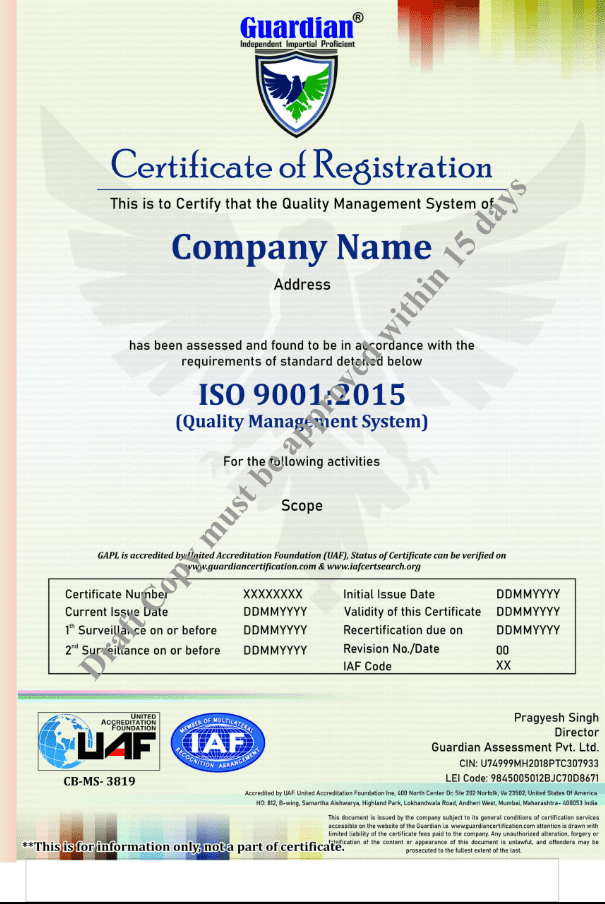
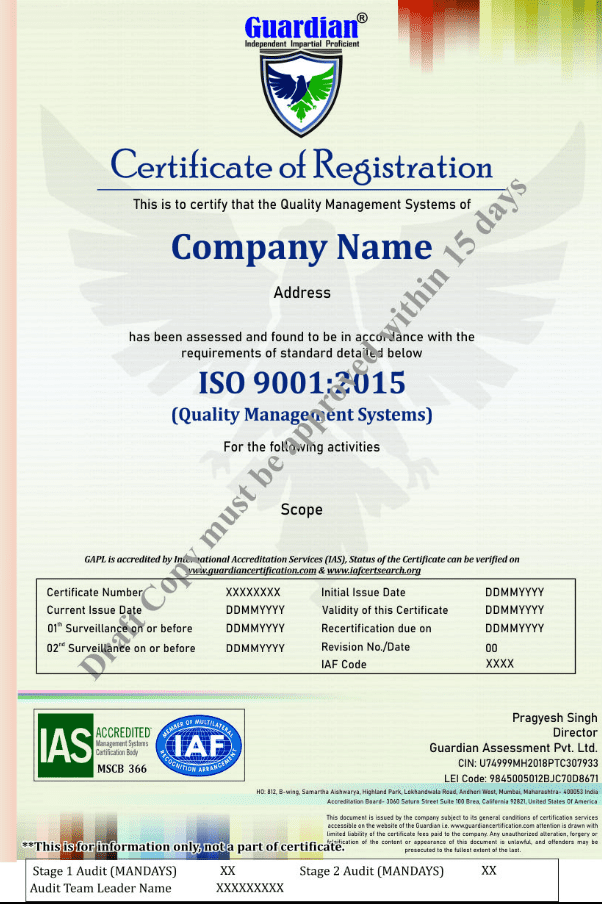
Request Quotation
Other Standards
Recognition


Sample Certificate
Why the Standard Is Being Revised
ISO standards follow a regular review cycle to remain relevant in a changing world. While ISO 9001:2015 has been highly successful, the ISO 9001:2026 revision incorporates modern business challenges including climate change, sustainability, digital transformation, AI & automation, ethical governance, and stronger stakeholder expectations.
Major drivers for the ISO 9001 latest version:
- Mandatory consideration of climate change (from 2024 ISO amendment)
- Strong focus on building quality culture and ethical behaviour
- Better integration of emerging technologies and organisational knowledge
- Clear separation between risk management and proactive opportunity pursuit
- Improved alignment with ISO 14001:2026 and other management system standards for easier Integrated Management Systems (IMS)
Current Draft Stage: FDIS Explained
The revision has progressed from the Draft International Standard (DIS) stage to the FDIS (Final Draft International Standard) stage, based on the latest available ISO project information. The final ISO 9001:2026 is now targeted for publication in September 2026.
Important Note: Until the final standard is officially published by ISO, ISO 9001:2015 continues to be the only valid and certifiable version for all new certifications, surveillance audits, and recertifications.
Evolution of ISO 9001
- 1987 — First edition (Quality Assurance focus)
- 1994 — Preventive action introduced
- 2000 — Process approach and customer satisfaction
- 2008 — Clarifications and alignment with ISO 14001
- 2015 — Risk-based thinking, leadership engagement, and context of the organisation
- 2026 — Sixth edition: Climate change integration, quality culture, ethical behaviour, opportunity-based thinking, and human error prevention
SIMPLE RULE OF APPLICABILITY — READ THIS FIRST
- ISO 9001:2015 remains the only valid, certifiable version of the standard until ISO 9001:2026 is officially published.
- New requirements will take effect only from the date of publication of the final International Standard.
- A transition period (typically three years) will be defined by the International Accreditation Forum (IAF).
- Guardian Assessment Private Limited will publish a detailed Transition Guide, transition audit programme, and support services once the final standard and IAF requirements are issued.
- Until then, all new applications, surveillance audits, and recertification audits will continue under ISO 9001:2015.
ISO 9001:2026 Timeline Overview
ISO 9001:2026 is currently at the FDIS stage (approved in April 2026), with publication targeted for September 2026. The IAF is expected to confirm a 3-year transition period (until approximately 2029).
| Phase | Timeline | Key Milestone |
| DIS Voting | Aug 27 – Nov 19, 2025 | Closed, feedback incorporated |
| FDIS Review | Q1-Q2 2026 | Final draft finalised |
| Publication | Sept 2026 | Official ISO release |
| Transition Start | Late 2026 | New audits available |
| Deadline | ~Sept 2029 | 2015 certificates expire |
When Should Certified Companies Transition to ISO 9001:2026?
Certified companies should start preparing before the final ISO 9001:2026 standard is published. Early preparation helps avoid last-minute documentation changes, audit pressure, and certification delays.
A practical transition plan should include:
- Review the expected ISO 9001:2026 changes
- Compare current ISO 9001:2015 documents with new requirements
- Update risk and opportunity controls
- Review quality objectives and process performance
- Train process owners and internal auditors
- Conduct an internal gap assessment
- Plan the transition audit with the certification body
After ISO 9001:2026 is officially published, the International Accreditation Forum is expected to define the formal transition period. Historically, ISO management system transitions often allow around three years, but companies should not wait until the last year.
ISO 9001:2026 Certification Process
The ISO 9001:2026 certification process will be similar to the current ISO 9001:2015 process, but companies may need to update their quality management system according to the new requirements.
The process usually includes:
- Application and quotation
The company shares basic details such as business activity, number of employees, location, and scope of certification. - Gap analysis
Existing documents, processes, risks, objectives, and controls are reviewed against ISO 9001 requirements. - QMS documentation update
Policies, procedures, risk controls, objectives, process records, and audit documents are updated as required. - Internal audit and management review
The organization checks whether its quality management system is working effectively before the certification audit. - Stage 1 audit
The certification body reviews readiness, documentation, scope, and basic compliance. - Stage 2 audit
The auditor verifies actual implementation of the quality management system. - Certification decision
If the audit is successful, the ISO 9001 certificate is issued. - Surveillance and transition audits
After ISO 9001:2026 is released, certified companies may need a transition audit to update their certificate from ISO 9001:2015 to ISO 9001:2026.
Who Needs ISO 9001:2026 Certification?
ISO 9001:2026 certification will be useful for any organization that wants to improve quality, customer satisfaction, process control, and business credibility.
It is suitable for:
- Manufacturing companies
- Construction companies
- IT and software companies
- Healthcare and laboratories
- Education and training institutes
- Trading and export businesses
- Engineering and fabrication companies
- Logistics and service providers
- Small and medium businesses
- Large organizations with multiple locations
Companies that already have ISO 9001:2015 certification will need to transition to ISO 9001:2026 after the new standard is officially released and the transition rules are announced.
ISO 9001:2026 Certification Cost Factors
The cost of ISO 9001:2026 certification will depend on the size and complexity of the organization. There is no fixed price for every company because each business has a different scope, risk level, number of employees, and number of locations.
Main cost factors include:
- Number of employees
- Number of sites or branches
- Scope of certification
- Type of business activity
- Complexity of processes
- Current ISO 9001:2015 certification status
- Gap analysis requirement
- Audit duration
- Transition audit requirements
- Certification body and accreditation requirements
Organizations that already have a strong ISO 9001:2015 quality management system may have a smoother and more cost-effective transition to ISO 9001:2026.
New Structure of ISO 9001:2026 (Based on the DIS)
ISO 9001:2026 follows the Harmonized Structure (formerly Annex SL), ensuring compatibility and easy integration with ISO 14001:2026, ISO 45001, ISO 27001, ISO 50001, and other standards for streamlined Integrated Management Systems (IMS).
ISO 9001:2026 Harmonized Structure
ISO 9001:2026 maintains the 10-clause Harmonized Structure for seamless IMS integration.
Clause | Focus Area | Key 2026 Updates |
4 | Context | Climate change issues |
5 | Leadership | Quality culture promotion |
6 | Planning | Separate risk/opportunity processes |
7 | Support | Psychosocial environment, AI knowledge |
8 | Operation | Human error prevention |
9 | Performance | Specific audit objectives |
10 | Improvement | Innovation/breakthrough emphasis |
Integration Benefits
- Single audit for ISO 9001 + ISO 14001 + ISO 45001 with potential cost savings
- Common terms across 30+ ISO standards
SMEs: Perfect for multi-certification needs.
Anticipated Core Changes (Clause-by-Clause)
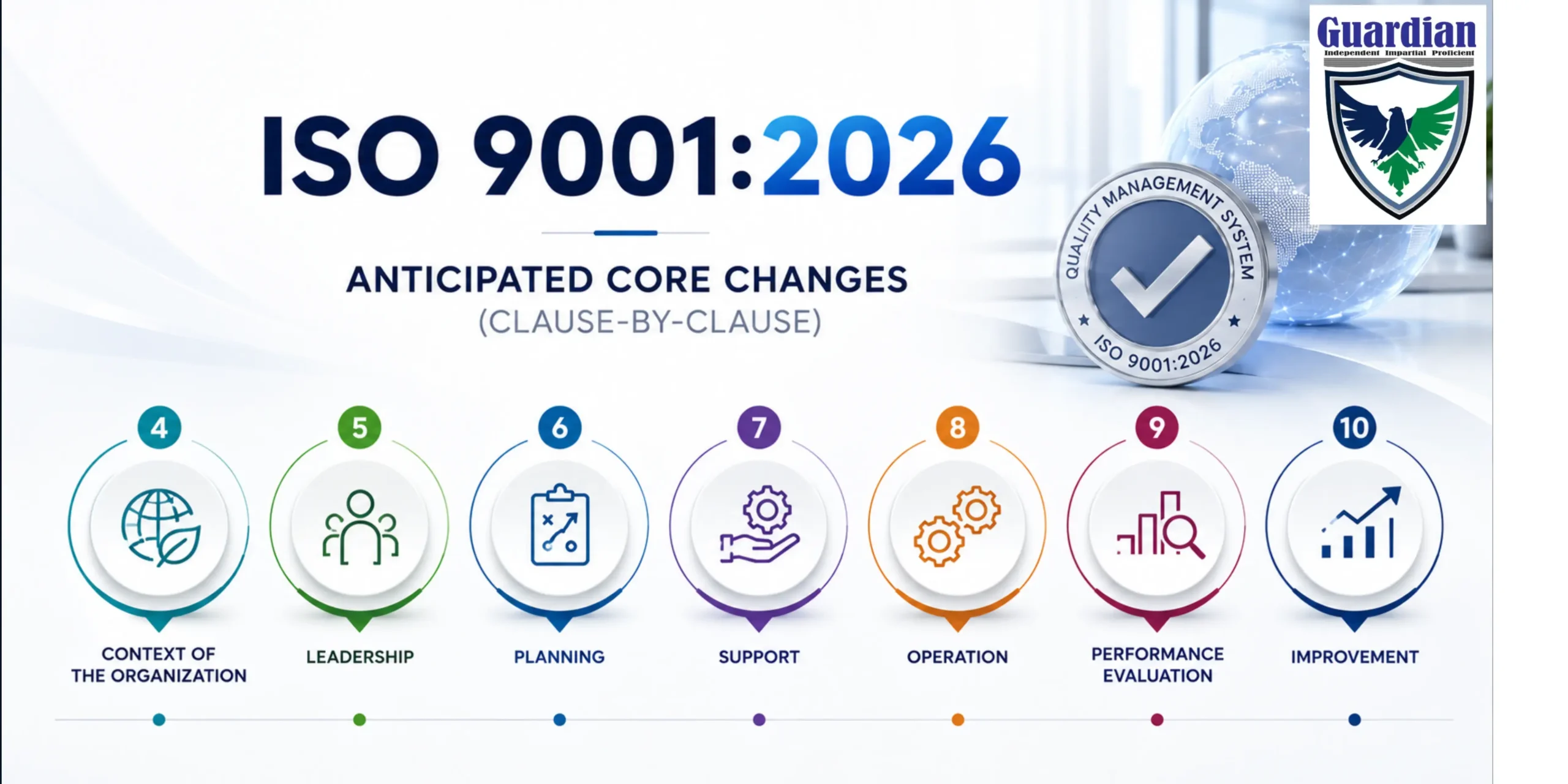
(Note: All references are based on the latest DIS/FDIS information and are subject to final editorial changes upon publication.)
Clause 4 – Context of the Organisation
Organisations must determine whether climate change is a relevant issue affecting the QMS and consider related requirements of interested parties. This builds on the 2024 climate amendment and strengthens the link between quality and sustainability.
Clause 5 – Leadership
Top management must actively promote quality culture and ethical behaviour throughout the organisation. Leadership accountability for QMS effectiveness, process approach, and risk-based thinking has been significantly strengthened.
Clause 6 – Planning
Actions to address risks and opportunities are now treated as distinct processes (new sub-clauses). Formal opportunity-based thinking is introduced to encourage proactive improvement, innovation, and growth.
Clause 7 – Support
The working environment now explicitly includes social, psychological, and physical factors. Awareness requirements expanded to include quality culture and ethical behaviour. Greater emphasis on retaining, applying, and sharing organisational knowledge, especially regarding emerging technologies.
Clause 8 – Operation
Strengthened operational planning and control. Customer communication now includes contingency actions for potential disruptions. New explicit requirement to implement measures for preventing human error in production and service provision.
Clause 9 – Performance Evaluation
Internal audits must define specific audit objectives, criteria, and scope for each individual audit. Management review inputs expanded to include risk/opportunity results, quality culture observations, and technology changes.
Clause 10 – Improvement
Continual improvement remains core, but the standard now explicitly recognises breakthrough change, innovation, and reorganisation as valid and valuable forms of improvement.
ISO 9001:2015 vs ISO 9001:2026 — Side-by-Side Comparison
Parameter | ISO 9001:2015 | ISO 9001:2026 |
Climate Change | Not addressed | Must be assessed as relevant issue |
Leadership Culture | Not explicit | Mandatory promotion of quality culture + ethical behaviour |
Risk & Opportunity | Combined | Separated into distinct processes |
Opportunity-Based Thinking | Not formalised | Clearly introduced |
Working Environment | Physical factors only | Social, psychological & physical factors |
Human Error Prevention | Not explicit | New dedicated requirement |
Internal Audit | Generic programme | Specific objectives, criteria & scope per audit |
Advantages of ISO 9001:2026
The new ISO 9001:2026 will help organisations achieve higher customer satisfaction, stronger market positioning, reduced defects and rework, better resource allocation, improved employee engagement, enhanced ESG & sustainability alignment, and superior competitiveness in tenders and global supply chains.
ISO 9001:2026 ROI Benefits
ISO 9001:2026 delivers tangible ROI through:
- 20–30% defect reduction via human error prevention (Clause 8) and opportunity management (Clause 6)
- ESG leadership through climate change assessment (Clause 4), helping win sustainability tenders
- 15% cost savings from quality culture and optimized resources (Clauses 5 & 7)
Early adopters of ISO 9001:2026 can strengthen customer trust and improve long-term business growth.
Limitations & Challenges of ISO 9001:2026
While highly beneficial, organisations may face challenges such as updating documentation, training on qualitative aspects (quality culture & ethics), initial implementation costs (especially for SMEs), and ensuring consistent auditor interpretation during the early transition phase.
How to Prepare for ISO 9001:2026 (Before Publication)
While beneficial, organizations face these transition hurdles:
Challenge | Clauses | Issue | Solution |
Documentation Updates | Clauses 4 & 6 | Climate and risk-opportunity separation needs new registers | Use Guardian’s free gap checklist |
Training Needs | Clauses 5 & 7 | Quality culture and ethics training for employees | Use Guardian’s online training modules |
SME Costs | All clauses | Implementation planning and resource allocation challenges | Use Guardian’s phased audit approach and subsidy guidance |
Auditor Variability | Early 2027 | Interpretation differences in new clauses | Choose accredited bodies like Guardian for consistent audits |
Good News: 80% of changes build on existing 2015 QMS, so minimal rework is needed.
You can start preparing immediately without waiting for publication:
- Strengthen your existing ISO 9001:2015 QMS
- Assess climate change relevance for your organisation
- Promote quality culture and ethical behaviour from leadership level
- Maintain separate registers/plans for risks and opportunities
- Review and improve controls for preventing human error
- Evaluate working environment (social, psychological, physical factors)
- Train internal auditors on anticipated changes
- Subscribe to official updates from Guardian Assessment Private Limited
Detailed Gap Analysis Checklist
This checklist is based on the ISO 9001:2026 DIS/FDIS updates. Use it to review your current QMS gaps.
Clause | 2026 Change | Gap Question | Action Example |
4 | Climate as an issue | Has climate change been considered in organizational context and interested parties? | Add emissions-related risks to the risk register |
5 | Quality culture and ethics | Is leadership actively promoting quality culture and ethical practices? | Conduct ethics training and leadership forums |
6 | Separate risk and opportunity processes | Are risks and opportunities managed through distinct processes? | Create separate risk and opportunity action plans |
7 | Psychosocial environment and organizational knowledge | Are employee wellbeing and technology-based knowledge sharing addressed? | Run employee surveys and AI knowledge-sharing sessions |
8 | Human error prevention | Are controls in place to prevent human errors? | Use Poka-Yoke methods and operational checklists |
9 | Specific audit objectives | Are clear objectives defined for each audit? | Define audit scope, criteria, and objectives before each audit |
Real-World Implementation Examples
Quality Culture — Clause 5
- Conduct quarterly leadership forums
- Introduce ethics recognition or awards
- Track training completion rates
- Monitor increase in error reporting and employee participation
Human Error Prevention — Clause 8
- Use visual work instructions
- Apply the “I’M SAFE” checklist: Illness, Medication, Stress, Alcohol, Fatigue, Eating
- Standardize operating procedures in manufacturing and service processes
Digital and AI Integration — Clauses 7 & 8
- Use AI-based predictive analytics for quality monitoring
- Apply digital twins to identify and prevent process errors
- Conduct AI knowledge-sharing sessions for employees and process owners
After Publication — What Will Happen Next
- ISO publishes the final ISO 9001:2026
- IAF issues mandatory transition document (typically 3 years)
- Guardian Assessment Private Limited releases detailed Transition Guide and opens combined transition audits
- Updated Lead Auditor and Awareness training programmes become available
- Existing certificate holders can plan smooth transition with minimal disruption
Why Choose Guardian Assessment Private Limited for ISO 9001 Certification
Guardian Assessment Private Limited is an accredited certification body, with accreditation details available through UAF, IAS, and IAF CertSearch. The company provides ISO certification services across global markets., with a service network supporting clients across 120+ countries. We provide reliable accredited ISO 9001 certification, integrated audits, expert transition support, and in-house training for both current and upcoming versions of the standard.
How Guardian Helps with ISO 9001 Certification and Transition Audit
Guardian Assessment Private Limited supports organizations in ISO 9001 certification, surveillance audits, recertification, and transition audit planning.
Guardian can help your organization with:
- ISO 9001 certification audit planning
- ISO 9001:2015 certification support
- ISO 9001:2026 transition readiness
- Gap assessment before transition audit
- Audit programme planning
- Multi-site certification support
- Documentation and implementation review
- Guidance on transition timeline after official publication
If your organization is already certified to ISO 9001:2015, Guardian can help you prepare early for ISO 9001:2026 and plan a smooth transition once the final standard and transition rules are officially announced.
Apply for ISO 9001 Certification
If you plan to pursue ISO 9001:2015 certification, request a quotation by providing your organization’s information in the application form. You can download the inquiry form from our website or submit your inquiry through the Apply Now button. Alternatively, send your inquiry via email to guardianassessment@gmail.com or click on Contact us. You have option to choose more than one standard and if you consider that other standard may help your organisation, you may integrate the standards within the accredited certification range and may apply for the certification for ISO 9001, ISO 14001, ISO 45001, ISO 21001, ISO 27001, ISO 37001.
References & Authoritative Sources
- Official ISO 9001 Standard Page: ISO 9001 – International Organization for Standardization
- UAF Accreditation Directory: Guardian Assessment Private Limited – UAF Accredited CAB Profile
- IAS Accreditation Directory: Guardian Assessment Private Limited – IAS Accredited CAB Profile
- Guardian Assessment Private Limited: Official Website
Disclaimer
This content is based on the latest available information from ISO/DIS 9001 and FDIS stage. The final published ISO 9001:2026 may have minor differences. Guardian Assessment Private Limited will update all guidance immediately after official publication. No transition timeline is final until IAF issues its mandatory document.
© Guardian Assessment Private Limited. All rights reserved. Accredited by UAF and IAS. www.guardiancertification.com
FAQ On ISO 9001:2026 Certification
Ans) The expected publication date for ISO 9001:2026 is September 2026. The standard is currently at the FDIS (Final Draft International Standard) stage. Until it is officially published by ISO, ISO 9001:2015 remains the only valid and certifiable version.
Ans) You can and should proceed with ISO 9001:2015 certification right now. It is the only certifiable version until ISO 9001:2026 is officially published. All new certifications, surveillance audits, and recertifications will continue under the 2015 version until then.
Ans) A 3-year transition period is expected after publication (likely until September 2029). The exact timeline will be confirmed by the International Accreditation Forum (IAF) once the standard is published. During this period, organizations can transition smoothly to the new version.
Ans) Key changes include:
- Mandatory assessment of climate change as a relevant issue (Clause 4).
- Stronger focus on quality culture and ethical behaviour promoted by top management (Clause 5).
- Clear separation of risks and opportunities into distinct processes (Clause 6).
- The working environment now covers social, psychological, and physical factors (Clause 7).
- New requirement for preventing human error (Clause 8).
- More specific requirements for internal audits and expanded management review inputs.
Ans) Yes. Your current certificate will remain valid during the 3-year transition period. You will need to transition to the new standard before the deadline set by IAF to maintain certification.
Ans) ISO standards are reviewed regularly to stay relevant. The 2026 revision addresses modern challenges such as climate change, sustainability, digital transformation, AI, ethical governance, stronger stakeholder expectations, and better alignment with other management system standards.
Ans) Yes, you can start preparing immediately:
- Strengthen your existing 2015 QMS.
- Assess the relevance of climate change to your organization.
- Promote quality culture and ethical behaviour from the leadership level.
- Maintain separate registers for risks and opportunities.
- Improve controls to prevent human error.
- Review the working environment (social, psychological & physical aspects).
Ans) It builds on the 2015 version with some new emphases (like quality culture, ethics, and climate change). While it introduces new requirements, the core structure (Harmonized Structure) remains the same, making integration with other standards like ISO 14001 easier. SMEs may face some challenges with documentation and training.
Ans) Benefits include higher customer satisfaction, better alignment with sustainability and ESG goals, stronger quality culture, improved innovation and opportunity management, reduced risks, and better competitiveness in global markets and tenders.
Ans) Yes. Choose an accredited certification body like Guardian Assessment Private Limited (accredited by UAF & IAS) that offers reliable certification, integrated audits, and future transition support. They will provide a detailed Transition Guide and assistance once the final standard and IAF requirements are released.
Note: All information is based on the latest available details from the DIS/FDIS stage. The final ISO 9001:2026 may have minor editorial changes. Until official publication, ISO 9001:2015 remains fully valid.