
Manufacturing businesses in India need to maintain product quality, control costs, keep workers safe, and meet changing customer and regulatory requirements. Problems such as defective products, supplier delays, machine breakdowns, or safety incidents can disrupt production and increase operating costs.
ISO certification for manufacturing helps businesses manage these challenges through consistent processes, clear responsibilities, and a systematic approach to identifying problems and improving performance.
Certification can also support customer approval, supplier registration, OEM requirements, export opportunities, and certain government or private tenders. However, ISO certification does not replace product approvals, statutory license, environmental permissions, workplace-safety requirements, or other legal obligations that may apply to a factory. The right certification depends on what your company manufactures, its operational risks, customer expectations, and business requirements.
Which ISO Certification Does a Manufacturing Company Need?
There is no single ISO certification that every manufacturer needs. For most manufacturing businesses, following ISO standards are required:
- ISO 9001 is the natural starting point because it focuses on quality, process consistency, customer requirements, and continual improvement.
- ISO 14001 is relevant where environmental impacts need stronger control.
- ISO 45001 helps manufacturers manage workplace health and safety.
- ISO 50001 is particularly useful where energy consumption is a significant operating concern. Some manufacturers may also consider
- ISO/IEC 27001 where connected machinery, engineering data, customer information, or intellectual property creates information-security risks.
- ISO 22301 may also be useful where production interruptions could seriously affect customers or the business.
The aim should not be to collect certificates. The right approach is to choose standards that address real operational risks, customer expectations, or business goals.
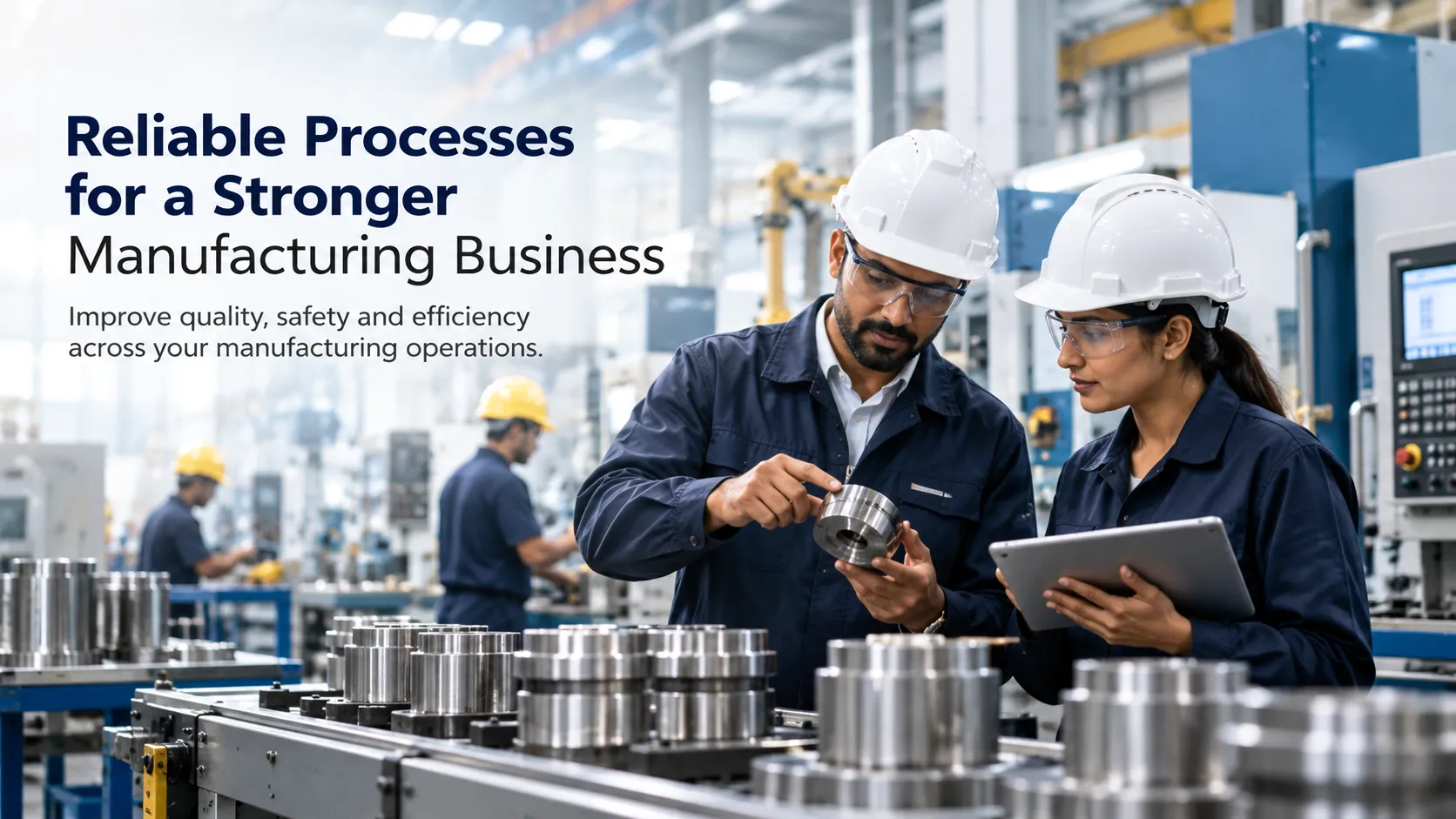
Why is ISO Certification Important in the Manufacturing Industry?
A manufacturing problem rarely stays within one department. Poor raw material can affect product quality. A supplier delay can stop production. A machine failure can affect delivery schedules, while weak inspection can result in rejected products. An effective ISO management system helps manufacturers bring these interconnected activities under greater control.
1. Reduce Rejections and Improve Product Consistency: Rejected products, repeated defects, rework, and customer complaints directly affect manufacturing cost and productivity. ISO 9001 helps manufacturers manage quality throughout the process rather than relying only on final inspection. It encourages better control from customer requirements and purchasing through production, inspection, handling of defective outputs, corrective action, and continual improvement.
The practical value is that quality becomes part of everyday production rather than something checked only after a product has been completed. For businesses supplying OEMs, large industrial buyers, export customers, or government organizations, ISO 9001 certification for manufacturing can also provide independent evidence that the company’s quality management system has been assessed against a recognised standard.
2. Make Production More Predictable: Manufacturing quality depends on materials, machinery, people, operating methods, maintenance, and monitoring. When these activities are handled differently across shifts, locations, or production lines, variation increases. A structured management system helps the factory define how important processes should work, who is responsible, what needs to be monitored, and what action should be taken when results fall outside expectations. This makes it easier to identify why recurring problems happen instead of repeatedly fixing the same symptoms.
3. Improve Supplier Performance: Manufacturers often rely on outside suppliers for raw materials, components, packaging, testing, logistics, tooling, maintenance, and specialist services. A supplier problem can quickly become a production problem. ISO management systems encourage manufacturers to manage suppliers more systematically by defining purchasing requirements, selecting appropriate suppliers, monitoring performance, and addressing recurring quality or delivery issues. For manufacturers with complex supply chains, stronger supplier control can support more reliable production and customer delivery.
4. Create Safer Manufacturing Operations: Manufacturing workplaces can involve machinery, electricity, chemicals, lifting activities, heat, noise, maintenance work, and other hazards. A structured health and safety management system helps manufacturers identify where people could be harmed, introduce suitable controls, and reduce the chance of incidents disrupting operations. For factories with significant workplace risks, ISO 45001 can provide a consistent way to make safety part of everyday operations rather than treating it only as a compliance exercise.
5. Manage Environmental Impact More Effectively: Waste, wastewater, emissions, chemicals, packaging, and resource consumption can create both environmental and business risks for manufacturers. A structured environmental management system helps the factory understand where these impacts arise, set improvement priorities, and manage resources more responsibly. For businesses facing customer sustainability expectations or significant environmental impacts, ISO 14001 can also provide a clearer way to monitor progress over time.
6. Understand and Control Energy Use: Energy can be a major operating cost for factories using furnaces, boilers, motors, compressors, pumps, cooling equipment, or other energy-intensive machinery. Better energy management helps manufacturers understand where consumption is highest, identify avoidable waste, and measure whether improvement actions are working.ISO 50001 provides a structured framework for making energy performance part of normal operational decision-making.
ISO Standards Commonly Used in Manufacturing
Different ISO standards address different manufacturing needs. The appropriate standard should be selected according to the actual risks and objectives of the factory.
1. ISO 9001 – Quality Management System: ISO 9001 Certification is one of the most relevant management-system standards for manufacturers. It focuses on consistent processes, customer requirements, leadership, risk management, performance monitoring, corrective action, and continual improvement. For manufacturing businesses, this can support production planning, supplier control, inspection, process changes, management of defective output, customer complaints, and improvement activities. The current edition is ISO 9001:2026, published on 16 September 2026.
Manufacturers already certified to ISO 9001:2015 should plan their transition. Under relevant accredited transition arrangements, new and initial accredited certifications move to ISO 9001:2026 from 31 March 2028, while existing ISO 9001:2015 certifications are expected to complete transition by 30 September 2029. Organizations should confirm the transition requirements that apply to their own certificate and certification arrangement.
2. ISO 14001 – Environmental Management System: ISO 14001 Certification helps manufacturers manage environmental responsibilities in a structured and measurable way. It is particularly relevant where operations create waste, emissions, wastewater, chemical risks, high resource use, or other significant environmental impacts. The current edition is ISO 14001:2026, published in April 2026.
Manufacturers already certified to ISO 14001:2015 should prepare for transition under the arrangements applicable to their certification. Relevant accredited transition requirements provide for new and initial certification to move to the 2026 edition from 31 October 2027, with existing certifications completing transition by 30 April 2029.
3. ISO 45001 – Occupational Health and Safety Management System: ISO 45001 Certification helps manufacturers manage workplace health and safety. It is particularly relevant where employees work with machinery, chemicals, electrical systems, heavy materials, warehouses, production lines, or other higher-risk activities.
Other Standards That May Be Relevant
Some manufacturers have risks beyond quality, environment, workplace safety, and energy. ISO/IEC 27001 may be relevant where production depends on connected machinery, industrial networks, engineering data, customer information, cloud systems, or intellectual property. ISO 22301 may be useful where production continuity is critical and interruptions caused by equipment failure, utility problems, cyber incidents, or supplier disruption could seriously affect customers.
Is ISO Certification Mandatory for Manufacturers?
ISO certification is not universally mandatory for manufacturing companies in India. Many manufacturers choose certification because they want more consistent processes, stronger customer confidence, improved supplier management, or better control over quality, safety, environmental performance, or energy use.
In other cases, certification may be requested by a customer, OEM, export buyer, supplier-registration programme, contract, or government tender. The important question is therefore not simply whether ISO certification is mandatory. A manufacturer should confirm which standard is required, who requires it, and what activities need to be included within the certification scope.
ISO Certification and Product Requirements Are Different
ISO certification focuses on the organization’s management system. Product approvals and statutory requirements are separate. For example, a manufacturer may have an ISO 9001-certified quality management system and still need BIS certification or another product approval where Indian regulations require it. One does not replace the other. The practical distinction is simple: ISO certification strengthens the management system, while statutory product requirements determine what approvals a particular product may need.
Workplace Safety and ISO 45001 in Indian Manufacturing
India’s workplace-safety framework is especially relevant to manufacturers because factories can involve machinery, chemicals, electrical risks, material handling, maintenance work, and other potentially hazardous activities. India’s Labour Codes came into force from 21 November 2025, including the Occupational Safety, Health and Working Conditions framework. The exact obligations that apply to a factory can depend on its activities, workforce, location, and applicable rules.
ISO 45001 can help manufacturers organise safety responsibilities, risk controls, incident management, worker involvement, and continual improvement within one management system. However, ISO 45001 certification does not replace Indian labour or workplace-safety requirements. Legal compliance and management-system certification must still be handled separately.
Environmental Responsibilities and ISO 14001
Indian manufacturers may need to manage pollution-control permissions, waste, wastewater, emissions, chemicals, environmental clearance, or other environmental requirements depending on their activities. ISO 14001 can help the business organise these responsibilities by giving management a clear way to identify obligations, assign responsibility, monitor controls, and respond when something is not working as intended. This can make environmental management more consistent across the factory, but ISO 14001 certification does not replace Consent to Establish, Consent to Operate, Environmental Clearance, or other statutory approvals.
EPR and Product Lifecycle Responsibilities: For some manufacturers, environmental responsibility continues after the product leaves the factory. India has Extended Producer Responsibility requirements covering areas such as electronic waste, batteries, plastic packaging, tyres, and other regulated waste streams. Affected businesses may need to manage registrations, recycling responsibilities, records, certificates, targets, or reporting. ISO 14001 can support the internal processes used to manage these responsibilities, but it does not replace the actual EPR requirements.
Energy and Carbon Performance in Manufacturing
Energy and carbon performance are becoming increasingly important for energy-intensive manufacturing businesses in India. India’s Carbon Credit Trading Scheme introduces greenhouse-gas performance requirements for specified obligated entities. This does not mean every manufacturing company is automatically covered.
For manufacturers that are affected, reliable information about energy use and emissions becomes increasingly important. ISO 50001 can support structured energy management, while ISO 14001 can support wider environmental and emissions management. These management systems can make responsibilities easier to control, but they do not replace statutory carbon targets, verification, or reporting requirements.
ISO Certification and Government Tenders
Some government and public-sector tenders specifically ask the bidder, manufacturer, or OEM to submit a valid ISO certificate. When this happens, manufacturers should check the tender carefully to confirm which ISO standard is required, whose certificate must be submitted, what certification scope is acceptable, and whether any other technical conditions apply.
Other tender requirements may include product approvals, manufacturing capacity, testing, previous experience, local content, MSE status, financial capability, or OEM authorisation. ISO certification can therefore help meet a qualification requirement where the tender specifically asks for it, but it does not guarantee eligibility or contract award.
Make in India and Local-Content Requirements
Government procurement may also include local-content requirements under the Public Procurement Preference to Make in India framework. Under the general framework, a Class-I local supplier generally has at least 50% local content, while a Class-II local supplier generally has at least 20% but less than 50% local content.
This requirement is separate from ISO certification. An ISO-certified manufacturer does not automatically become a Class-I or Class-II local supplier. In the same way, meeting local-content requirements does not automatically satisfy an ISO requirement where a tender separately asks for certification. Manufacturers bidding for public procurement should therefore check both conditions independently.
ZED, LEAN and ISO Certification for Manufacturing MSMEs
India also has improvement programmes designed specifically for manufacturing MSMEs. These programmes can complement ISO management systems but should not be confused with ISO certification.
1. MSME Sustainable ZED Certification: ZED stands for Zero Defect Zero Effect. The programme encourages manufacturing MSMEs to improve product quality while reducing negative environmental impact and strengthening manufacturing practices. For an MSME, ZED can support objectives around quality, resource efficiency, workplace practices, environmental performance, and competitiveness.
However, ZED Certification is not the same as ISO 9001, ISO 14001, or ISO 45001 certification. A manufacturing business may use ZED and ISO management systems together where they support different goals.
2. MSME Competitive LEAN: The MSME Competitive LEAN Scheme focuses on improving productivity and reducing operational waste. For a manufacturer, this can mean reducing rejection, unnecessary movement, delays, wasted resources, and inefficient working methods.
LEAN and ISO 9001 can work well together. LEAN focuses strongly on making processes more efficient, while ISO 9001 provides the wider management framework needed to control processes, meet customer requirements, monitor performance, and continually improve.
Which Manufacturers Can Benefit from ISO Certification?
ISO certification can be useful across a wide range of manufacturing businesses. The most suitable standard depends on the company’s processes, risks, customers, and business requirements.
- General manufacturing companies: ISO 9001 can help improve product consistency, process control, customer satisfaction, and continual improvement.
- Engineering and fabrication companies: Certification can support better control over drawings, materials, machining, welding, inspection, and customer specifications.
- Electrical and electronics manufacturers: These businesses may need to manage quality, supplier performance, environmental impacts, product requirements, and information security in a structured way.
- Machinery and equipment manufacturers: ISO management systems can help improve control over assembly, testing, inspection, maintenance, technical documentation, and supplier performance.
- Automotive and component manufacturers: These companies often operate in demanding OEM supply chains where quality, delivery, process control, supplier performance, workplace safety, and environmental management are important.
- Chemical, metal, plastic, and process manufacturers: These industries may face higher environmental, safety, energy, and operational risks. ISO 14001, ISO 45001, or ISO 50001 may therefore be relevant alongside ISO 9001.
- Export-oriented manufacturers: Accredited ISO certification can help demonstrate to international customers that the applicable management system has been independently assessed against a recognised standard.
The value of certification depends on how closely the selected ISO standard matches the manufacturer’s actual operations, risks, customer expectations, and business goals.
Cost and Process of ISO Certification in Manufacturing Industries
As we discussed above, implementing strong ISO certification for manufacturing helps your factory reduce waste, minimize rejected parts, and avoid costly operational downtime. Because certification directly improves your long-term profit margins, understanding the initial financial investment and the workflow required for the audit is an important first step. The cost of ISO certification for manufacturing industry businesses can vary depending on factors such as organization size, activities, locations, employee strength, required standards, and certification scope.
To get a clear, straightforward picture of how audit fees are calculated for production units and factories, read our complete guide on How Much Does ISO Certification Cost?. (Need a deeper dive into the exact steps of the audit? Review our detailed ISO Certification Process breakdown).
Why Choose Guardian Assessment for Manufacturing Certification?
Using an accredited audit agency like Guardian Assessment Private Limited will ensure the credibility of your certificate on the global market. Manufacturers looking for ISO certification for manufacturing industry services can evaluate the certification body’s accreditation scope, industry expertise, and audit capabilities before proceeding with certification.
- Deep Expertise in Manufacturing: Our auditors possess sound technical knowledge of manufacturing processes.
- Impartial & Objective Audits: As an accredited assessment agency, we conduct impartial and transparent audits that gain global trust.
- Global Recognition: Our certificates are accredited by United Accreditation Foundation and IAS and are recognized worldwide in Europe, America, the Middle East, and other places.
- IAF CertSearch: Verify the validity of eligible accredited ISO management system certificates through the IAF CertSearch database
Ready to Start ISO Certification for Your Manufacturing Business?
The right ISO certification starts with understanding what your factory needs to improve and what your customers, contracts, or tenders expect. Choosing the correct standard and certification scope from the beginning can make the certification journey much clearer.
Contact Guardian Assessment Private Limited to discuss your manufacturing activities, certification requirements, and the appropriate next step for your organization.
Request an ISO Certification Quote
Frequently Asked Questions
The most commonly applicable standards for manufacturing businesses are ISO 9001 for quality management, ISO 45001 for occupational health and safety, and ISO 14001 for environmental management. Depending on the nature of production, energy use, customer requirements, and operational risks, other standards may also be relevant.
ISO certification for manufacturing company operations helps demonstrate that production processes, quality controls, workplace safety, and environmental responsibilities are managed through structured systems. It can also support supplier qualification, customer confidence, tender participation, and access to wider supply chains.
ISO 9001 manufacturing practices help companies establish consistent controls for production, supplier management, inspections, nonconforming products, corrective actions, documented processes, and continual improvement. This can help reduce defects, rework, and inconsistent output.
ISO 45001 helps manufacturing organizations identify workplace hazards, assess occupational health and safety risks, implement operational controls, prepare for emergencies, and improve worker participation. It is particularly relevant where employees work with machinery, chemicals, electrical equipment, lifting operations, or other industrial hazards.
ISO 14001 helps manufacturing companies systematically manage environmental aspects such as waste generation, emissions, resource consumption, energy use, wastewater, and material handling. It also supports a structured approach to identifying and managing applicable environmental compliance obligations.