
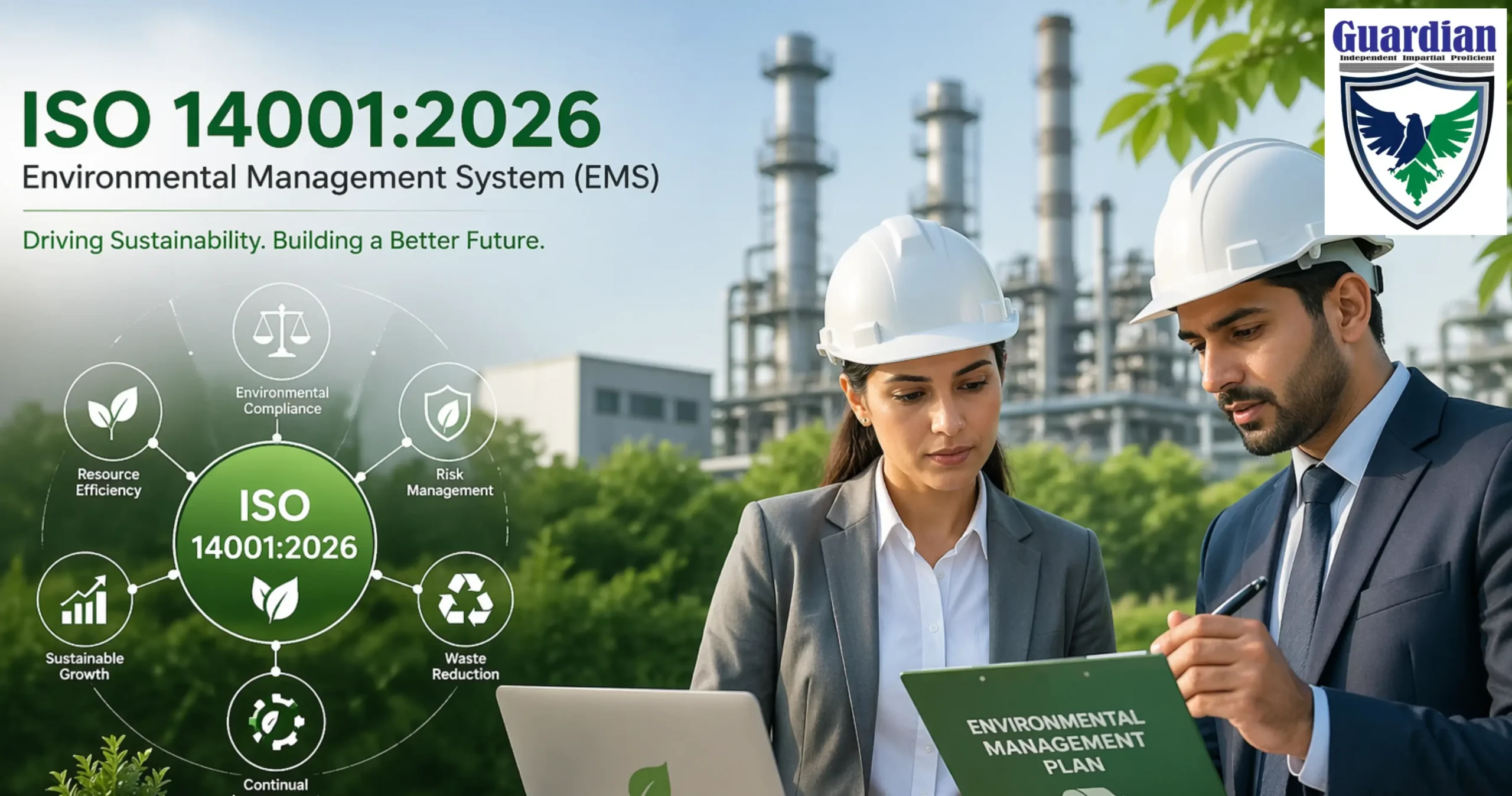
Guardian Certification is an internationally accredited certification body providing ISO 14001:2026 certification under its applicable UAF and IAS accreditation scopes. Whether you are applying for ISO 14001 certification for the first time or transitioning from ISO 14001:2015, our experienced auditors provide structured guidance throughout the certification process. We support organizations in establishing and demonstrating an effective Environmental Management System (EMS), helping them prepare for certification in a clear, systematic, and internationally aligned manner.
Request Quotation
ISO 14001:2026 Key Facts At-a-Glance
| Parameter | Details |
| Standard Name | ISO 14001:2026 |
| Full Title | Environmental Management Systems — Requirements with Guidance for Use |
| Published | April 2026 |
| Replaces | ISO 14001:2015 |
| Edition | 4th Edition |
| Transition Deadline | April 2029 (3-year window) |
| Certifying Body | Guardian Assessment Private Limited |
| Accreditation | UAF Accredited, IAS Accredited |
| Valid For | All industries and organisation sizes worldwide |
What is ISO 14001:2026 Certification?
ISO 14001:2026 is the latest internationally recognised standard for Environmental Management System (EMS) requirements, published by the International Organization for Standardization (ISO) in April 2026. It provides a structured framework that enables organisations of all sizes and across all industries to identify, manage, monitor, and continuously improve their environmental performance. For organisations searching for ISO 14001, ISO 14001 requirements, or ISO 14001 clauses explained, this standard serves as the foundation for managing environmental obligations through a systematic and auditable management approach.
An ISO 14001 certification issued by an accredited certification body — such as Guardian Assessment Private Limited — demonstrates to customers, regulators, investors, and supply-chain partners that your organisation has a robust, independently audited system in place to manage its environmental obligations. Businesses that want ems certification, Environment Management System Certification, or ISO 14001 certification india can use this certification to improve credibility, compliance, and operational control.
Purpose and Scope of the New EMS Standard
The standard applies to any organisation — regardless of size, type, or sector — that wishes to establish, implement, maintain, and continually improve an Environmental Management System. ISO 14001:2026 is not prescriptive about specific environmental performance targets; instead, it requires organisations to commit to continual improvement, legal compliance, and pollution prevention within a defined management framework. This is why many businesses that ask how to reduce environmental impact with ISO 14001 see it as a practical framework rather than just a certificate.
Who Needs ISO 14001:2026 Certification?
ISO 14001:2026 certification is relevant to a wide range of industries and organisation types, including:
- Manufacturing and production companies
- Construction and infrastructure firms
- Logistics, transport, and warehousing operators
- IT and software service organisations
- Healthcare and pharmaceutical companies
- Food and beverage producers
- Energy, utilities, and oil and gas companies
- Educational institutions and government bodies
- Any organisation involved in export, global trade, or government tendering
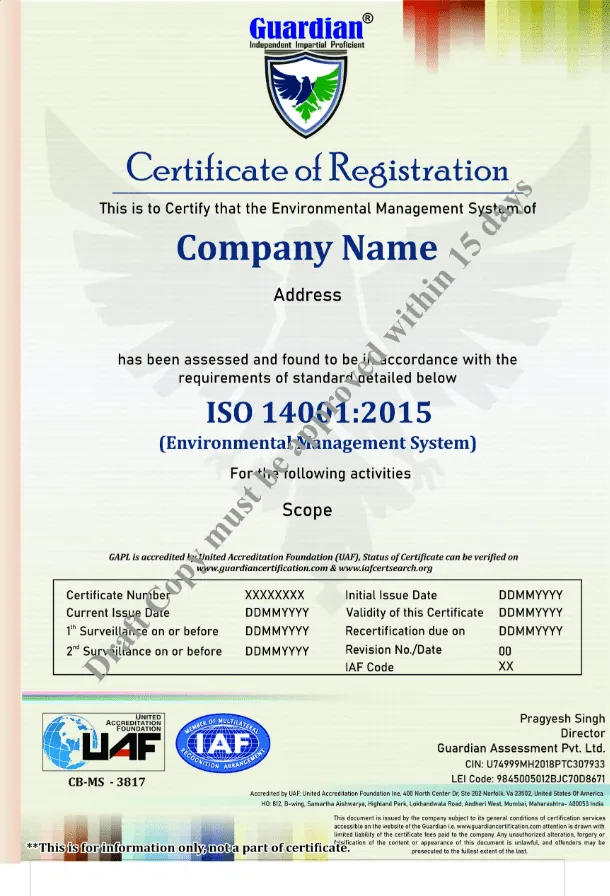
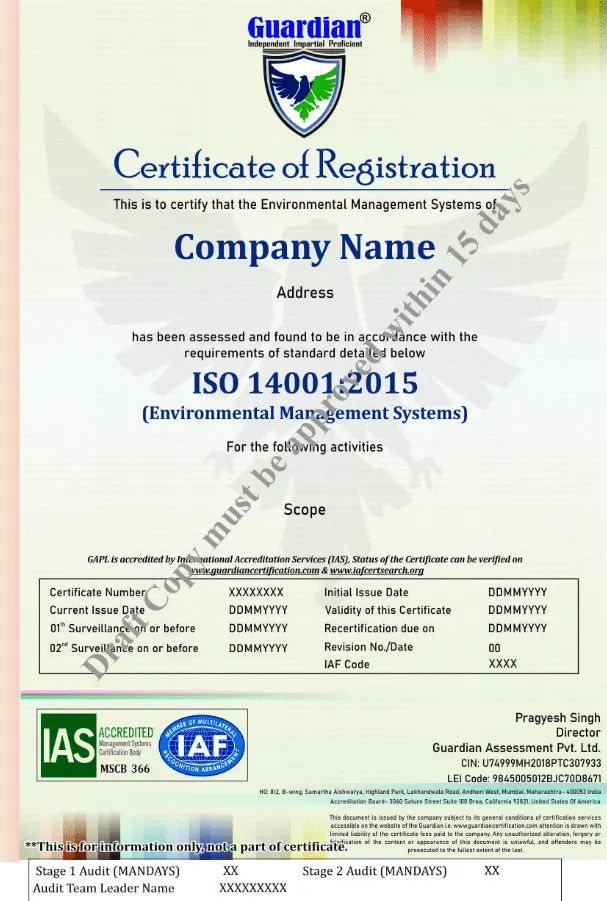
Sample Certificate
Request Quotation
Other Standards
Recognition


Sample Certificate
This makes ISO 14001 for manufacturing industry especially important where resource use, waste, emissions, and compliance obligations are significant. Likewise, ISO 14001 for construction companies supports environmental planning, waste handling, site controls, legal compliance, and risk reduction for projects with a direct environmental footprint.
The Evolution of ISO 14001 (1996 to 2026)
Since its inception, ISO 14001 has continuously evolved to meet the changing environmental realities of the global business landscape. What began as a framework focused purely on pollution control has matured into a comprehensive system for corporate sustainability and life-cycle management.
- 1996 — The Foundation: Following the success of the world’s first environmental standard (BS 7750 in 1992), the International Organization for Standardization published the first edition of ISO 14001. This initial version established the core “Plan-Do-Check-Act” (PDCA) cycle and focused heavily on basic pollution control and managing negative environmental impacts.
- 2004 — The Integration Update: The second edition, ISO 14001:2004, focused on clarifying the original requirements and making the standard easier to integrate with the quality management standard, ISO 9001. It also introduced a clearer distinction between environmental aspects an organisation could strictly control versus those it could only influence.
- 2015 — The Strategic Shift: The 2015 revision was a major structural overhaul. It adopted the High-Level Structure (Annex SL) to perfectly align with other ISO standards. It shifted the focus from mere compliance to strategic environmental management, introducing the “Life Cycle Perspective” and requiring top management to take direct accountability for EMS performance.
- 2026 — The Climate & Resilience Era: The new ISO 14001:2026 represents the standard’s most urgent update yet. By explicitly mandating the inclusion of climate change, biodiversity, and natural resource scarcity into corporate planning, and by introducing strict change-management controls (Clause 6.3), the standard now positions environmental management as a critical pillar of overall business resilience and ESG reporting.
Key Changes: ISO 14001:2015 vs. ISO 14001:2026
| Area | ISO 14001:2015 | ISO 14001:2026 |
| Climate Change | Limited | Explicit requirement |
| Biodiversity | Not explicit | Explicitly included |
| Change Management | No dedicated clause | New Clause 6.3 |
| Life Cycle Perspective | Present | Expanded |
| Leadership Accountability | Top management | Wider role-based accountability |
ISO 14001:2015 to 2026 Transition Guidelines
All organisations currently certified to ISO 14001:2015 must complete a formal transition to ISO 14001:2026. This is one of the most time-sensitive actions your organisation needs to take in 2026. If you are looking for How to apply for ISO 14001 certification, ISO 14001 certification process, or Procedure for ISO 14001 certification, this transition path is essential for existing certificate holders.
Transition Timeline (3-Year Window ending April 2029)
| Item | Details |
| Published | April 2026 |
| Transition Period | 3 years |
| Last Date | April 2029 |
| After Deadline | 2015 certificate invalid |
We strongly recommend beginning transition preparation now rather than waiting, as audit capacity across accredited certification bodies will become constrained as the deadline approaches.
Step-by-Step Transition Plan for Existing Certificate Holders
- Obtain and review ISO 14001:2026 — Purchase the official standard and circulate it to your EMS team and top management
- Conduct a gap analysis — Identify what your current EMS covers and what needs to be added or updated to meet the 2026 requirements
- Update your context analysis — Add climate change, biodiversity, and natural resource considerations to Clause 4
- Revise your aspect-impact register — Apply the expanded life cycle perspective to include supply chain and end-of-life impacts
- Implement Clause 6.3 change management — Establish a procedure for managing planned changes to the EMS
- Update operational controls — Address externally provided processes and supplier environmental controls
- Train internal auditors — Ensure your internal audit team understands all changes in ISO 14001:2026 before conducting internal audits
- Conduct internal audit and management review — Complete a full internal audit cycle under the new standard
- Apply to Guardian Certification for transition audit — Submit your transition application at least 60 days before your preferred audit date
- Transition audit and certificate issuance — Guardian’s auditors will conduct a transition audit; upon successful completion, a new ISO 14001:2026 certificate will be issued
Can the Transition Audit Be Combined With My Surveillance Audit?
Yes. If your next surveillance or recertification audit is already scheduled, Guardian Certification can combine it with the ISO 14001:2026 transition audit in a single visit, saving time and cost. Please contact your assigned client manager or reach out to our office to discuss scheduling.
What Happens if You Miss the Deadline? (Suspension/Cancellation risks)
If your organisation has not transitioned to ISO 14001:2026 before the deadline (approximately April 2029), your existing ISO 14001:2015 certificate will:
- Be marked as expired/invalid on the IAF CertSearch public register
- No longer be accepted for government tenders, export documentation, or procurement requirements
- Result in suspension and eventual withdrawal of your certification status
The transition window is three years but begins now — we encourage all Guardian-certified clients to begin preparation immediately.
Top Business Benefits of ISO 14001 Certification

For organisations comparing ISO 14001 certification cost, iso 14001 certification price, and long-term value, the benefits of ISO 14001 certification go beyond compliance. Whether your company needs EMS certification for tenders, supply-chain approval, or internal environmental control, the certification offers direct operational and commercial advantages.
1. Regulatory Compliance & Legal Risk Reduction: ISO 14001:2026 provides a systematic framework to identify all applicable environmental laws, regulations, and permit conditions, and to ensure your organisation stays in compliance. This dramatically reduces the risk of regulatory penalties, enforcement actions, and reputational damage caused by environmental non-compliance.
2. Cost Savings (Energy, Waste, Resources): Organisations implementing ISO 14001:2026 consistently report measurable reductions in energy consumption, water use, raw material waste, and disposal costs. The systematic identification of environmental aspects and operational controls creates direct financial savings alongside environmental benefit. This is one of the main reasons businesses ask how to reduce environmental impact with ISO 14001 while also lowering operating costs.
3. Competitive Advantage in Government Tenders and Global Trade: ISO 14001 certification is a mandatory requirement in a growing number of government procurement processes. Many multinational corporations now require their suppliers to hold valid EMS certification. An ISO 14001:2026 certificate from an accredited body like Guardian Certification signals credibility to global buyers and procurement teams.
4. ESG, Sustainability Reporting, and Investor Confidence: With ESG reporting becoming a mainstream business requirement — especially for listed companies, export-oriented businesses, and organisations seeking green finance — ISO 14001:2026 provides the operational evidence base that sustainability reports, investor disclosures, and supply-chain ESG audits increasingly demand.
5. Improved Operational Control and Risk Management: The structured approach of ISO 14001:2026 builds environmental considerations into day-to-day operations, emergency preparedness, and supplier management, reducing operational risk and improving resilience.
How to Apply ISO 14001 Certification ?
If your organisation wants to know How to apply for ISO 14001 certification, the ISO 14001 certification process generally follows a structured route. Guardian Certification follows a structured, impartial, and internationally aligned certification process in accordance with ISO/IEC 17021-1:2015. For businesses comparing providers in ISO 14001 certification, choosing a competent and accredited ISO 14001 certification body is essential.
Step 1: Application & Gap Analysis: Submit your certification application. Our team will confirm the scope of certification, applicable activities, and the number of audit days required based on your organisation’s size and complexity. At this stage, many applicants also seek ISO 14001 consultancy services or support from an ISO 14001 consultant to review readiness and close documentation gaps before the audit.
Step 2: Stage 1 Audit (Documentation Review): Our auditor will review your EMS documentation — including your environmental policy, aspects and impacts register, legal compliance register, objectives, and operational procedures — to assess readiness for the Stage 2 audit. Any significant gaps will be communicated at this stage. This stage is also where ISO 14001 manuals and documented procedures become important.
Step 3: Stage 2 Audit (On-Site/Remote Evaluation): The main certification audit is conducted at your premises (or remotely where applicable). Our auditor will evaluate whether your EMS is effectively implemented, maintained, and performing in accordance with ISO 14001:2026. Any non-conformities identified will be documented.
Step 4: Certification Decision & Issuance: Where non-conformities are raised, your organisation must submit documented corrective actions and evidence of resolution within the agreed timeframe. Our auditors will verify the effectiveness of the corrections before a certification recommendation is made.
Guardian Certification’s independent Certification Decision Maker reviews the audit report and, where all requirements are met, authorises the issuance of the ISO 14001:2026 certificate. Your certificate will be registered on the IAF CertSearch public database.
Step 5: Surveillance Audits (Year 1 & 2): To maintain your certification, Guardian conducts annual surveillance audits in Year 1 and Year 2 of the three-year certification cycle to verify continued compliance and improvement.
Step 6: Recertification: At the end of the three-year cycle, a full recertification audit is conducted to renew your ISO 14001:2026 certificate for a further three years.
Important Guidelines for Stakeholders
For Guardian Certified Clients (Action items for transition)
All existing ISO 14001:2015 certified clients of Guardian Assessment Private Limited should take the following actions immediately:
- Download the ISO 14001:2026 Transition Checklist from our website
- Conduct a self-assessment gap analysis against the new standard
- Update your EMS documentation to address climate change, biodiversity, life cycle perspective, and Clause 6.3 change management
- Train your internal auditors on ISO 14001:2026 before your next internal audit
- Submit your Transition Application to Guardian at least 60 days before your preferred audit date
- Contact your assigned client manager to discuss combining the transition audit with your upcoming surveillance or recertification visit
For Guardian Franchise & Global Partners (Client communication duties)
Guardian’s worldwide partner network plays a critical role in supporting clients through the ISO 14001:2026 transition. Partners are requested to:
- Proactively inform all ISO 14001:2015 certified clients in your territory about the transition timeline and deadline
- Coordinate gap analysis and training support for clients in your region
- Ensure that all new EMS certification applications submitted after the official ISO 14001:2015 cut-off date are processed under ISO 14001:2026
- Refer all client interpretation queries to Guardian’s Technical Committee
For partner and franchise queries, please visit our Apply for Franchise page.
Why Choose Guardian as Your ISO 14001 Certification Body?
If you are searching for an ISO 14001 certification body, accredited ISO 14001 certification body, or a dependable provider for ISO 14001 certification, Guardian Assessment Private Limited offers international alignment, structured audit methodology, and sector-specific experience.
UAF and IAS Accredited Legitimacy: Guardian Assessment Private Limited is accredited Certification Body by UAF (United Accreditation Foundation) and IAS (International Accreditation Service), both IAF MLA signatories. This means every ISO 14001:2026 certificate issued by Guardian Certification is internationally recognised and verifiable on the IAF CertSearch public register (www.iafcertsearch.org). You can verify Guardian’s accreditation status at any time through the IAF CertSearch platform.
Global Reach (India, UK, Middle East): Guardian Assessment Private Limited holds certifications across India and operates internationally through its global partner network and UK entity. Whether you are a single-site SME in Mumbai or a multi-site organisation with operations across multiple countries, Guardian has the reach and capacity to serve you.
Expert, Multi-Sector Lead Auditors: Our auditor team brings hands-on experience across a wide range of industries, including manufacturing, construction, IT, healthcare, food, energy, and logistics. We understand that environmental management looks different in a pharmaceutical plant versus a software company — our auditors are trained to audit your sector, not just your paperwork.
Structured, Impartial, and Client-Focused Proces: As an independent certification body, Guardian maintains strict impartiality between certification and consulting activities. We do not provide EMS implementation consultancy for clients we certify — ensuring that your certificate reflects a genuine, independently verified EMS rather than a document-led exercise.
Transparent and Supportive Throughout the Certification Lifecycle: From your initial application through to recertification, Guardian’s team provides clear guidance, responsive communication, and structured audit feedback at every stage. We are a certification partner for the long term, not just a one-time audit.
Eligibility Criteria for ISO 14001 Certification
To achieve ISO 14001 certification, an organization should have:
- A defined Environmental Management System
- Top management commitment
- An environmental policy
- Identified environmental aspects and impacts
- Applicable compliance obligations
- Objectives and plans
- Competent personnel
- Operational controls
- Internal audit and management review process
- Corrective action and continual improvement approach
These are the practical foundations of ISO 14001 requirements and they apply whether the organization is a startup, SME, project-based business, or large enterprise.
What are the Documents Required for ISO 14001 Certification ?
A strong answer to the search intent behind ISO 14001 manuals and documentation needs includes the following controlled documents and records:
Core documents
- Scope of the EMS
- Environmental Policy
- Environmental Objectives
- Aspect and Impact Register
- Legal and Compliance Obligations Register
- Roles and Responsibilities
- Operational Control Procedures
- Emergency Preparedness and Response Procedure
- Supplier or outsourced process controls
- Documented Information Control Procedure
Important records
- Training and competence records
- Monitoring and measurement records
- Compliance evaluation records
- Internal audit reports
- Management review minutes
- Nonconformity and corrective action records
- Evidence of environmental performance monitoring
- Records of communication and awareness
- Incident or emergency-response records where applicable
Organizations often search ISO 14001 manuals because they want ready documentation, but effective certification depends on real implementation, not only paperwork.
Recognition Through UAF and IAS Accreditation
For clients comparing certification providers, accreditation matters because it supports trust, competence, and global acceptance. Guardian positions its certification services through UAF and IAS accreditation, making it relevant for businesses that want an Accredited ISO 14001 certification body rather than a basic document issuer.
This is especially important for export businesses, government-supply chains, multinational suppliers, and organizations whose clients verify certification credibility before approval.
Looking for for ISO 14001:2026 Certification
If you plan to pursue ISO 14001 certification, you may request a quotation by providing your organization’s information in the application form. The inquiry form can be downloaded from our website, or you may submit your inquiry through the Apply Now button. Alternatively, you may send your inquiry via email to guardianassessment@gmail.com or click on Contact Us.
If you are looking for ISO 14001 certification, ISO 14001 certification cost, or a reliable ISO 14001 certification body, Guardian Assessment Private Limited is ready to support your certification journey. Whether your organization requires a fresh Environmental Management System certification, a transition audit, or guidance on the ISO 14001 certification process, our team can support you from inquiry to certification through a structured and credible approach.
You also have the option to choose more than one standard. Where appropriate, your organization may integrate other standards within the accredited certification range and apply for certification for ISO 9001, ISO 14001, ISO 45001, ISO 21001, ISO 27001, and ISO 37001.
Frequently Asked Questions Related to ISO 14001-2026
ISO 14001:2026 is the latest version of the international standard for Environmental Management Systems, published in April 2026. It replaces ISO 14001:2015 and introduces new requirements on climate change, biodiversity, supply chain controls, and change management.
ISO 14001:2026 adds explicit requirements for climate change and biodiversity, introduces a new Clause 6.3 on planning of changes, expands the life cycle perspective into the supply chain, and extends leadership accountability. The core 10-clause structure remains the same.
ISO 14001 certification cost depends on factors such as organisation size, number of sites, scope of certification, industry risk level, documentation readiness, and audit duration. Because of this, iso 14001 certification price can vary from one organisation to another. The final cost is usually determined after reviewing the application and audit scope.
Yes. Guardian Certification can combine the ISO 14001:2026 transition audit with your next scheduled surveillance or recertification audit. Contact your client manager to arrange this.
For a new applicant, the process typically takes 4–12 weeks depending on your organisation's size, readiness of documentation, and audit scheduling. For existing ISO 14001:2015 certificate holders, a transition audit is generally faster when combined with a scheduled surveillance or recertification audit. This timeline may also depend on how prepared your ISO 14001 manuals, procedures, and implementation records are before audit.
Yes. Guardian Assessment Private Limited is accredited by UAF and IAS, both IAF MLA signatories, and is authorised to issue ISO 14001:2026 certificates. You can verify this on IAF CertSearch.
How to apply for ISO 14001 certification usually starts with submitting an application to an accredited certification body, defining the scope, sharing documentation, and scheduling the audit. After Stage 1 and Stage 2 audit completion and closure of any non-conformities, the organisation receives the certification decision and certificate issuance.
The Procedure for ISO 14001 certification generally includes application, scope review, documentation assessment, implementation verification, audit, corrective action closure, certification decision, and surveillance. Many organisations also take support through ISO 14001 consultancy services or an ISO 14001 consultant before audit readiness.
Yes. Businesses often ask How to integrate ISO 14001 with ISO 9001 because both standards use a similar high-level structure. Common processes such as document control, internal audit, management review, corrective action, risk-based thinking, and continuous improvement can be aligned into one integrated management system.
Yes. ISO 14001 manuals and supporting documented information help demonstrate that the Environmental Management System is defined, implemented, maintained, and controlled. These may include environmental policy, aspect-impact register, legal register, objectives, procedures, records, internal audit reports, and management review outputs.
Yes. ISO 14001 for manufacturing industry helps control emissions, waste, resource usage, hazardous materials, legal obligations, and operational risks. ISO 14001 for construction companies supports site-level environmental planning, waste handling, contractor control, pollution prevention, and regulatory compliance across projects.
Yes. ISO 14001 certification india is widely relevant for government tenders, export businesses, large supply chains, contractors, manufacturers, and service organisations that need to show environmental control, legal compliance, and responsible business practices.