
Education is an important part of individual development, organizational growth, and society. Educational organizations are expected to provide effective learning experiences, support the development of competence, and respond to the needs of learners and other interested parties. ISO 21001:2025 provides an international framework to help organizations manage these responsibilities through an Educational Organizations Management System (EOMS).
Published on July 7, 2025, ISO 21001:2025 is the second edition of the international standard for Educational Organizations Management Systems. It replaces ISO 21001:2018, including Amendment 1:2024 on climate action. The revised edition retains the established EOMS framework, with its main technical changes focusing on assessment-related requirements. If your organization is already certified to ISO 21001:2018, you should review the revised requirements and confirm the applicable transition arrangements with your certification body. Organizations applying for certification for the first time should prepare their EOMS against the current 2025 edition.
This guide explains the evolution of ISO 21001 certification, the key updates in the 2025 edition, the benefits of certification, and the practical steps organizations can take to prepare for certification or transition.
Request Quotation
ISO 21001:2025 Key Facts At-a-Glance
Key Information | Details |
Standard | ISO 21001:2025 |
Full Title | Educational Organizations — Management Systems for Educational Organizations — Requirements with Guidance for Use |
Edition | Second edition |
Publication Date | July 7, 2025 |
Previous Edition | |
Previous Amendment | ISO 21001:2018/Amd 1:2024 |
Transition Deadline | Confirm the applicable deadline with your certification body; the IAS certification-body transition milestone is not a universal certificate-holder deadline |
Certification Provider | Guardian Assessment Private Limited; confirm current service availability and applicable arrangements before applying |
Accreditation | Confirm the certification body’s current accreditation status and whether ISO 21001:2025 is included in the applicable scope |
Validity/ Applicability | Educational organizations of different types, sizes, and delivery methods that use a curriculum to support competence development through teaching, learning, training, or research |
Main Purpose | To help educational organizations manage and improve their educational services through a structured Educational Organizations Management System |
The 2025 edition retains the established EOMS framework while revising assessment-related text to reflect current practices in educational assessment. Organizations should review the published standard to identify the specific changes relevant to their educational activities.
What is ISO 21001:2025 Certification?
ISO 21001:2025 is an international standard that helps educational organizations establish and improve an Educational Organizations Management System (EOMS). It applies to organizations that provide education, training, or research through a curriculum, including schools, colleges, universities, vocational training centres, professional training providers, and online learning organizations. It can also apply to training departments within larger organizations.
An EOMS helps organizations manage key activities such as curriculum planning, teaching, learner support, assessment, and feedback to improve the quality of their educational services. ISO 21001 Certification allows each organization to develop a system suited to its own needs and does not require a common teaching method or curriculum. Certification confirms that the organization’s management system has been assessed against the standard within the approved certification scope. It does not replace applicable statutory approvals, institutional accreditation, or regulatory requirements.
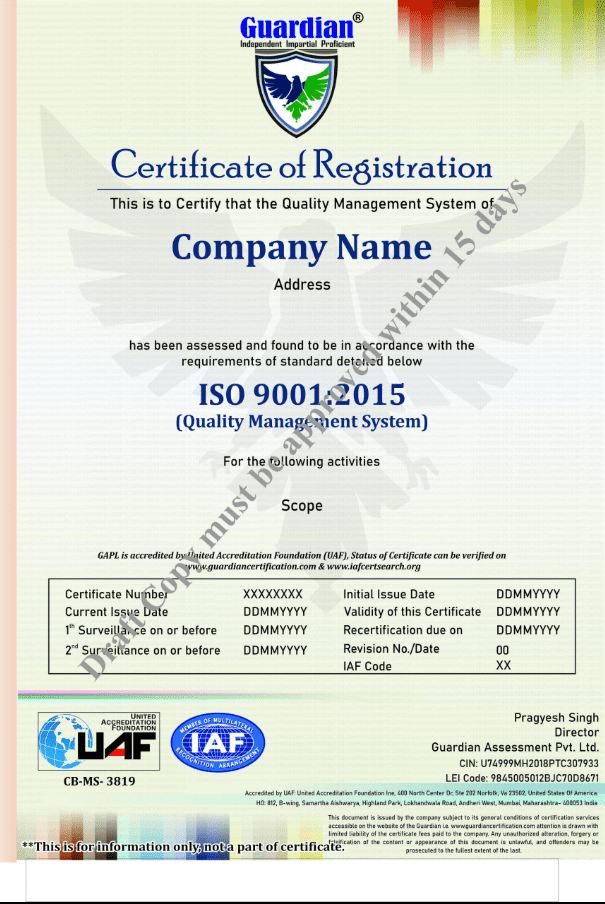
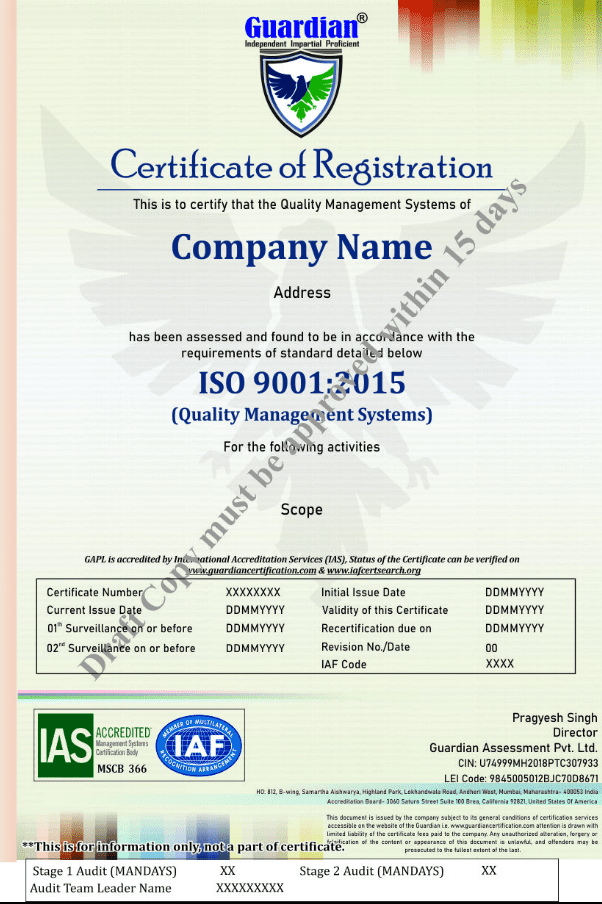
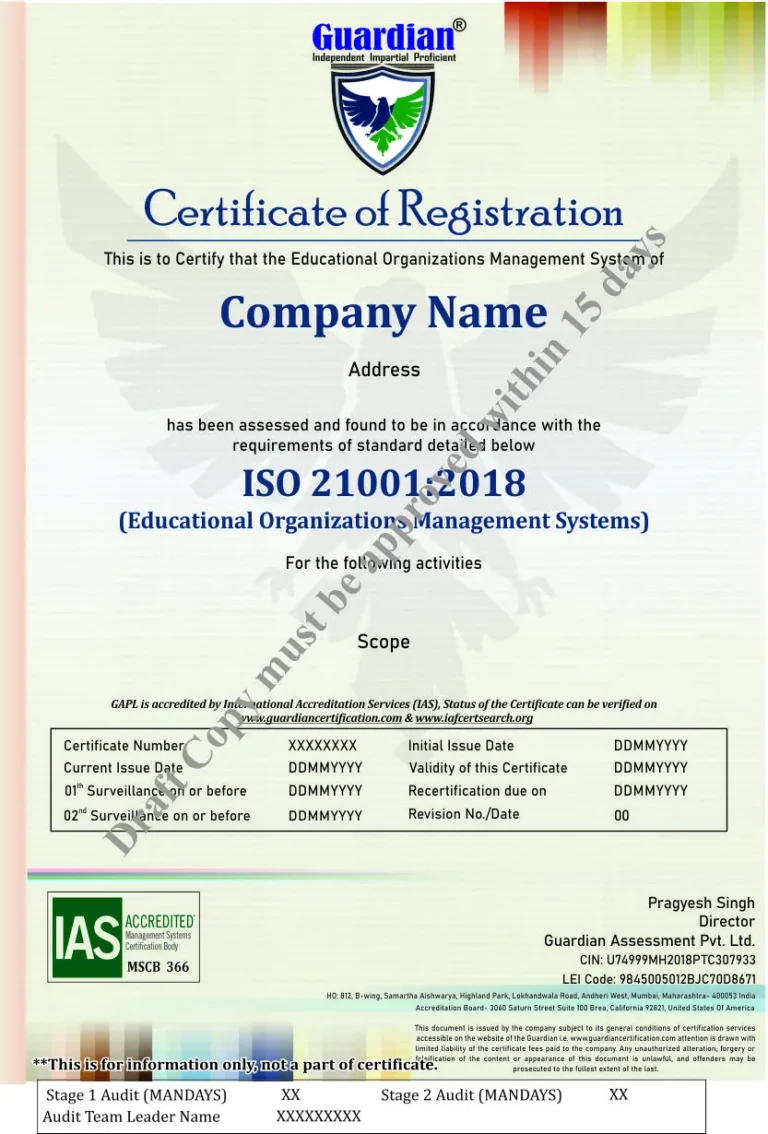
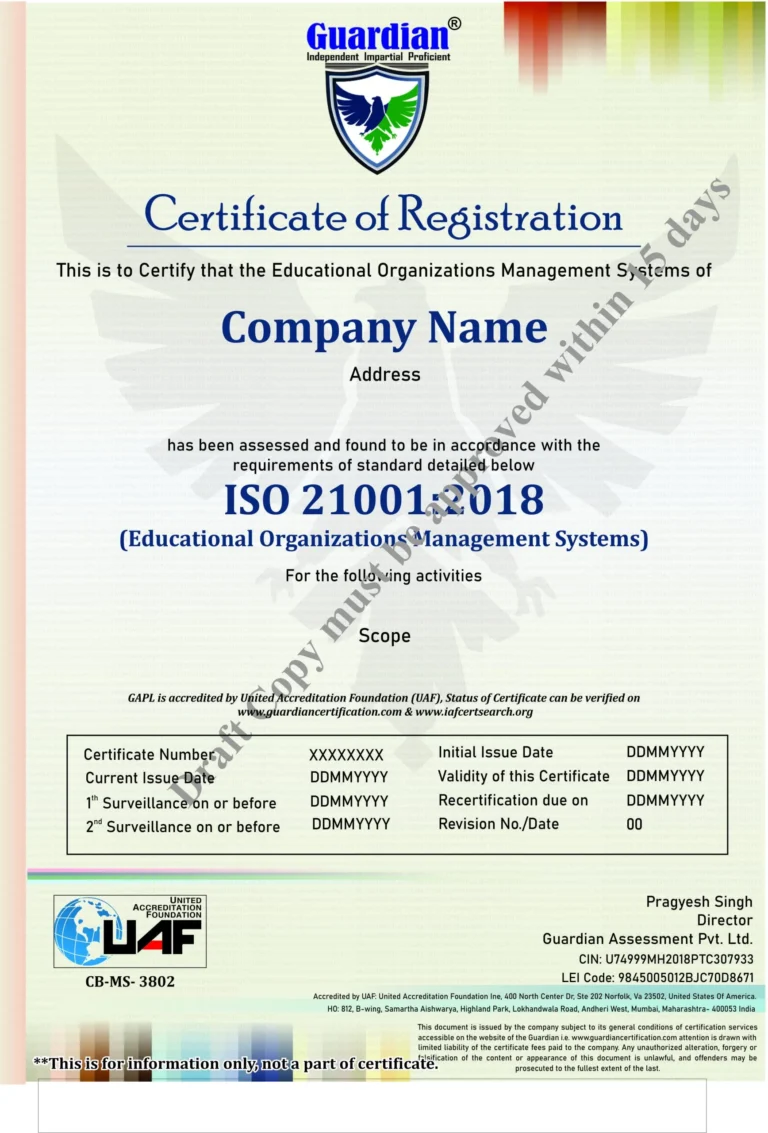
Sample Certificate
Request Quotation
Other Standards
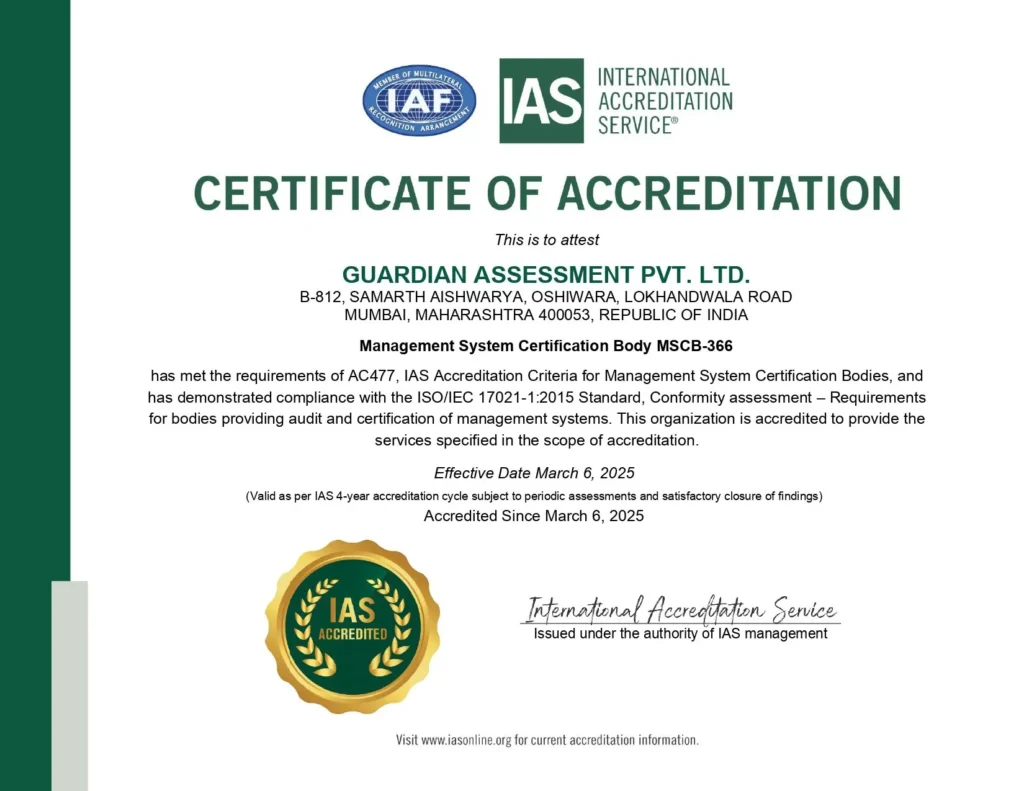
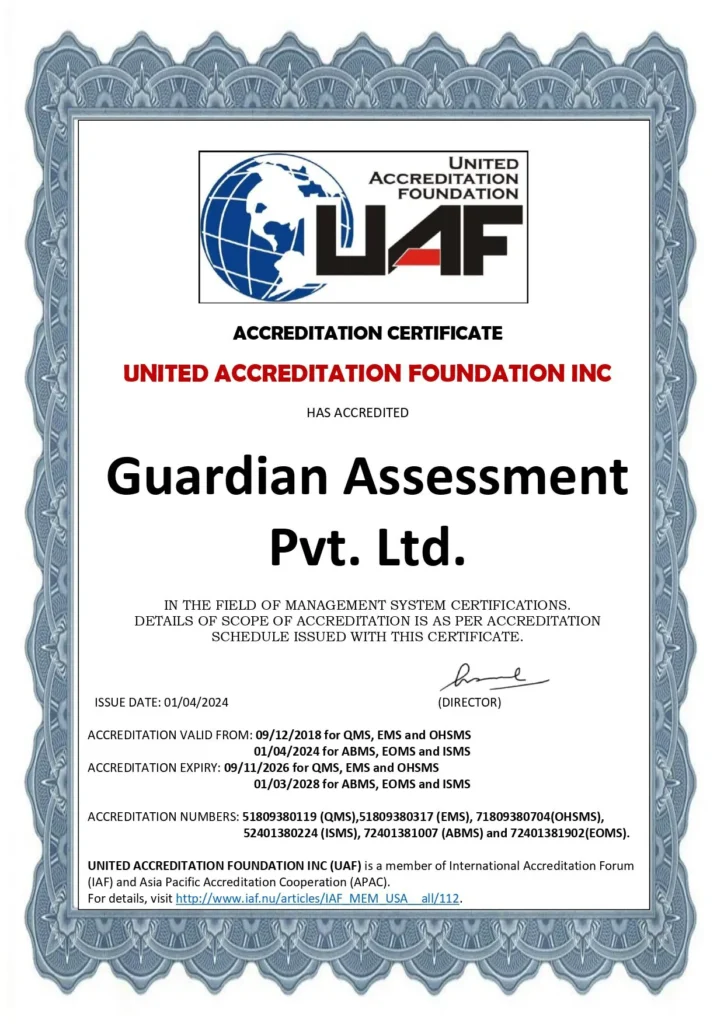
Recognition
Sample Certificate
The Evolution of ISO 21001 (2018 to 2025)
Since its first publication in 2018, ISO 21001 has provided an international framework for organizations delivering educational products and services. The standard has evolved to support consistent educational management practices and address developments affecting educational organizations.
ISO 21001:2018 — The First Edition: The first edition was published on April 30, 2018. It established requirements for an Educational Organizations Management System, with an emphasis on learner needs, educational processes, leadership, assessment, performance evaluation, and continual improvement. It provided a common framework for educational organizations of different types and sizes.
ISO 21001:2018/Amd 1:2024 — Climate Action Amendment: In February 2024, ISO published an amendment addressing climate action in ISO 21001:2018. It required organizations to consider whether climate change was a relevant issue in their organizational context and recognized that relevant interested parties may have climate-related requirements. This was an amendment to the 2018 edition, not a separate edition of ISO 21001.
ISO 21001:2025 — The Second Edition: Published on July 7, 2025, ISO 21001:2025 is the second edition of the standard. It cancels and replaces ISO 21001:2018, which had been technically revised, together with its 2024 climate-action amendment. The main technical change identified in the foreword is the revision of assessment-related text to reflect current best practices in educational assessment. Organizations certified to the 2018 edition should review the revised assessment requirements and confirm the transition arrangements applicable to their certification.
Why Was ISO 21001 Updated in 2025?
ISO 21001 was updated in 2025 to reflect current educational practices, particularly in the way organizations assess learners and record learning outcomes. The revised edition provides clearer requirements for assessment security, grade traceability, recognition of assessed learning, and the retention of assessment records. It also incorporates the 2024 climate-action amendment into the updated standard.
For organizations certified to ISO 21001:2018, the update means reviewing existing processes and making any necessary changes. It does not mean that the entire management system needs to be redesigned. The work required will depend on the organization’s current practices and the differences identified during its review.
What Has Changed in ISO 21001:2025?
The main changes in ISO 21001:2025 relate to learner assessment, particularly the requirements in Clauses 8.5.1.4 and 8.5.1.5. The revised wording gives organizations clearer direction on how assessments are secured, how grades are supported by evidence, and how results are communicated and recorded. The six key areas to review are explained below.
1. Updated Assessment-Related Requirements — Clauses 8.5.1.4 and 8.5.1.5: The 2025 edition gives greater clarity to requirements for summative assessments, such as final examinations, tests, and assignments used to evaluate learning outcomes. Organizations should review whether their assessment methods are suitable for the courses they provide and whether assessment results are properly evaluated and recorded.
For example, a training provider should be able to show how its examinations or practical assessments measure the learning outcomes of a course.
2. Clarified Assessment Security and Academic Integrity — Clause 8.5.1.4: The standard provides clearer requirements for preventing and detecting plagiarism and other forms of assessment malpractice. Organizations should establish suitable security measures and communicate them to learners, examination supervisors (proctors), and other relevant parties.
For example, an online learning provider may use identity checks, examination monitoring, and secure access to assessment materials to help prevent malpractice. The 2018 edition already addressed plagiarism and malpractice detection. The 2025 edition clarifies the expected measures and who should be informed about them.
3. Clearer Traceability of Assessment Results and Grades — Clause 8.5.1.4: The revised wording clarifies that there should be an objective connection between a learner’s assessment results and the grade awarded. Organizations should maintain records that explain how grades are determined and provide evidence to support grading decisions.
For example, a college should be able to link a learner’s examination answers or submitted work to the assessment results and final grade. This requirement was also present in the 2018 edition; the 2025 edition makes the wording clearer.
4. Greater Transparency in the Recognition of Assessed Learning — Clause 8.5.1.5: The 2025 edition clarifies the information and access learners should receive after an assessment. Learners should be informed of their scores and grades and have an opportunity to appeal or request corrections. They should also have access to their assessed work, relevant score details, and feedback. Organizations must retain documented information supporting assessment scores and grading decisions.
For example, an institution should have a clear process for sharing results, responding to learner appeals, and explaining assessment outcomes.
5. Updated Requirements for Assessment Record Retention — Clauses 8.5.1.4 and 8.5.1.5: Organizations must retain documented information supporting grades, assessment scores, and grading decisions for the specified period. The applicable record-retention period must also be made publicly available.
For example, an educational institution may maintain examination results, grading records, learner feedback, and appeal outcomes under a documented retention policy. These requirements were already included in the 2018 edition. The 2025 edition retains and clarifies them, including the reference to assessment scores.
6. Climate Change Considerations and the Updated Edition — Clauses 4.1 and 4.2: ISO 21001:2025 includes the climate-action requirements introduced through the 2024 amendment to the 2018 edition. Under Clause 4.1, organizations must determine whether climate change is relevant to their context. Clause 4.2 also recognizes that interested parties may have climate-related requirements.
For example, an educational organization may consider whether climate-related conditions could affect its facilities, learning environment, or continuity of educational services. Organizations should review these considerations as part of their EOMS. The 2024 amendment is incorporated into the 2025 edition and is not a separate current standard.
ISO 21001:2018 vs. ISO 21001:2025
The following table summarizes the main areas organizations should review when moving from ISO 21001:2018 to ISO 21001:2025. It is a high-level comparison, not a substitute for a clause-by-clause assessment of the published standards.
Area | ISO 21001:2018 | ISO 21001:2025 |
Edition status | First edition | Second edition and current edition |
Assessment-related text | Contains requirements for learner assessment and recognition of assessed learning | Revises assessment-related text to reflect current best practices in educational assessment |
Assessment security | Requires methods to detect plagiarism and other malpractices and communicate them to learners | Clarifies the need for adequate measures to prevent and detect plagiarism and other malpractices, communicated to learners, proctors, and other interested parties |
Traceability of grades | Requires an objective connection between learner work presented and the grade assigned | Refers to an objective connection between a learner’s assessment results and the grade assigned |
Recognition of assessed learning | Addresses communication of assessment outcomes and grades, appeals, access to work, feedback, and documented evidence | Clarifies communication of assessment scores and grades, appeals or rectification, access to assessment-score details, and documented evidence of assessment scores |
Assessment record retention | Requires assessment records as evidence of grades and public availability of the retention period | Retains these requirements and clarifies the documented information relating to assessment scores and grading decisions |
Climate considerations | Climate-action amendment applies through ISO 21001:2018/Amd 1:2024 | Replaces the 2018 edition together with its climate-action amendment; climate considerations remain addressed |
Transition | Previous edition | Transition arrangements depend on the applicable accreditation and certification requirements |
Important: The main technical revision identified by ISO concerns assessment-related text. Several assessment controls, including grade traceability and record-retention expectations, were already present in the 2018 edition. The comparison should not be interpreted as meaning that every topic listed above is an entirely new requirement. Organizations should consult the published standard to determine the precise changes relevant to their EOMS.
Benefits of ISO 21001:2025 Certification
ISO 21001:2025 certification can help educational organizations demonstrate that their Educational Organizations Management System has been assessed against the applicable requirements of the revised standard. Its practical value depends on how effectively the organization implements and maintains its EOMS.
- More Structured Educational Management: An EOMS helps define responsibilities, establish educational processes, and monitor the performance of educational services. This can make educational management more consistent across the organization. For example, a school or training provider can use its EOMS to coordinate curriculum planning, teaching activities, learner support, assessment, and performance evaluation.
- Stronger Focus on Learner Needs: The standard places learners and other beneficiaries at the centre of the management system. Organizations can use the framework to identify learner needs, monitor satisfaction, evaluate educational progress, and review whether their services are meeting intended requirements. This can help educational organizations make more informed decisions about teaching methods, learner support, and improvements to educational services.
- Improved Assessment Management and Transparency: The revised assessment-related requirements help organizations review assessment security, grading traceability, communication of results, learner feedback, appeals, and record retention. A structured approach can support consistent assessment practices and provide clearer evidence of how learner results are evaluated and recorded.
- Support for Inclusive and Accessible Education: ISO 21001 includes requirements and guidance relating to accessibility, equity, and learners with special needs. An EOMS can help organizations consider different learner requirements and review whether suitable support arrangements are available. For example, an educational institution may review its learning environment, teaching resources, support services, and assessment methods to identify reasonable ways of addressing different learner needs within its capacity and applicable requirements.
- A Framework for Continual Improvement: Monitoring, internal audits, management reviews, learner feedback, and corrective actions help organizations identify opportunities to improve their EOMS over time. Rather than treating educational quality as a one-time project, organizations can use the system to evaluate performance, address gaps, and review progress toward educational objectives.
Which Educational Organizations Can Get ISO 21001:2025 Certified?
ISO 21001:2025 is designed for educational organizations of different types and sizes. It is not limited to schools or universities. Any organization that provides, supports or facilitates education and learning can implement an Educational Organization Management System (EOMS) and seek ISO certification for education, provided its activities fall within the standard’s scope. Some key types of educational organizations include:
- Schools and K-12 Institutions: Primary, secondary and higher secondary schools can use ISO 21001 to improve teaching processes, student support, learning outcomes and educational service delivery.
- Colleges and Universities: Higher education institutions can use an EOMS to manage academic activities, curriculum development, student services, faculty responsibilities and educational performance.
- Vocational and Technical Training Institutes: Skill development centers, technical institutes and vocational training providers can establish consistent processes for practical training, competency development and learner assessment.
- Coaching and Tutoring Centers: Coaching institutes, private tutoring centers and examination preparation providers can use the standard to improve teaching quality, learner support and training delivery.
- Online and E-Learning Providers: Digital learning platforms, online education companies and virtual training providers can manage course delivery, digital learning resources, learner support and online assessments.
- Professional Training Organizations: Organizations providing professional development, corporate training, leadership programs and workplace learning can use ISO 21001 to improve training design and delivery.
These are examples rather than a complete list. ISO 21001:2025 can also apply to public, private and non-profit educational organizations, including educational departments within larger organizations. The certification scope should accurately describe the educational products and services, activities, locations and processes covered by the EOMS. The standard does not apply to organizations that only manufacture educational products.
ISO 21001:2025 Transition Deadline and Timeline
ISO 21001:2025 was published on July 7, 2025, replacing ISO 21001:2018 and its Amendment 1:2024. However, ISO’s published standard information does not specify a universal transition deadline for all organizations holding ISO 21001:2018 certificates.
Transition arrangements for accredited certification can depend on the applicable accreditation body’s requirements and the certification body’s procedures. Organizations should obtain written confirmation of the applicable transition schedule rather than assume that a standard three-year transition period automatically applies. The following table summarizes the relevant publication and transition information.
Date | Transition milestone |
April 30, 2018 | ISO 21001:2018, the first edition, was published |
February 23, 2024 | ISO 21001:2018/Amd 1:2024 on climate action was published |
July 7, 2025 | ISO 21001:2025, the second edition, was published and replaced the 2018 edition and its amendment |
June 30, 2026 | ISO/PAS 25171:2026, providing guidance for auditing ISO 21001:2025, was published |
July 7, 2027 | Deadline listed in IAS accreditation documentation for existing certification bodies to complete their transition to ISO 21001:2025 |
To be confirmed | The applicable transition deadline for an organization holding an ISO 21001:2018 certificate should be confirmed with its certification body |
The July 7, 2027 date relates to the transition of existing certification bodies under the applicable IAS accreditation arrangements. It should not be interpreted as a universal certificate-holder deadline. Organizations should confirm the applicable arrangements with their own certification body and, where necessary, the relevant accreditation body.
ISO/PAS 25171:2026 provides guidance for auditing ISO 21001:2025, including examples of audit questions, objective evidence, and measures for evaluating ongoing conformity. It is an auditing guidance document and does not replace the requirements of ISO 21001:2025.
When Should Your Organization Start Preparing?
It is sensible to begin reviewing your EOMS as soon as possible. Waiting until the applicable transition deadline is close may leave insufficient time to review assessment arrangements, update documented information, implement corrective actions, and complete the certification decision. A practical preparation plan is to:
- Obtain and review ISO 21001:2025 and identify the requirements relevant to your educational organization.
- Compare the revised edition with your existing EOMS.
- Review assessment security, grading procedures, learner feedback, appeals, and record-retention arrangements.
- Identify gaps in documented information and implementation.
- Update relevant educational processes and responsibilities.
- Communicate revised procedures to educators, staff, learners, and other relevant interested parties.
- Agree on the applicable transition audit schedule with your certification body.
- Allow time to address audit findings and complete the certification decision.
The timing should reflect your existing certification cycle, operational needs, and the transition arrangements applicable to your certification body.
How to Transition from ISO 21001:2018 to ISO 21001:2025
Organizations already certified to ISO 21001:2018 can use the following roadmap to prepare for the revised edition.
Step 1: Review the Published Standard: Obtain and review ISO 21001:2025. Identify the revised requirements and clarifications relevant to your existing Educational Organizations Management System. Pay particular attention to the updated assessment-related requirements in Clauses 8.5.1.4 and 8.5.1.5, including assessment security, traceability of grades, recognition of assessed learning, and assessment record retention. Use the published standard as the basis for determining the changes that apply to your organization rather than relying solely on unofficial summaries.
Step 2: Conduct a Gap Assessment: Compare your existing EOMS with the requirements of ISO 21001:2025. Identify areas where assessment procedures, learner communication, grading arrangements, documented information, responsibilities, or implementation practices may need attention. A gap assessment helps prioritize necessary actions instead of making unnecessary changes across the entire management system.
Step 3: Update Your Educational Organizations Management System: Revise the relevant parts of your EOMS based on the findings. This may involve reviewing assessment methods, examination security, grading procedures, learner appeals, feedback arrangements, assessment records, and documented retention periods. Also review the climate-related considerations in Clauses 4.1 and 4.2 and their relevance to your organization. The extent of the changes will depend on how effectively your current system already meets the applicable requirements.
Step 4: Communicate Changes to Employees and Learners: Ensure that educators, examination supervisors, administrative staff, and other relevant personnel understand any revised responsibilities or procedures that affect their work. Training and communication should be appropriate to each person’s role. Learners should also receive relevant information about assessment arrangements, examination security, grading, feedback, appeals, and other applicable procedures.
Step 5: Check Implementation and Evidence: Review whether the updated EOMS is being implemented in practice. Relevant evidence may include assessment records, examination security procedures, grading records, learner feedback, appeal records, training records, internal audit findings, management review outputs, and records of actions taken, as applicable. Address identified gaps before the transition audit.
Step 6: Arrange the Transition Audit: Contact your certification body to agree on the transition arrangements and audit schedule. The audit will assess the EOMS against the applicable requirements of ISO 21001:2025. If nonconformities are identified, the organization will need to address them in accordance with the certification body’s procedures. The transition is complete only when the applicable certification requirements and decision process have been satisfied within the relevant deadline.
Can the Transition Audit Be Combined with a Surveillance or Recertification Audit?
It may be possible to conduct the transition assessment during a scheduled surveillance audit, a recertification audit, or as a separate transition audit. The permitted arrangements depend on the applicable accreditation requirements and the procedures of your certification body. The most suitable option depends on your certification cycle, audit requirements, readiness, and the transition arrangements offered by your certification body. Before confirming the schedule, discuss the following:
- Whether your existing audit date can accommodate the transition assessment.
- What additional audit time or evidence may be required.
- Whether your EOMS review and implementation activities will be complete before the audit.
- How any nonconformities will be addressed.
- Whether there is sufficient time to complete the certification decision before the applicable deadline.
Combining audits may help coordinate the assessment with your existing certification cycle, but it does not remove the need to meet the revised requirements or complete the transition within the applicable deadline.
What Happens If Your Organization Misses the Transition Deadline?
Organizations holding ISO 21001:2018 certification should confirm the applicable transition deadline with their certification body. The withdrawal of the 2018 edition by ISO does not, by itself, establish a single certificate-expiry date for every accredited certification arrangement.
Where an applicable accreditation or certification arrangement sets a transition deadline, failure to complete the transition may affect the validity or recognition of the existing certificate under that arrangement. The consequences will depend on the applicable requirements and the certification body’s procedures.
This can affect an organization’s ability to demonstrate current ISO 21001 certification to learners, parents, employers, business partners, procurement teams, or other interested parties. The practical consequences will also depend on the requirements of the relevant customer, contract, tender, or educational recognition process. Organizations should not assume that every interested party applies identical acceptance rules.
To reduce the risk of a delayed transition:
- Confirm the applicable transition deadline with your certification body.
- Start the gap assessment early.
- Agree on an audit schedule with your certification body.
- Complete necessary EOMS updates before the audit.
- Allow time to address any audit findings.
- Confirm that the certification decision and updated certificate can be completed within the applicable deadline.
How to Get ISO 21001:2025 Certification
Organizations applying for certification for the first time can establish and implement their Educational Organizations Management System against the 2025 edition. Existing certificate holders should follow the transition route applicable to their current certification. A typical certification process includes the following activities.
- Application Review: Provide information about your organization, educational activities, locations, and proposed certification scope. This information helps determine the applicable certification arrangements.
- Audit Planning: The audit arrangements are planned according to the organization’s scope, educational activities, size, complexity, and applicable certification requirements.
- Educational Organizations Management System Assessment: The audit team evaluates relevant documented information, implementation, and evidence against the applicable requirements of ISO 21001:2025. This may include reviewing educational policies, learner requirements, curriculum planning, teaching and learning processes, assessment arrangements, learner support, and performance evaluation.
- Audit Findings and Corrective Actions: If nonconformities are identified, the organization must address them in accordance with the certification body’s procedures and provide the required evidence.
- Certification Decision: The certification body reviews the audit outcome and determines whether the applicable certification requirements have been met.
- Certificate Issuance: A certificate is issued when the applicable requirements and certification decision process have been satisfied.
The exact arrangements depend on the type of application, the organization’s circumstances, and the certification body’s procedures. ISO 21001 certification does not replace applicable statutory approvals, institutional accreditation, programme accreditation, or other educational recognition requirements.
For more information about the general process, visit the ISO Certification Process page.
Documents to Review Before Transitioning to ISO 21001:2025
There is no single document list that applies identically to every educational organization. The documented information and records needed depend on the organization’s educational activities, EOMS scope, learner requirements, assessment methods, and applicable requirements. As part of your transition preparation, consider reviewing:
- Educational organization policy and EOMS scope.
- Identification of learners, other beneficiaries, and relevant interested parties and their needs.
- Educational objectives and plans for achieving them.
- Curriculum and educational programme documentation.
- Learning outcomes and assessment criteria.
- Teaching, learning, and educational service delivery procedures.
- Learner admission criteria and relevant admission records.
- Assessment procedures, including formative and summative assessment arrangements.
- Examination security procedures and controls for preventing and detecting plagiarism and other malpractices.
- Records showing that relevant assessment security measures have been communicated to learners, proctors, and other interested parties.
- Grading procedures and records demonstrating the traceability of assessment results.
- Learner assessment results, evidence of assessment scores, and grading decision records.
- Learner feedback, appeals, and rectification records.
- Assessment record-retention policies and information about applicable retention periods.
- Arrangements for learners with special needs and relevant learner support.
- Competence, awareness, and training records for educators and staff.
- Learner satisfaction, monitoring, measurement, and educational performance records.
- Internal audit programmes, records, and findings.
- Management review records and resulting actions.
- Nonconformities and corrective action records.
- Relevant information about externally provided educational processes, products, and services.
- Climate-related considerations where relevant to the organization’s context and interested parties.
This is a preparation checklist, not a universal mandatory document list. Review the applicable requirements to determine what your organization needs to maintain or update. The records and documented information should be appropriate to the organization’s activities and the requirements of ISO 21001:2025.
Why Choose Guardian as Your ISO 21001 Certification Body
- Accreditation by UAF and IAS. Guardian holds accreditation from UAF and IAS for applicable management system certification activities. Confirm that ISO 21001:2025 and the relevant educational organization sectors are covered by the current accreditation scopes.
- Auditors who understand educational organizations. We assign auditors based on the organization’s educational activities, EOMS scope and operational context.
- Impartial certification process. We assess and certify management systems without providing consultancy on the systems we certify. Certification decisions are reviewed independently.
- Integrated management system audits. Organizations can combine ISO 21001 with other applicable management system standards, where the certification scopes and audit arrangements permit.
- Based in India. Our head office is in Lucknow, Uttar Pradesh, and we provide certification services to educational organizations across India.
- Certificate transfer support. Organizations holding an eligible accredited ISO 21001 certificate from another certification body can explore transferring their certification to Guardian, subject to a review of the existing certificate, audit history and applicable transfer requirements.
Apply for ISO 21001:2025 Certification
Guardian Assessment Pvt. Ltd., accredited by UAF (United Accreditation Foundation) and IAS (International Accreditation Service) for applicable management system certification activities. Eligible certificates can be verified through the IAF CertSearch global database.
Apply for ISO 21001:2025 certification and take the next step towards improving your educational management system.
Frequently Asked Questions
ISO 21001:2025 is the second edition and replaces ISO 21001:2018 and its 2024 climate action amendment. The updated edition retains the EOMS framework, with its main technical changes focusing on assessment-related requirements and current educational practices.
The certification timeline depends on the organization's size, number of locations, educational activities and readiness of its management system. The process generally includes application, audit planning, Stage 1 audit, Stage 2 audit and certification decision.
An ISO 21001:2025 certificate is generally issued for a three-year certification cycle, subject to successful surveillance audits and continued compliance with the standard. Surveillance audits are normally conducted annually, with recertification required before the certification cycle ends.
Yes. Educational organizations can integrate ISO 21001:2025 with other management system standards, depending on their needs and activities. Common combinations include ISO 9001 for quality management, ISO 14001 for environmental management, ISO 45001 for occupational health and safety, ISO/IEC 27001 for information security and ISO 37001 for anti-bribery management.
An organization can get ISO 21001:2025 certification by applying to a certification body, defining the EOMS scope and implementing the standard's requirements. The certification body then conducts Stage 1 and Stage 2 audits. If the organization meets the applicable requirements and addresses any identified nonconformities, the certification decision can be made.