
Environmental responsibilities are becoming an important part of how businesses manage their operations, resources, and long-term risks. ISO 14001:2026 provides an updated framework to help organizations manage these responsibilities through an Environmental Management System (EMS).
Published on April 15, 2026, ISO 14001:2026 is the fourth edition of the international environmental management standard. It replaces ISO 14001:2015, including Amendment 1:2024 on climate action. The revised edition builds on the existing framework, with clearer guidance, improved structure, and clarification of key requirements. If your organization is already certified to ISO 14001:2015, you should begin planning the transition to the 2026 edition. Under the applicable Global ACI transition requirements, the transition period ends on April 30, 2029. Organizations applying for certification for the first time should prepare their Environmental Management System against the current edition.
This guide explains the evolution of ISO 14001 certification, the key updates in the 2026 edition, the benefits of certification, and the practical steps organizations can take to prepare for certification or transition.
Guardian Certification is an internationally accredited certification body providing ISO 14001:2026 certification under its applicable UAF and IAS accreditation scopes. Whether you are applying for ISO 14001 certification for the first time or transitioning from ISO 14001:2015, our experienced auditors provide structured guidance throughout the certification process. We support organizations in establishing and demonstrating an effective Environmental Management System (EMS), helping them prepare for certification in a clear, systematic, and internationally aligned manner.
Planning your certification or transition? Contact Guardian Assessment Private Limited to discuss your requirements and the applicable certification arrangements.

Request Quotation
ISO 14001:2026 Key Facts At-a-Glance
Key Information | Details |
Standard | ISO 14001:2026 |
Full Title | Environmental Management Systems — Requirements with Guidance for Use |
Edition | Fourth edition |
Publication Date | April 15, 2026 |
Previous Edition | ISO 14001:2015 |
Previous Amendment | ISO 14001:2015/Amd 1:2024 |
Transition Deadline | April 30, 2029, under applicable Global ACI transition requirements |
Certifying Body | Guardian Assessment Private Limited |
Accreditation | UAF-accredited and IAS-accredited (confirm that ISO 14001:2026 is included in the current applicable scope) |
Validity / Applicability | Applicable to organizations of different sizes, types, and industries worldwide |
Main Purpose | To help organizations manage environmental responsibilities through a structured environmental management system |
The 2026 edition retains the established Environmental Management System framework while clarifying selected requirements and improving how the standard can be understood and applied.
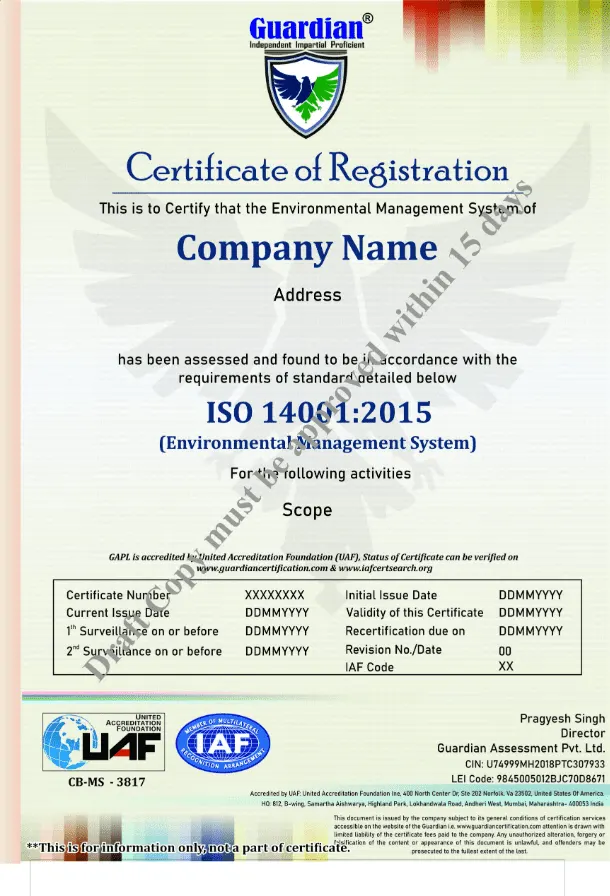
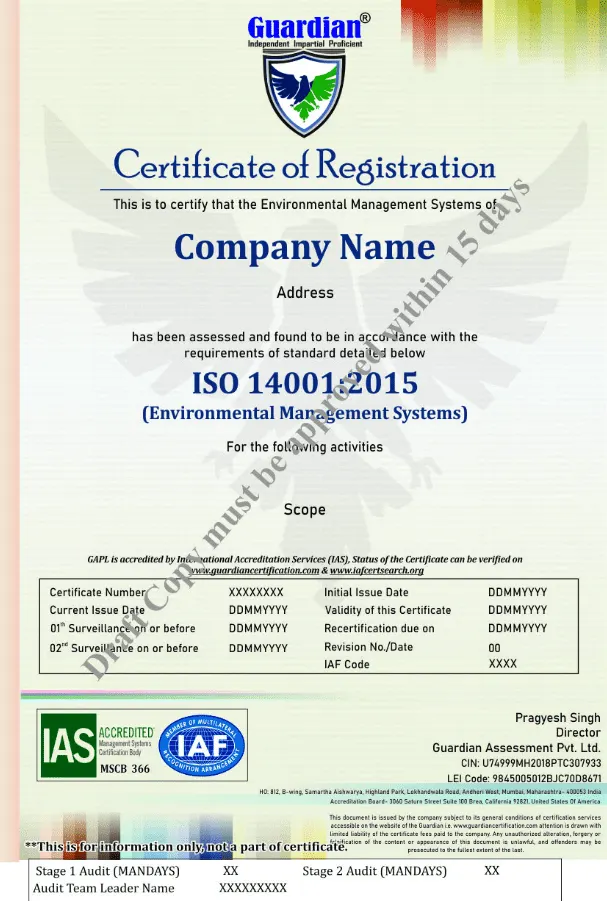
Sample Certificate
Request Quotation
Other Standards
Recognition


Sample Certificate
What is ISO 14001:2026 Certification?
ISO 14001:2026 is an international standard that specifies requirements for an Environmental Management System. An EMS helps an organization identify and manage the environmental aspects of its activities, meet applicable compliance obligations, address relevant risks and opportunities, and work toward its environmental objectives.
Environmental aspects vary depending on an organization’s operations. For example, a manufacturing business may need to manage energy consumption, wastewater, emissions, and production waste. A logistics company may focus on fuel use, vehicle maintenance, packaging waste, and the environmental effects of transportation. An EMS provides a structured way to address these responsibilities. It helps organizations establish an environmental policy, assign responsibilities, set objectives, monitor performance, and improve their processes over time.
ISO 14001:2026 does not require every organization to follow an identical environmental program. The system should reflect the organization’s activities, environmental aspects, applicable compliance obligations, and relevant risks and opportunities. Certification involves an assessment by a certification body against the applicable requirements of the standard. The certificate covers the approved certification scope, including the activities and locations identified in the certification documents.
The Evolution of ISO 14001 (1996 to 2026)
Since its first publication in 1996, ISO 14001 has evolved to help organizations manage their environmental responsibilities through a structured Environmental Management System. Each edition has refined the framework to improve its relevance and application across different industries.
ISO 14001:1996 — The First Edition: The first edition of ISO 14001 was published in September 1996. It established an international framework for organizations to develop an Environmental Management System, set environmental objectives, and consider applicable legal requirements and significant environmental impacts.
ISO 14001:2004 — Clarifying EMS Requirements: The second edition was published in November 2004. It clarified requirements for implementing and maintaining an EMS, helping organizations understand their environmental responsibilities and apply the standard more consistently.
ISO 14001:2015 — A Broader Management Approach: The third edition was published in September 2015. It introduced a revised structure aligned with the common framework used by other management system standards. It also strengthened the focus on organizational context, leadership, risks and opportunities, and a life cycle perspective when considering environmental aspects.
ISO 14001:2024 — Climate Action Amendment: In 2024, ISO introduced a climate-action amendment to ISO 14001:2015. It required organizations to consider whether climate change was a relevant issue in their organizational context and recognized that relevant interested parties may have climate-related requirements. This was an amendment to the 2015 edition, not a separate edition of ISO 14001.
ISO 14001:2026 — The Fourth Edition: Published on April 15, 2026, ISO 14001:2026 is the fourth edition of the standard. It replaces ISO 14001:2015 together with the 2024 climate-action amendment. The updated edition builds on the established EMS framework, clarifies key topics, and improves the standard’s usability. Organizations certified to ISO 14001:2015 should review the revised requirements and plan their transition under the applicable certification arrangements.
Why Was ISO 14001 Updated in 2026?
ISO 14001:2026 was developed to improve the clarity and usability of the standard while keeping its central purpose: helping organizations manage their environmental responsibilities systematically. The revision reflects current environmental priorities, including climate change, biodiversity, resource efficiency, and the relationship between environmental conditions and business operations. It also aligns the standard with the latest applicable requirements for management system standards.
For organizations already using ISO 14001:2015 certification, the update provides an opportunity to review how their EMS operates and identify any adjustments needed under the revised requirements. Organizations seeking certification for the first time can use the 2026 edition as the basis for establishing their EMS. The changes do not mean that every organization needs to rebuild its environmental management system from the beginning. The amount of work required depends on the existing system, the organization’s activities, and the differences identified during its review.
What Has Changed in ISO 14001:2026?
ISO describes the 2026 edition as a refinement of the existing framework, with clearer requirements and guidance. The changes include a more structured approach to risks and opportunities, change management, external providers, internal audits, and management reviews.
The following sections explain the principal areas organizations should review when preparing for the revised edition. The precise changes applicable to an organization should be confirmed against the published standard rather than inferred from a general summary.
1. Clearer Planning for Risks and Opportunities — Clause 6.1.4: The revised edition introduces a more clearly structured approach to planning actions related to risks and opportunities. Organizations should review how they identify and evaluate relevant environmental risks and opportunities and how they determine appropriate actions. These actions should connect with the organization’s environmental aspects, compliance obligations, objectives, and operational circumstances.
For example, a manufacturing company may need to consider risks associated with water availability, waste generation, pollution, or changing environmental conditions. It should then determine which actions are appropriate and how their effectiveness will be evaluated. The purpose is to make environmental planning more systematic and better connected to business decisions.
2. A Formalized Approach to Managing Change — Clause 6.3: ISO 14001:2026 includes a dedicated clause addressing the planning and management of changes. Changes to equipment, materials, processes, facilities, or suppliers can affect environmental aspects and operational controls. Organizations should consider relevant environmental implications when planning changes and determine whether their existing EMS arrangements remain suitable.
For example, introducing a new production process may change energy consumption, waste generation, emissions, or the controls needed to prevent pollution. Reviewing these implications before implementation can help the organization identify and manage potential issues. Organizations should review their current change-management practices against the requirements of Clause 6.3 and determine what adjustments are needed.
3. Greater Clarity on External Providers
The revised wording places clearer emphasis on externally provided processes, products, and services. An organization’s environmental performance may be influenced by suppliers, contractors, outsourced processes, and other external providers. Businesses should review how they determine and manage relevant environmental requirements for these relationships.
For example, a manufacturer may need to consider how waste collection, material supply, transportation, or outsourced production activities affect its environmental objectives and controls. The level of control or influence will vary by activity. Organizations should identify the relevant relationships and establish appropriate arrangements based on their environmental aspects and applicable requirements.
4. More Structured Internal Audit Requirements: Internal audits help organizations determine whether their Environmental Management System meets the applicable requirements and is being implemented effectively. The 2026 edition clarifies aspects of the internal audit process, including audit programmes and objectives. Organizations should review how they plan, conduct, document, and follow up on internal audits. A practical review should consider whether:
- The internal audit programme reflects the importance of the processes and relevant changes.
- Audit objectives and criteria are clearly established.
- Audits provide evidence of how the EMS is implemented.
- Findings are communicated to the appropriate people.
- Corrective actions are taken where necessary and their effectiveness is reviewed.
The aim is to make internal auditing a useful tool for evaluating the EMS rather than treating it as a routine documentation exercise.
5. A More Structured Management Review: Management reviews help top management evaluate whether the Environmental Management System remains suitable, adequate, and effective. The revised edition clarifies the structure and expectations of this process. Organizations should review how management considers environmental performance, progress toward objectives, audit findings, compliance-related information, changes in relevant circumstances, and opportunities for improvement.
For example, management may review whether environmental objectives are being achieved, whether operational controls remain effective, and whether resources or responsibilities need to change. The review should support decisions and actions, not simply record that a meeting has taken place.
6. Clearer Guidance on Environmental Context and Life Cycle Perspective: The 2026 edition also improves the clarity of guidance on environmental context and the life cycle perspective. Organizations should consider relevant environmental conditions, such as climate change, pollution, biodiversity, ecosystem health, and resource availability, when evaluating their context and determining what is relevant to their EMS.
A life cycle perspective helps an organization consider relevant environmental effects beyond an individual activity or location. Depending on its ability to control or influence those effects, this may include raw materials, product design, purchasing, transportation, use, and end-of-life treatment. These topics were already part of the broader environmental management framework. The 2026 edition provides clearer guidance on how they fit into the system; organizations should not assume that every topic represents a completely new requirement.
ISO 14001:2015 vs. ISO 14001:2026
The following table summarizes the main areas organizations should review. It is a high-level comparison, not a substitute for a clause-by-clause assessment of the published standards.
Area | ISO 14001:2015 | ISO 14001:2026 |
Edition status | Previous edition | Current edition |
Climate considerations | Includes the 2024 climate-action amendment when applied | Replaces the 2015 edition and its 2024 amendment |
Risks and opportunities | Addresses environmental risks and opportunities | Provides a more structured approach, including Clause 6.1.4 |
Managing change | Organizations manage changes through relevant EMS arrangements | Includes a dedicated clause on planning and managing changes, Clause 6.3 |
External providers | Addresses relevant outsourced processes and operational controls | Clarifies wording relating to externally provided processes, products, and services |
Internal audits | Requires internal audits of the EMS | Clarifies aspects of audit programmes and objectives |
Management review | Requires top management to review the EMS | Provides a more structured approach to management review |
Environmental context | Requires consideration of relevant internal and external issues | Clarifies guidance on environmental conditions and their relevance |
Life cycle perspective | Requires consideration of a life cycle perspective when addressing environmental aspects | Clarifies aspects of applying this perspective |
Transition | Previous edition | Transition under applicable arrangements ends April 30, 2029 |
Important: The revision clarifies and reorganizes requirements; it should not be interpreted as meaning that every topic listed above is entirely new. Organizations should consult the published standard to determine the precise changes relevant to their EMS.
Benefits of ISO 14001:2026 Certification
ISO 14001:2026 certification can help organizations demonstrate that their Environmental Management System has been assessed against the applicable requirements of the revised standard. Its practical value depends on how well the organization implements and maintains its EMS.
1. More Structured Environmental Management: An EMS helps define responsibilities, establish controls, and monitor environmental performance. This can make environmental management a more consistent part of daily operations.
For example, a manufacturing business can use its EMS to establish procedures for handling waste, monitoring resource consumption, and managing activities that may affect the environment.
2. Better Visibility of Environmental Risks: Reviewing environmental aspects, risks, and compliance obligations can help management identify issues that need attention and prioritize suitable actions. This may include evaluating risks associated with resource use, waste handling, pollution, environmental emergencies, and changing operating conditions.
3. Support for Environmental Objectives: The framework helps organizations set environmental objectives, monitor progress, and evaluate whether their actions are achieving the intended results. Depending on the organization’s priorities, objectives may relate to reducing waste, improving resource efficiency, monitoring emissions, or strengthening operational controls.
4. Improved Preparation for Customer Requirements: Some customers, supply chains, and tenders may ask suppliers to demonstrate environmental management arrangements or hold ISO 14001 certification. Requirements vary, so organizations should check the specific contract or tender conditions. Maintaining an effective EMS can help an organization provide documented evidence of its environmental management approach when such information is requested.
5. A Framework for Continual Improvement: Monitoring, internal audits, management reviews, and corrective actions help organizations identify opportunities to improve their EMS over time. Rather than treating environmental management as a one-time project, organizations can use the system to review performance, address gaps, and evaluate progress toward their objectives. Certification does not guarantee zero environmental impact, automatic legal compliance, or acceptance by every customer. Its value depends on effective implementation and the needs of the organization and its stakeholders.
ISO 14001:2026 Transition Deadline and Timeline
Global ACI has published transition requirements for moving from ISO 14001:2015, including Amendment 1:2024, to ISO 14001:2026. These requirements are mandatory for Global ACI Multilateral Recognition Arrangement signatories and their accredited certification bodies operating within the applicable scope. Organizations should confirm which transition requirements apply to their certification arrangements.
Under the applicable Global ACI timetable, the transition period ends on April 30, 2029.
Date | Transition milestone |
April 15, 2026 | ISO 14001:2026 was published |
October 31, 2026 | Accreditation bodies are expected to be ready to assess against the revised edition |
January 31, 2027 | Certification bodies must submit their transition declaration and supporting information under the Global ACI timetable |
April 30, 2027 | Accreditation-body transition decisions are to be completed under the timetable |
October 31, 2027 | From this date, new and initial accredited certifications may only be issued to ISO 14001:2026 under the applicable transition requirements |
April 30, 2029 | Deadline for organizations certified to ISO 14001:2015 to complete their transition under the applicable arrangements |
When Should Your Business Start Preparing?
It is sensible to begin reviewing your EMS well before the final deadline. Waiting until the last few months may leave insufficient time to address audit findings, implement corrective actions, and complete the certification decision. A practical preparation plan is to:
- Review ISO 14001:2026 and identify the requirements relevant to your organization.
- Compare the revised edition with your existing EMS.
- Identify gaps in documented information and implementation.
- Update relevant environmental controls and responsibilities.
- Train employees and communicate changes where needed.
- Agree on a transition audit schedule with your certification body.
- Allow time to close any nonconformities and complete the transition.
The timing should reflect your existing certification cycle, operational needs, and your certification body’s transition arrangements.
How to Transition from ISO 14001:2015 to ISO 14001:2026
Organizations already certified to ISO 14001:2015 can use the following roadmap to prepare for the revised edition.
Step 1: Review the Published Standard: Obtain and review ISO 14001:2026. Identify the revised requirements and clarifications relevant to your existing Environmental Management System. Use the published standard as the basis for determining the changes that apply to your organization rather than relying solely on unofficial summaries.
Step 2: Conduct a Gap Assessment: Compare your existing EMS with the revised requirements. Identify areas where documentation, responsibilities, operational controls, internal audits, management reviews, or implementation practices may need attention. A gap assessment helps prioritize actions instead of making unnecessary changes across the entire management system.
Step 3: Update Your Environmental Management System: Revise the relevant parts of your EMS based on the findings. This may involve reviewing risks and opportunities, change-management arrangements, environmental aspects, compliance obligations, operational controls, internal audit programmes, management reviews, and documented information. The extent of the changes will depend on how effectively your current system already meets the applicable requirements.
Step 4: Communicate Changes to Employees: Ensure that employees understand any revised responsibilities or procedures that affect their work. Training and communication should be appropriate to each person’s role. Employees involved in activities with significant environmental aspects may require more specific instruction about the controls they must follow.
Step 5: Check Implementation and Evidence: Review whether the updated EMS is being implemented in practice. Relevant evidence may include monitoring results, inspection records, training records, compliance evaluations, internal audit findings, management review outputs, and records of actions taken, as applicable. Address identified gaps before the transition audit.
Step 6: Arrange the Transition Audit: Contact your certification body to agree on the transition arrangements and audit schedule. The audit will assess the EMS against the applicable requirements of ISO 14001:2026. If nonconformities are identified, the organization will need to address them in accordance with the certification body’s procedures. The transition is complete only when the applicable certification requirements and decision process have been satisfied within the relevant deadline.
Can the Transition Audit Be Combined with a Surveillance or Recertification Audit?
Yes. Under the applicable Global ACI transition arrangements, the transition may take place during a scheduled surveillance audit, a recertification audit, or a separate transition audit. The most suitable option depends on your certification cycle, audit requirements, readiness, and the arrangements offered by your certification body. Before confirming the schedule, discuss the following:
- Whether your existing audit date can accommodate the transition assessment.
- What additional audit time or evidence may be required.
- Whether your EMS review and implementation activities will be complete before the audit.
- How any nonconformities will be addressed.
- Whether there is sufficient time to complete the certification decision before the applicable deadline.
Combining audits may help coordinate the assessment with your existing certification cycle, but it does not remove the need to meet the revised requirements.
What Happens If Your Business Misses the Transition Deadline?
Organizations covered by the applicable Global ACI transition requirements must complete the transition from ISO 14001:2015 to ISO 14001:2026 by April 30, 2029. After the transition period ends, certification to the 2015 edition will no longer remain valid under those arrangements. This can affect an organization’s ability to demonstrate current ISO 14001 certification to customers, procurement teams, business partners, or other interested parties.
The practical consequences will depend on the applicable certification arrangements and the requirements of the relevant customer, contract, tender, or procurement process. Organizations should not assume that every buyer applies identical acceptance rules. To reduce the risk of a delayed transition:
- Start the gap assessment early.
- Agree on an audit schedule with your certification body.
- Complete necessary system updates before the audit.
- Allow time to address any audit findings.
- Confirm that the certification decision and updated certificate can be completed within the applicable deadline.
How to Get ISO 14001:2026 Certification
Organizations applying for certification for the first time can prepare their Environmental Management System against the 2026 edition. Existing certificate holders should follow the transition route applicable to their current certification. A typical certification process includes the following activities.
- Application Review: Provide information about your organization, activities, locations, and proposed certification scope. This information helps determine the applicable certification arrangements.
- Audit Planning: The audit arrangements are planned according to the organization’s scope, activities, and applicable certification requirements.
- Environmental Management System Assessment: The audit team evaluates relevant documented information, implementation, and evidence against the applicable requirements of the standard.
- Audit Findings and Corrective Actions: If nonconformities are identified, the organization must address them in accordance with the certification body’s procedures and provide the required evidence.
- Certification Decision: The certification body reviews the audit outcome and determines whether the applicable certification requirements have been met.
- Certificate Issuance: A certificate is issued when the applicable requirements and certification decision process have been satisfied. The exact arrangements depend on the type of application, the organization’s circumstances, and the certification body’s procedures.
For more information about the general process, visit the ISO Certification Process page.
Documents to Review Before Transitioning to ISO 14001:2026
There is no single document list that applies identically to every organization. The documented information and records needed depend on the organization’s activities, environmental aspects, compliance obligations, and management system. As part of your transition preparation, consider reviewing:
- Environmental policy and EMS scope.
- Identification and evaluation of environmental aspects and impacts.
- Applicable environmental compliance obligations and related evaluations.
- Environmental risks, opportunities, and objectives.
- Operational controls and relevant work instructions.
- Responsibilities, competence, awareness, and training records.
- Monitoring, measurement, and environmental performance records.
- Emergency preparedness and response arrangements, where applicable.
- Internal audit programmes, records, and findings.
- Management review records and resulting actions.
- Nonconformities and corrective action records.
- Relevant information about suppliers, contractors, and externally provided processes, products, and services.
This is a preparation checklist, not a universal mandatory document list. Review the applicable requirements to determine what your organization needs to maintain or update. For available forms and resources, visit the Guardian ISO Downloads page.
ISO 14001:2026 Certification with Guardian Assessment
If you plan to pursue ISO 14001 certification, you may request a quotation by providing your organization’s information in the application form. The inquiry form can be downloaded from our website, or you may submit your inquiry through the Apply Now button. Alternatively, you may send your inquiry via email to guardianassessment@gmail.com or click on Contact Us.
If you are looking for ISO 14001 certification, ISO 14001 certification cost, or a reliable ISO 14001 certification body, Guardian Assessment Private Limited is ready to support your certification journey. Whether your organization requires a new Environmental Management System certification, a transition audit, or guidance on the ISO 14001 certification process, our team can support you from inquiry to certification through a structured approach. Guardian Assessment provides certification services under applicable United Accreditation Foundation (UAF) and International Accreditation Service (IAS) accreditation scopes. Please confirm the current accreditation scope for ISO 14001:2026 with our team before applying.
You also have the option to choose more than one standard. Where applicable within the relevant accreditation scopes, your organization may integrate multiple management systems and apply for certification to ISO 9001, ISO 14001, ISO 45001, ISO 21001, ISO 27001, and ISO 37001.
Request an ISO Certification Quote
Frequently Asked Questions Related to ISO 14001-2026
ISO 14001:2026 is the latest version of the international standard for Environmental Management Systems, published in April 2026. It replaces ISO 14001:2015 and introduces new requirements on climate change, biodiversity, supply chain controls, and change management.
ISO 14001:2026 adds explicit requirements for climate change and biodiversity, introduces a new Clause 6.3 on planning of changes, expands the life cycle perspective into the supply chain, and extends leadership accountability. The core 10-clause structure remains the same.
ISO 14001 certification cost depends on factors such as organisation size, number of sites, scope of certification, industry risk level, documentation readiness, and audit duration. Because of this, iso 14001 certification price can vary from one organisation to another. The final cost is usually determined after reviewing the application and audit scope.
Yes. Guardian Certification can combine the ISO 14001:2026 transition audit with your next scheduled surveillance or recertification audit. Contact your client manager to arrange this.
For a new applicant, the process typically takes 4–12 weeks depending on your organisation's size, readiness of documentation, and audit scheduling. For existing ISO 14001:2015 certificate holders, a transition audit is generally faster when combined with a scheduled surveillance or recertification audit. This timeline may also depend on how prepared your ISO 14001 manuals, procedures, and implementation records are before audit.
Yes. Guardian Assessment Private Limited is accredited by UAF and IAS, both IAF MLA signatories, and is authorised to issue ISO 14001:2026 certificates. You can verify this on IAF CertSearch.
How to apply for ISO 14001 certification usually starts with submitting an application to an accredited certification body, defining the scope, sharing documentation, and scheduling the audit. After Stage 1 and Stage 2 audit completion and closure of any non-conformities, the organisation receives the certification decision and certificate issuance.
The Procedure for ISO 14001 certification generally includes application, scope review, documentation assessment, implementation verification, audit, corrective action closure, certification decision, and surveillance. Many organisations also take support through ISO 14001 consultancy services or an ISO 14001 consultant before audit readiness.
Yes. Businesses often ask How to integrate ISO 14001 with ISO 9001 because both standards use a similar high-level structure. Common processes such as document control, internal audit, management review, corrective action, risk-based thinking, and continuous improvement can be aligned into one integrated management system.
Yes. ISO 14001 manuals and supporting documented information help demonstrate that the Environmental Management System is defined, implemented, maintained, and controlled. These may include environmental policy, aspect-impact register, legal register, objectives, procedures, records, internal audit reports, and management review outputs.
Yes. ISO 14001 for manufacturing industry helps control emissions, waste, resource usage, hazardous materials, legal obligations, and operational risks. ISO 14001 for construction companies supports site-level environmental planning, waste handling, contractor control, pollution prevention, and regulatory compliance across projects.
Yes. ISO 14001 certification india is widely relevant for government tenders, export businesses, large supply chains, contractors, manufacturers, and service organisations that need to show environmental control, legal compliance, and responsible business practices.