
ISO 21001 certification helps educational organizations establish and improve an Educational Organizations Management System (EOMS). It provides a structured approach to managing educational processes, understanding learners’ needs, supporting accessibility, evaluating performance, and improving the delivery of education and training.
The standard can be relevant to schools, colleges, universities, vocational institutes, training providers, e-learning organizations, and corporate learning departments. It focuses on how an organization manages its educational processes rather than guaranteeing a particular academic result.
Guardian Assessment Private Limited provides management-system certification services. If your organization is considering ISO 21001 certification, start by clarifying your educational activities, locations, intended certification scope, and any customer or tender requirements.
Request Quotation
Which Edition of ISO 21001 Applies Now?
ISO 21001:2025 is the current edition of the international standard for Educational Organizations Management Systems. Published on 7 July 2025, it replaces ISO 21001:2018 and its 2024 climate action amendment.
It helps educational organizations manage their processes, meet learners’ needs, and improve their educational services. Organizations certified to the earlier edition should check the transition requirements with their certification body. New applicants should confirm that their certification body is authorized to assess ISO 21001:2025 and holds the required accreditation scope, where applicable.
ISO 21001 Certification at a Glance
Item | Details |
Standard | ISO 21001 |
Current published edition | ISO 21001:2025 |
Management system | Educational Organizations Management System (EOMS) |
Main purpose | Manage and improve educational processes and services |
Typical applicants | Schools, universities, training institutes, e-learning providers, and corporate training departments |
Main requirements | Clauses 4–10 |
Assessment | Review of the management system, its implementation, and supporting evidence |
Certification decision | Made after audit findings and relevant certification requirements have been reviewed |
Certification cost | Depends on the organization’s scope, size, complexity, locations, and audit requirements |
Validity | Commonly managed through a three-year certification cycle, subject to the applicable certification scheme and terms |
What Is ISO 21001 Certification?
ISO 21001 is an international management-system standard for educational organizations. It sets out requirements for an EOMS that an organization can use to manage its educational activities and improve how it meets the needs of learners and other relevant stakeholders.
ISO 21001 certification involves an independent assessment of the organization’s management system against the applicable requirements. The assessment considers whether the system is appropriately established, implemented, maintained, and improved within the agreed certification scope.
The standard can help an educational organization create a more systematic approach to:
- Understanding learner and other stakeholder needs.
- Establishing educational objectives and responsibilities.
- Managing curriculum-related and educational delivery processes.
- Supporting accessibility and inclusive learning.
- Monitoring educational services and learner feedback.
- Evaluating performance and addressing problems.
- Using internal audits and management reviews to drive improvement.
Certification does not guarantee academic results, institutional recognition, regulatory approval, or acceptance by every customer or tender authority. Those outcomes depend on the relevant circumstances and requirements.
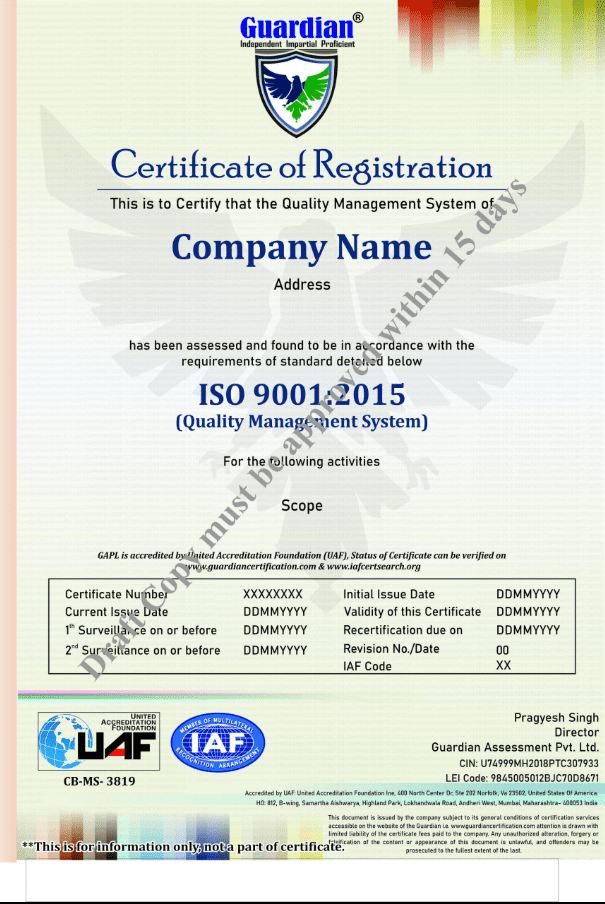
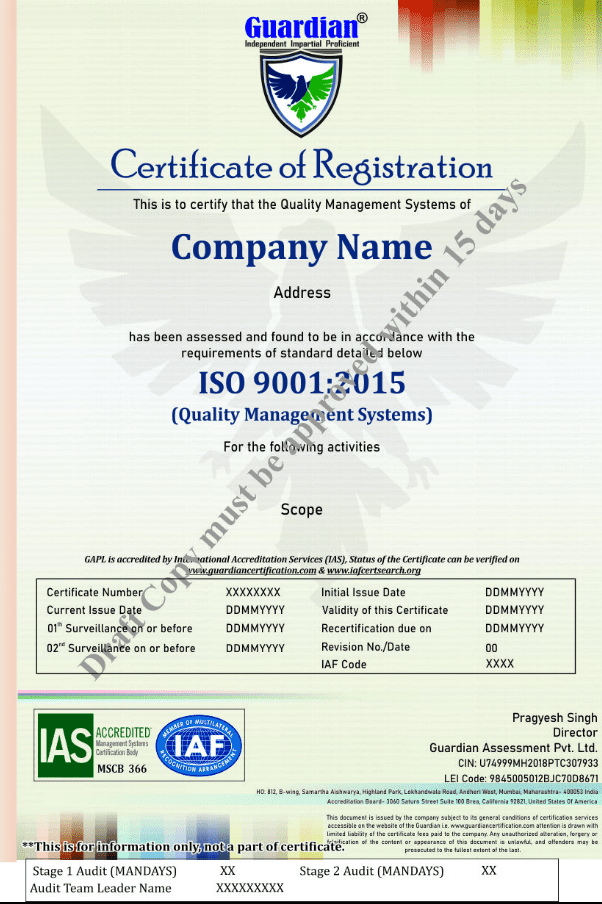
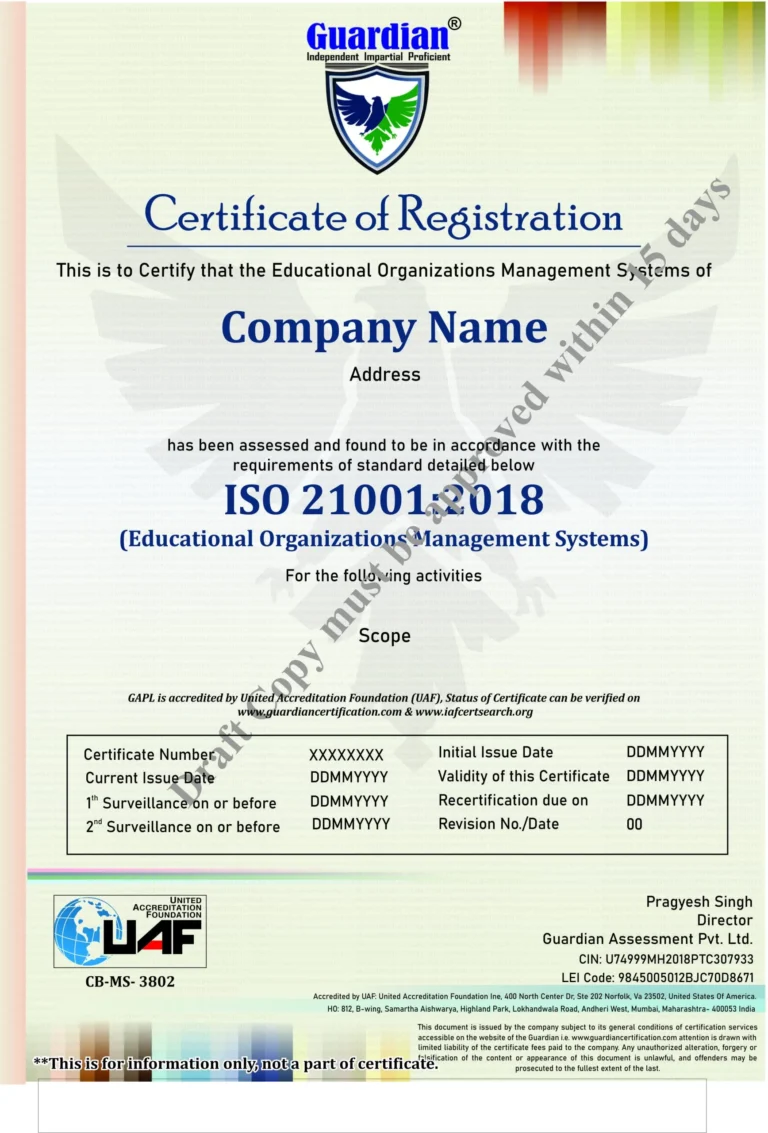
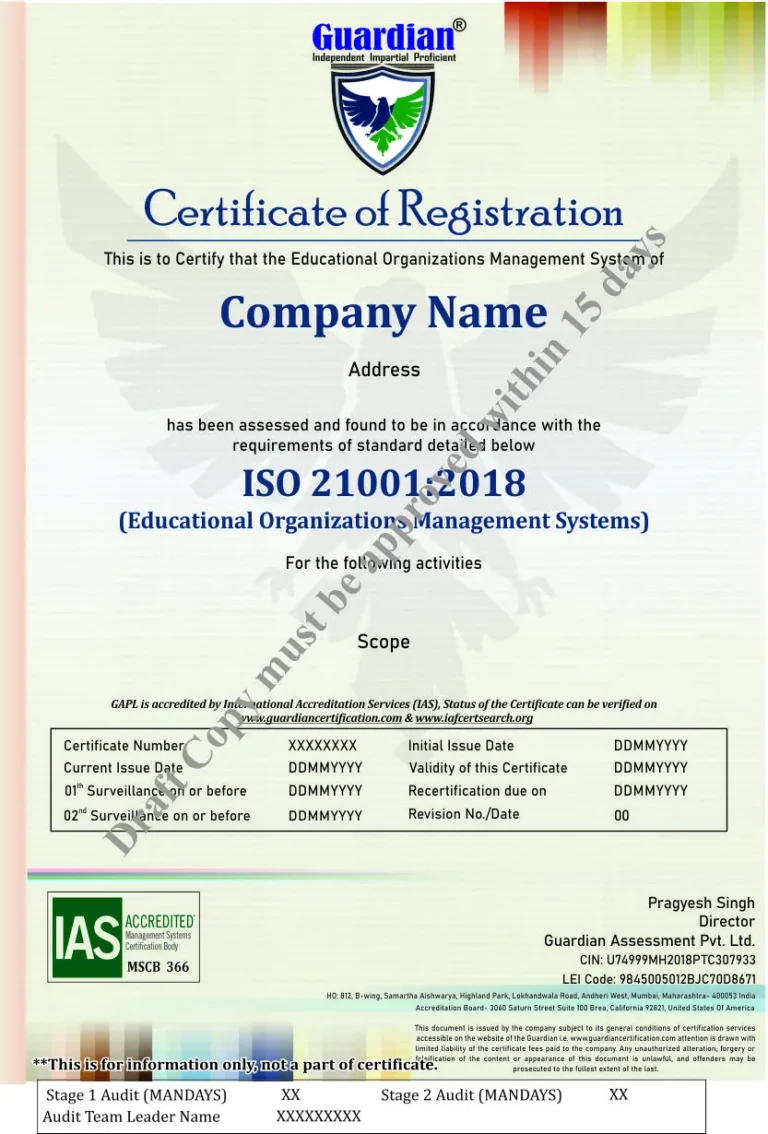
Sample Certificate
Request Quotation
Other Standards
Recognition
Sample Certificate
What Is the Difference Between ISO and a Certification Body?
Three parties have distinct responsibilities:
- ISO (International Organization for Standardization): Develops and publishes international standards, including ISO 21001:2025 for educational organizations. ISO does not audit individual educational organizations or issue ISO 21001 certificates.
- Your organization: Establishes, implements, maintains, and improves an educational organization management system (EOMS) that meets the applicable ISO 21001 requirements.
- The certification body: Independently audits the management system and makes a certification decision based on objective evidence and applicable certification requirements.
ISO 21001 certification applies to the educational organization’s management system and the activities covered by its certification scope. It does not mean that ISO has directly certified the organization or guarantee better educational outcomes, student satisfaction, or learning results.
Who Can Apply for ISO 21001 Certification?
ISO 21001 can apply to organizations that use a curriculum to support competence development through teaching, learning, training, or research. ISO certification for education is not limited to a particular organization size or delivery method. An organization should first define which educational activities, locations, and services it wants included in the certification scope.
Organization type | Possible application |
Schools and academies | Managing teaching, learner support, assessment, and educational processes |
Colleges and universities | Coordinating academic processes, learner services, and performance evaluation |
Vocational and technical institutes | Managing skills training, practical learning, and competence assessment |
Coaching and training centers | Establishing consistent delivery, feedback, and evaluation processes |
E-learning providers | Managing online learning design, delivery, learner support, and feedback |
Corporate training departments | Managing employee learning programs and competence development |
Professional development providers | Coordinating structured training, evaluation, and improvement activities |
Other educational organizations | Applying the standard where the organization’s activities fall within its scope |
The suitability of a particular organization depends on its actual activities and proposed scope. Organizations should explain their educational model and delivery arrangements during the application review.
What are the Benefits of ISO 21001 Certification
ISO 21001 gives educational organizations a framework for managing their activities consistently and evaluating whether their processes are meeting intended objectives. The benefits depend on how well the system is implemented and maintained.
- A More Structured Approach to Educational Management: Defined processes, responsibilities, and objectives can help an organization coordinate educational activities and identify gaps in how work is carried out.
- Greater Focus on Learners and Other Stakeholders: The standard encourages organizations to understand relevant needs and feedback, then use that information when managing and improving educational services.
- Improved Monitoring and Evaluation: Performance monitoring, internal audits, and management reviews help an organization evaluate whether its EOMS is working as intended and identify areas that need attention.
- More Consistent Educational Processes: Documented methods and clear responsibilities can help reduce avoidable variation between teams, courses, locations, or delivery methods.
- Support for Accessibility and Inclusive Education: An organization can use its management system to identify relevant barriers, consider different learner needs, and evaluate how its educational services are designed and delivered.
- A Demonstrable Commitment to Continual Improvement: Certification provides evidence that the management system has been independently assessed against the applicable standard. It does not, by itself, prove that every learner will achieve a particular outcome.
What Can These Benefits Look Like in Practice?
Area | Practical example |
Learner feedback | Reviewing feedback to identify recurring service issues |
Course delivery | Defining responsibilities for planning, delivering, and evaluating courses |
Assessment | Establishing consistent processes for assessment and recording results |
Staff competence | Identifying competence needs and maintaining relevant training records |
Complaints | Recording concerns, reviewing causes, and tracking corrective action |
Improvement | Using audit results and performance information to prioritize changes |
ISO 21001 Requirements: Clauses 4–10
ISO 21001 uses a management-system structure that connects organizational context, leadership, planning, support, operations, performance evaluation, and improvement.
Clause | Main focus | What an organization should consider |
Clause 4: Context of the organization | Understanding the organization and its context | Relevant internal and external issues, interested parties, their needs, and the EOMS scope |
Clause 5: Leadership | Leadership and commitment | Management responsibilities, policy, roles, and focus on learners and other beneficiaries |
Clause 6: Planning | Risks, opportunities, and objectives | Actions to address relevant risks and opportunities, measurable objectives, and planning |
Clause 7: Support | Resources and supporting processes | People, competence, awareness, communication, infrastructure, and documented information |
Clause 8: Operation | Educational processes and delivery | Planning, controlling, and evaluating the educational activities within the organization’s scope |
Clause 9: Performance evaluation | Monitoring and review | Measurement, analysis, evaluation, internal audits, and management review |
Clause 10: Improvement | Corrective action and continual improvement | Addressing nonconformities, determining causes where appropriate, and improving the EOMS |
The precise evidence required depends on the organization’s activities and scope. A training provider, a school, and a university may have different processes even though they are assessed against the same standard.
Documents and Records Required for ISO 21001 Certification
ISO 21001 uses the term documented information to describe information an educational organization maintains and records it retains as evidence. The documentation needed depends on the organization’s educational services, learner needs, operational complexity, applicable requirements, and the scope of its Educational Organization Management System (EOMS).
Common documented information
Depending on the EOMS and its scope, this may include:
- Educational Organization Management System scope.
- Educational organization policy.
- Educational objectives and plans for achieving them.
- Information about the needs and expectations of learners and other relevant beneficiaries.
- Processes for designing, delivering, and evaluating educational products and services, where applicable.
- Criteria and arrangements for evaluating educational processes and outcomes.
- Information about risks, opportunities, and relevant planning arrangements.
- Procedures or work instructions for educational and administrative activities where necessary.
- Processes for monitoring learner satisfaction and feedback.
- Arrangements for internal audits and management reviews.
- Processes for addressing nonconformities and implementing corrective actions.
Common records to maintain
Relevant records may include:
- Staff competence, qualifications, and training records.
- Learner admission, enrollment, and participation records, where applicable.
- Records of educational service delivery and assessment activities.
- Learner performance and evaluation results, where appropriate.
- Feedback and satisfaction survey results from learners and other relevant beneficiaries.
- Records of communication with learners and other interested parties.
- Internal audit program and results.
- Management review outputs.
- Educational service nonconformities and complaints.
- Corrective actions and evidence of their effectiveness.
- Progress toward educational objectives.
- Records of monitoring and evaluation of educational processes and services.
This is a practical overview, not an exhaustive list of every documented-information requirement. Educational organizations must maintain the information required by the applicable ISO 21001 edition and necessary for the effective operation of their EOMS. The specific records will vary depending on the organization’s educational activities, scope, and applicable requirements.
What Should You Have in Place Before Certification?
Documentation is only one part of readiness. Before an audit, the organization should also be able to demonstrate that its EOMS is being used in practice. Use the following ISO 21001 audit checklist as an initial readiness review:
- The proposed certification scope clearly describes the educational activities and relevant locations.
- Relevant internal and external issues and stakeholder needs have been considered.
- Management responsibilities, policy, and educational objectives are established.
- Key educational processes have been identified and are operating.
- Staff have the competence needed for their assigned responsibilities.
- Relevant learner feedback, complaints, and communication are being managed.
- Monitoring and evaluation methods are defined and used.
- Applicable records are maintained and can be retrieved.
- An internal audit has been conducted as planned.
- Management has reviewed the EOMS and identified necessary actions.
- Identified nonconformities or other issues have been addressed appropriately.
This checklist is a preparation aid, not a substitute for the full standard or an audit. For additional audit guidance, see ISO/PAS 25171:2026. This published ISO document provides examples of open-ended audit questions, evidence for evaluating conformity, and ways to assess an EOMS’s ability to monitor conformity over time.
What is the Process of ISO 21001 Certification
Guardian Assessment follows a structured management system certification process aligned with ISO/IEC 17021-1 and applicable accreditation requirements. The initial certification process consists of six main stages.
Step 1: Application Review: Submit information about your educational organization, educational services, employee numbers, operating locations, and proposed certification scope. Guardian reviews the application to understand your certification requirements, assess the proposed scope, and determine whether the requested activities fall within its capabilities and applicable accreditation arrangements.
Step 2: Audit Planning: After the application review, Guardian determines the required audit duration, appoints a competent audit team, and establishes the audit plan. Planning considers factors such as the organization’s size, number of learners, locations, educational services, operational complexity, and activities included within the proposed certification scope.
Step 3: Stage 1 Audit: The Stage 1 audit evaluates the organization’s readiness for the Stage 2 assessment. The auditor reviews relevant Educational Organization Management System (EOMS) documented information, the certification scope, educational processes, and implementation status, including internal audits and management reviews. The findings help determine whether the organization is sufficiently prepared to proceed to Stage 2.
Step 4: Stage 2 Audit: The Stage 2 audit evaluates the implementation and effectiveness of the EOMS. Auditors gather objective evidence through interviews, observation of educational and administrative activities, examination of records, and sampling of relevant processes. The assessment determines whether the management system conforms to the applicable ISO 21001 requirements and supports the educational organization in achieving its intended objectives.
Step 5: Audit Findings and Independent Technical Review: If nonconformities are identified, they are reported to the organization. The organization is responsible for investigating the causes, carrying out appropriate corrections and corrective actions, and submitting the required evidence. Guardian evaluates the relevant evidence according to the applicable certification requirements. Audit findings and certification information then undergo independent technical review by appropriately authorized personnel who were not involved in conducting the audit.
Step 6: Certification Decision and Certificate Issuance: An independent certification decision is made after the required audit activities and review have been completed. If the applicable requirements are satisfied and the certification decision is positive, Guardian issues the ISO 21001 certificate identifying the certified educational organization, approved scope, locations, and applicable standard edition. Completing an application or certification audit does not guarantee that a certificate will be issued.
Important: Confirm that Guardian Assessment’s current certification scope and applicable accreditation arrangements cover ISO 21001:2025 before publishing this as a description of its available certification service.
What Do Auditors Check During an ISO 21001 Audit?
Auditors assess whether the EOMS conforms to the applicable requirements and whether the organization can demonstrate that its management system is operating as intended. Depending on the scope, evidence may include:
- Context and scope: Whether the EOMS scope and relevant organizational issues are understood and maintained.
- Leadership: Whether responsibilities, policy, and objectives are established and supported by management.
- Educational operations: Whether relevant educational processes are planned, controlled, and evaluated.
- Learner and stakeholder needs: How applicable requirements, feedback, and complaints are considered.
- Competence and resources: Whether people and resources are suitable for the activities they perform.
- Monitoring and evaluation: Whether the organization measures performance and uses results to evaluate the EOMS.
- Internal audits and management review: Whether these processes are conducted as planned and result in appropriate actions.
- Corrective action and improvement: Whether identified problems are addressed and follow-up is carried out.
The auditor selects and evaluates evidence relevant to the organization’s scope. Passing an audit is not a matter of having a particular folder or template; the organization must demonstrate that its management system meets the applicable requirements.
What Happens After ISO 21001 Certification?
Certification requires ongoing attention to the management system. After certification, the organization should continue to operate its EOMS, monitor performance, address problems, and retain relevant evidence.
- ISO Surveillance Audits: Surveillance audits are conducted according to the certification program to assess continued conformity and implementation. The timing and scope of these audits should be confirmed with the certification body.
- ISO Recertification Audits: At the end of the certification cycle, recertification assesses whether the organization continues to meet the applicable requirements and can maintain certification. Significant changes to the organization, locations, or certified activities should be discussed with the certification body because they may affect the certification scope or audit arrangements.
- Maintaining the EOMS: The organization should continue to review learner and stakeholder feedback, monitor objectives, maintain relevant records, and address changes that may affect its educational activities.
How Long Does ISO 21001 Certification Take?
The time required depends on the organization’s size, the complexity of its educational activities, the number of locations, the readiness of its EOMS, and the availability of audit resources. The overall schedule may also be affected by how quickly the organization provides information, addresses audit findings, and completes any required corrective actions.
A reliable estimate should be based on the actual application and proposed scope rather than a universal number of days. The certification body can provide a more meaningful timeline after reviewing the organization’s details.
How Long Is an ISO 21001 Certificate Valid?
ISO 21001 certificates are commonly managed through a three-year certification cycle, subject to the applicable certification scheme and the certification body’s terms. Surveillance and recertification activities are used to evaluate continued conformity during that cycle.
The organization should check its certificate and certification agreement for the exact validity dates, surveillance schedule, and recertification requirements. A certificate should not be assumed to remain valid if certification has been suspended, withdrawn, or otherwise changed.
What is the Cost ISO 21001 Certification
The ISO 21001 certification cost depends on the work needed to assess the organization’s EOMS. There is no single fee that applies to every educational organization. The certification body needs enough information to determine the proposed scope, audit requirements, and applicable certification arrangements before providing a meaningful quotation.
What Affects ISO 21001 Certification Cost?
Cost factor | Why it matters |
Organization size | The number of people involved in the relevant activities can affect audit planning |
Educational scope | Different activities and processes may require different assessment considerations |
Number of locations | Multiple sites can affect audit planning and the overall schedule |
Delivery methods | Classroom, online, blended, and practical training arrangements may affect the assessment |
Process complexity | The variety and complexity of educational activities influence audit planning |
Readiness of the EOMS | Issues that need additional attention can affect the overall time needed |
Travel and logistics | Location and audit arrangements may affect the quotation |
Certification cycle | The quotation should explain applicable initial, surveillance, and recertification charges |
What Information Should You Share for a Quote?
To help the certification body assess your request, prepare:
- Organization’s legal name and contact details.
- Main educational activities and proposed certification scope.
- Approximate number of employees involved in the relevant activities.
- Number and location of sites.
- Delivery methods, such as classroom, online, or blended learning.
- Any tender, buyer, or customer requirement that specifies a certification or accreditation route.
Ask for clarity on what the quotation includes, the expected audit stages, and any additional fees that may apply.
Contact Guardian Assessment to discuss your requirements and request a quotation.
ISO 21001 Certification for Tenders and Supplier Requirements
Some tenders, customers, business partners, or procurement processes may request ISO 21001 certification as evidence that an educational organization has an assessed management system. Before applying, review the exact requirement. It may specify the standard, edition, certification scope, accreditation arrangement, or certificate-verification method.
ISO 21001 certification does not automatically guarantee acceptance in every tender or regulatory process. Acceptance depends on the requirements set by the relevant authority, buyer, or contracting organization. If certification is intended for a specific tender or contract, share the wording with the certification body before proceeding. This helps establish whether the proposed certification scope and applicable accreditation arrangements match the stated requirement.
Accredited ISO 21001 Certification and Certificate Verification
What Is the Difference Between Certification and Accreditation?
- Certification: is the independent assessment of an educational organization’s Educational Organization Management System (EOMS) against the applicable ISO 21001 requirements.
- Accreditation: is the independent assessment of a certification body’s competence and impartiality for specified certification activities.
When selecting a certification body, educational organizations should confirm that its accreditation covers the relevant standard, edition, technical scope, and certification activity. Accreditation provides additional confidence in the certification process, but it does not automatically guarantee acceptance by every buyer, regulator, education authority, or tender authority.
How to Verify an ISO 21001 Certificate
An ISO 21001 certificate is only as reliable as the certification body that issued it. A certification body audits an educational organization’s Educational Organization Management System (EOMS), while an accreditation body assesses the certification body’s competence and impartiality. Accreditation helps establish confidence that the certification process follows recognized requirements.
Before accepting or choosing an ISO 21001 certification body, educational organizations should verify the certificate and the issuing body. To check a certificate:
- Check it with the certification body. Guardian certificates can be verified through our client search (https://search.guardiancertification.com/).
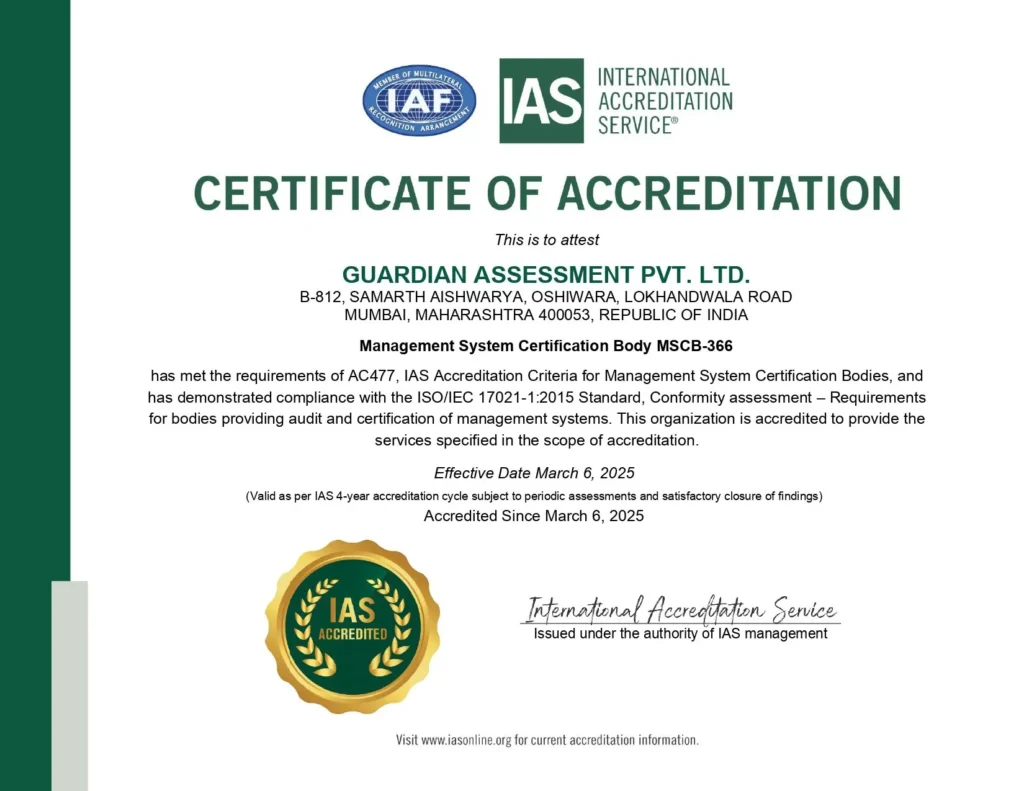
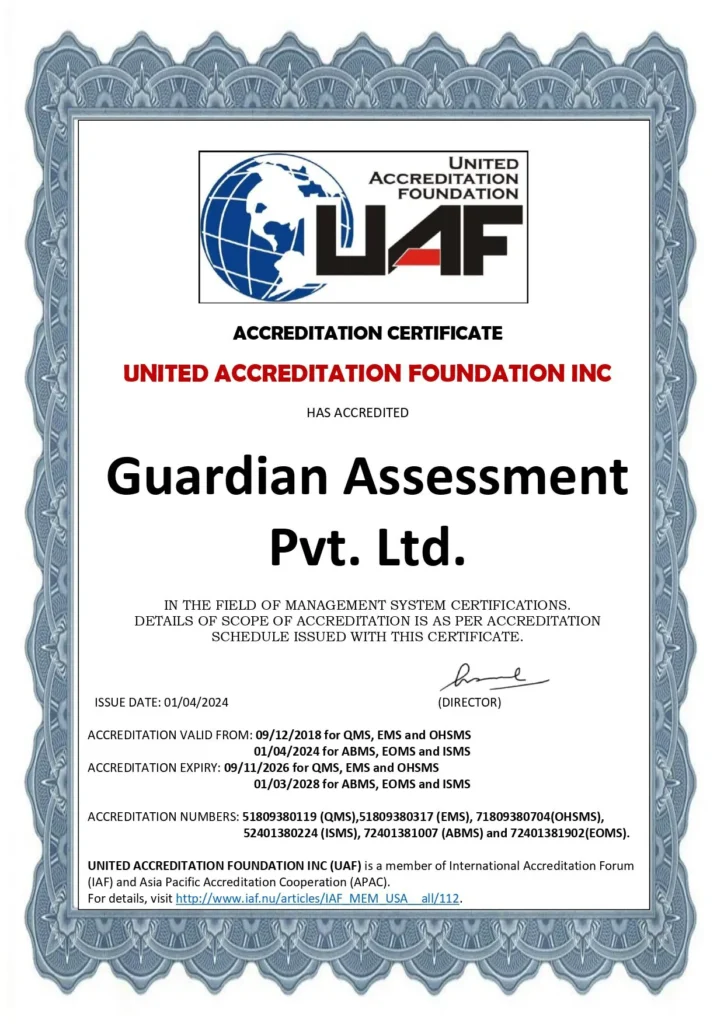
- Check the certification body’s accreditation. Search the accreditation body’s directory to confirm its current accreditation status and whether ISO 21001 is included in its applicable scope. Guardian is listed by UAF and IAS; confirm the relevant ISO 21001 scope before relying on this claim.
- Check IAF CertSearch (www.iafcertsearch.org), the global database for verifying accredited management system certifications. Check whether the certificate and certification body are listed.
Why Choose Guardian as Your ISO 21001 Certification Body -
- Accreditation by UAF and IAS. Guardian holds accreditation from UAF and IAS for applicable management system certification activities. Confirm that ISO 21001:2025 and the relevant educational organization sectors are covered by the current accreditation scopes.
- Auditors who understand educational organizations. We assign auditors based on the organization’s educational activities, EOMS scope and operational context.
- Impartial certification process. We assess and certify management systems without providing consultancy on the systems we certify. Certification decisions are reviewed independently.
- Integrated management system audits. Organizations can combine ISO 21001 with other applicable management system standards, where the certification scopes and audit arrangements permit.
- Based in India. Our head office is in Lucknow, Uttar Pradesh, and we provide certification services to educational organizations across India.
- Certificate transfer support. Organizations holding an eligible accredited ISO 21001 certificate from another certification body can explore transferring their certification to Guardian, subject to a review of the existing certificate, audit history and applicable transfer requirements.
Integrating ISO 21001 With Other Management System Standards (IMS)
Educational organizations may operate several management systems to manage education quality, information security, occupational health and safety, environmental responsibilities and other operational requirements.
An Integrated Management System (IMS) can bring compatible management system requirements together under a coordinated framework. This can help reduce duplicated procedures, simplify documentation and make audits more efficient. Under IAF MD 11, audit time for integrated management systems may be reduced where the applicable requirements and integration criteria are met.
Guardian Assessment provides management system certification services for standards that may be integrated with ISO 21001, including:
Note: Guardian Assessment also provides compliance assessments for specialized frameworks, including ISO 22000 (Food Safety), ISO 13485 (Medical Devices), ISO 50001 (Energy), ISO/IEC 27701 (Privacy), ISO/IEC 20000-1 (IT Service Management), ISO 41001 (Facility Management), ISO 55001 (Asset Management), and ISO/IEC 42001 (Artificial Intelligence).
Apply for ISO 21001:2025 Certification
Tell us about your educational organization, the services you provide, your locations and the scope of your Educational Organization Management System. Our team can guide you through the application, audit planning and certification process.
You can apply for ISO 21001:2025 certification independently or explore combining it with ISO 9001, ISO 14001, ISO 45001 or other applicable management system standards.
Frequently Asked Questions
Organizations that use a curriculum to support competence development through teaching, learning, training, or research may be eligible. Examples include schools, universities, vocational institutes, e-learning providers, and corporate training departments.
ISO 21001:2025 is the current published edition. Refer to the official ISO standard page for publication details.
The timeline depends on the organization’s size, scope, number of locations, readiness, audit planning, and any corrective actions required. A reliable estimate can be provided after the application has been reviewed.
Yes. It can apply to educational organizations using different delivery methods, including distance and online education, as well as training departments within larger organizations, provided their activities fall within the standard’s scope.
Certificates are commonly managed through a three-year certification cycle, subject to the applicable certification scheme and terms. The certificate and certification agreement should specify the relevant dates and surveillance requirements.