
The economy of Peru has various large-scale industries ranging from mining and mineral processing in the south to the growing export of agro-products along the coast, as well as logistics, manufacturing, and technology services in the capital, Lima, and Callao. In order for Peruvian businesses to be more successful in domestic and foreign markets, consistent quality, operational excellence, and proper management systems have become crucial.
In order to be able to bid, respond to buyers needs, as well as comply with the regulations and standards of the industries, businesses need to show proper quality, safety, and risk management. ISO certification provides independent proof of conformity with internationally accepted management systems standards, which allows businesses to strengthen their credibility, improve performance, and qualify suppliers.
At Guardian Assessment Private Limited, we provide independent and impartial ISO certification audits for businesses in Peru according to applicable accreditation scopes and service arrangements. Being a certification body accredited by UAF and IAS for relevant management system certification activities, we perform evidence-based evaluations to help organizations to prove their conformity, strengthen their reputation, and meet their business goals.
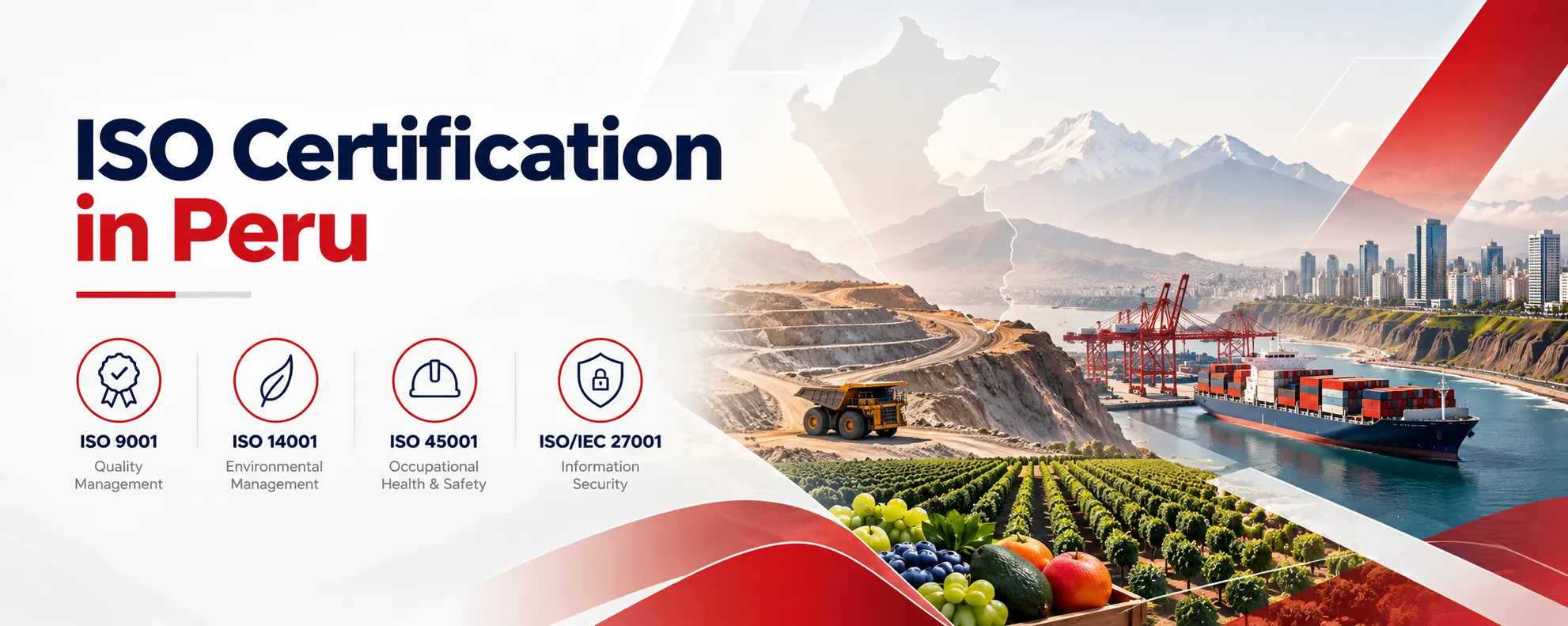
ISO Certification Standards Available in Peru
Different ISO management system standards address different business activities and operational requirements. The right standard depends on your organization’s objectives, industry, customer expectations, and applicable contractual or regulatory obligations.
Guardian Assessment Private Limited provides certification services for the following standards, subject to the applicable accreditation scope, standard edition, and certification arrangements.
- ISO 9001 – Quality Management System: Helps organizations improve process consistency, product and service quality, and customer satisfaction. Peru approved NTP-ISO 9001:2026 on 17 September 2026 and published it on 21 September, replacing the 2015 national edition and its 2024 amendment. The revision strengthens leadership, quality culture, and risk and opportunity management. Under separate international transition arrangements, new and initial accredited certifications must follow the 2026 edition from 31 March 2028, while existing ISO 9001:2015 certifications must transition by 30 September 2029. Organizations should confirm the applicable edition and their certification body’s accredited scope.
- ISO 14001 – Environmental Management System: Provides a structured approach to identifying environmental aspects, managing waste and resource consumption, and improving environmental performance. Particularly relevant to mining, industrial operations, construction, and agro-processing.
- ISO 45001 – Occupational Health and Safety Management System: Helps organizations identify workplace hazards, manage occupational health and safety risks, and establish safer working conditions. Applicable to mining, construction, manufacturing, and other activities involving significant workplace hazards.
- ISO/IEC 27001 – Information Security Management System: Supports the management of information security risks and protection of sensitive business information. Relevant to IT companies, financial services, outsourcing providers, and businesses handling confidential customer data.
- ISO 37001 – Anti-Bribery Management System: The current ISO 37001:2025 edition provides a framework for preventing, detecting, and addressing bribery risks through policies, due diligence, and internal controls. Useful for organizations involved in procurement, contracting, and complex supplier relationships.
- ISO 21001 – Management Systems for Educational Organizations: Helps educational organizations improve learning services, management processes, and learner satisfaction. The latest international edition is ISO 21001:2025. It is applicable to schools, universities, training institutions, and other education providers.
Why ISO Certification is Important for Businesses in Peru
Organizations supplying domestic and international customers are often expected to demonstrate consistent quality, effective risk management, and reliable operational practices. ISO certification provides an independent assessment of a management system against recognized requirements. When properly implemented, these systems can support business performance in several ways.
- Improved Operational Consistency: Defined responsibilities, documented processes, and performance monitoring help reduce errors and maintain consistent products and services.
- Greater Customer Confidence: Accredited certification provides independent evidence that a management system has been assessed against the applicable ISO standard.
- Supplier and Contract Requirements: Businesses supplying large companies, infrastructure projects, and international markets may need to demonstrate recognized quality, safety, or information security management practices.
- Effective Risk Management: ISO management systems help organizations identify operational risks, implement appropriate controls, and monitor their effectiveness.
- Continual Improvement: Internal audits, management reviews, corrective actions, and performance evaluations help organizations identify problems and improve operations over time.
Peru’s National Quality Policy to 2030
Peru approved its Política Nacional para la Calidad al 2030 through Supreme Decree No. 006-2024-PRODUCE to encourage the adoption of quality standards and strengthen business competitiveness. For businesses in manufacturing, mining-related services, exports, and other industries, ISO management systems can support these objectives by improving process reliability, supplier management, and organizational performance. The policy does not make ISO certification universally mandatory for private businesses.
Which Industries in Peru Benefit from ISO Certification?
Peru has diverse industrial and commercial activities, from mining and mineral processing in the south to agricultural exports along the coast and logistics and digital services concentrated around Lima and Callao. The relevance of individual ISO standards depends on the type of business, its operational risks, and its customer or contractual requirements.
- Mining and Mineral Processing – Arequipa and Southern Peru: Mining operators, engineering contractors, and equipment suppliers can use ISO 9001 to strengthen process quality, ISO 14001 to manage environmental aspects, and ISO 45001 to improve occupational health and safety management.
- Agriculture and Agro-Exporting – Ica and La Libertad: Agricultural processors, exporters, and packaging businesses can use ISO 9001 to improve production controls, traceability, supplier evaluation, and consistency in meeting customer specifications. Separate food safety requirements may also apply.
- Manufacturing and Engineering – Lima and Industrial Regions: Manufacturers can use quality management systems to control production processes, maintain inspection records, manage nonconforming products, and improve customer satisfaction.
- Logistics and International Trade – Lima and Callao: Warehousing companies, transport operators, and logistics service providers can apply ISO 9001 to improve service reliability, supplier coordination, documentation, and process control.
- Construction and Infrastructure: Contractors and engineering service providers can use ISO 9001 for project quality management, ISO 45001 for workplace safety, and ISO 14001 for managing relevant environmental aspects.
- Tourism, Hospitality, and Professional Services – Cusco and Other Commercial Centres: Hotels, tourism operators, and service providers can use quality management systems to standardize services, manage customer complaints, and improve operational consistency.
- Information Technology and Digital Services – Software developers, IT service providers, and businesses processing confidential information can apply ISO 9001 for service quality and ISO/IEC 27001 for information security management.
Certification requirements vary according to the organization’s operations, the chosen standard, and its intended certification scope.
What Do Businesses Need to Get ISO Certified?
Before applying for accredited ISO certification, an organization must establish and implement a management system that meets the ISO certification requirements of its chosen standard. The specific requirements depend on the standard, but most management system certifications involve the following preparations:
- Define the Management System Scope: Identify the business activities, products, services, processes, and operational locations covered by the certification.
- Establish Policies and Objectives: Develop relevant management policies, measurable objectives, and responsibilities aligned with the organization’s activities and selected standard.
- Maintain Documented Information: Prepare and control the policies, procedures, operational records, and other documented information necessary to demonstrate effective implementation.
- Address Applicable Requirements: Identify relevant legal, regulatory, customer, and contractual obligations affecting the management system. For example, safety management systems must consider applicable Peruvian occupational health and safety requirements.
- Assign Responsibilities and Ensure Competence: Define responsibilities and ensure employees have the necessary training, competence, and awareness to perform their activities.
- Conduct Internal Audits and Management Reviews: Evaluate the system’s conformity and effectiveness, review performance with management, and identify improvements before the external certification assessment.
- Address Nonconformities: Implement appropriate corrections and corrective actions and maintain evidence that identified problems have been addressed.
These preparations help organizations demonstrate that their management system is implemented in practice rather than existing only as documentation. ISO certification does not replace applicable government licences, statutory approvals, or regulatory inspections.
ISO Certification and Government Tenders in Peru
Under Peru’s Law No. 32069, businesses participating in public procurement must meet applicable supplier registration and tender requirements, including RNP registration where required. ISO certification is not mandatory for every government tender. However, certain procurement procedures may include ISO 9001 or other management system certifications as qualification or evaluation criteria, subject to the applicable rules. Businesses should review the individual tender documents to confirm certification, accreditation, and eligibility requirements.
Cost and Process of ISO Certification
Implementing a structured management system can help organizations improve operational consistency, manage risks, meet customer requirements, and strengthen confidence among buyers and business partners. Understanding the certification cost and audit process is an important first step before applying. The cost of ISO certification varies depending on factors such as the number of employees, operational locations, business activities, certification scope, selected ISO standard, and applicable audit requirements. For a detailed explanation of pricing considerations, read our guide on How Much Does ISO Certification Cost?
Want to understand the steps involved in certification? Read our detailed ISO Certification Process guide to learn about application review, Stage 1 and Stage 2 audits, handling nonconformities, and the certification decision.
Why Choose Guardian Assessment for ISO Certification in Peru?
Choosing an accredited certification body like Guardian Assessment Private Limited helps businesses obtain credible and independently assessed ISO certification. Organizations seeking ISO certification in Peru can evaluate a certification body’s accreditation scope, industry expertise, and audit capabilities before proceeding.
- Industry Expertise: Our auditors have technical knowledge of management systems and business processes across industries such as mining, manufacturing, construction, logistics, agriculture, and professional services.
- Impartial & Objective Audits: As an accredited certification body, Guardian Assessment Private Limited conducts independent, impartial, and evidence-based audits against applicable ISO standards.
- Global Recognition: Guardian Assessment holds accreditation from the United Accreditation Foundation (UAF) and International Accreditation Service (IAS) for applicable management system certification activities. International recognition and certificate acceptance depend on the relevant accreditation scope and customer or regulatory requirements.
- IAF CertSearch: The validity of eligible accredited ISO management system certificates can be checked through the IAF CertSearch database.
Request an ISO Certification Quote
Frequently Asked Questions
Certification costs depend on the selected standard, company size, operational complexity, number of sites, and assessment requirements. A certification body can prepare an appropriate quotation after reviewing the organization's scope and activities.
The timeline depends on management system readiness, audit scheduling, operational complexity, and the resolution of any nonconformities. An organization with an established management system may be ready for external assessment sooner than one beginning implementation.
Yes. ISO management system standards can be applied to organizations of different sizes. Small businesses and startups can seek certification when they have implemented the applicable requirements and can demonstrate an effective management system.
Internationally accredited ISO certificates may be accepted by customers and contracting authorities, subject to the relevant accreditation scope and contractual or regulatory requirements. Foreign accreditation does not automatically mean recognition within INACAL's National Accreditation System. Acceptance should be confirmed where certification is needed for a specific purpose.