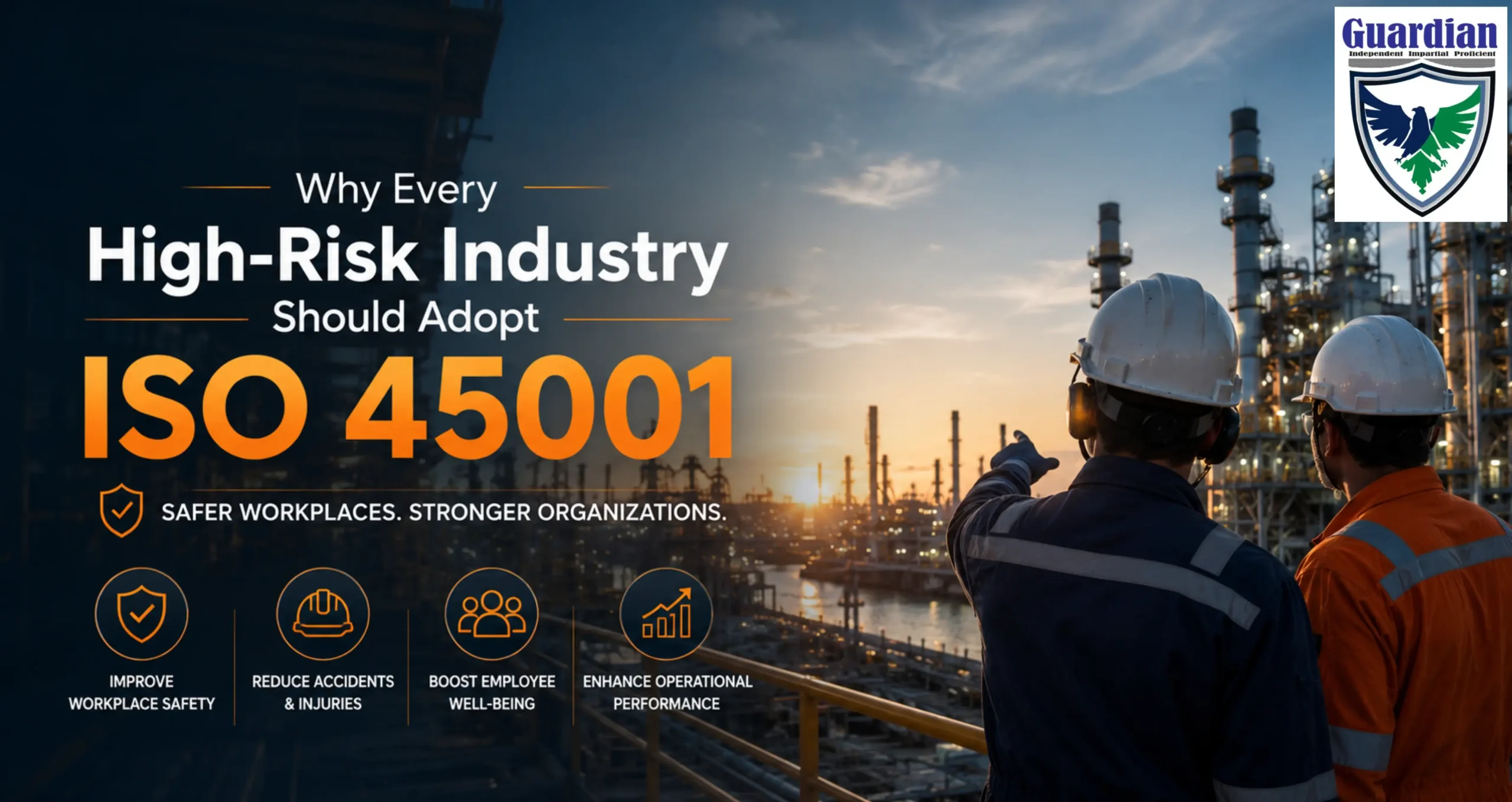
Why Every High-Risk Industry Should Adopt ISO 45001
High-risk industries face life-threatening dangers every single day. Whether it’s heavy machinery, working at heights, hazardous chemicals, confined spaces, or extreme physical pressure — one small error can cause serious injury, downtime, or even loss of life.
Old-style safety management — just putting up posters or doing basic training — is no longer enough. Today’s high-risk workplaces need a powerful, proactive system that prevents accidents before they happen. That system is ISO 45001.
ISO 45001 certification is the international standard for Occupational Health and Safety Management Systems (OH&S). It helps organizations build a strong safety culture, reduce risks systematically, and protect their most valuable asset — their people.
In this detailed 2000-word guide, you will discover why every high-risk industry must adopt ISO 45001, how it works in real life, and the powerful benefits it delivers. This blog is written in simple, easy language so you can understand and apply it immediately.
Risk Prevention: Focuses on identifying and eliminating hazards before incidents occur.
Worker Safety: Protects employees through structured safety systems.
Operational Stability: Reduces downtime and improves productivity.
Why High-Risk Industries Face Bigger Safety Challenges
High-risk sectors deal with unique and constant dangers that normal offices or low-risk businesses never see. Here are the major challenges:
- Constant Exposure to Hazards: Heavy equipment, moving parts, toxic substances, noise, dust, vibration, and height-related risks.
- Dynamic Work Conditions: Weather changes, shift work, emergency repairs, and sudden process modifications.
- Multiple Teams on Site: Regular employees, contractors, subcontractors, and visitors — all working in the same high-danger zone.
- High Pressure for Production: Sometimes speed is prioritized over safety, leading to shortcuts.
- Severe Consequences: A single incident can cause fatalities, legal issues, reputation damage, and huge financial losses.
Because of these reasons, traditional safety methods fall short. ISO 45001 fills this gap by creating a complete, organization-wide safety management system.
What Makes ISO 45001 Different and Better for High-Risk Work?
ISO 45001 is not just another certificate to hang on the wall. It is built on risk-based thinking and follows the famous Plan-Do-Check-Act cycle.
Key Features that High-Risk Industries Love:
- Focuses on prevention instead of reaction
- Involves top leadership directly
- Gives real importance to worker participation
- Works perfectly with other standards (like ISO 9001 and ISO 14001)
- Flexible — can be applied to any size of operation
- Encourages continual improvement every year
This standard changes safety from a “compliance burden” into a business advantage.
Major Benefits of Implementing ISO 45001 in High-Risk Industries
Here are the powerful benefits you can expect:
1. Dramatic Reduction in Accidents and Injuries
Systematic hazard identification and risk controls help catch dangers early. Many organizations see a sharp drop in incidents after implementation.
2. Improved Worker Morale and Engagement
When workers see real care for their safety, they feel valued. This leads to higher motivation, lower absenteeism, and better retention of skilled staff.
3. Better Operational Efficiency
Fewer accidents mean less downtime, smoother production, and more consistent output.
4. Stronger Legal Compliance
ISO 45001 helps you meet all important health and safety legal requirements in a structured way.
5. Enhanced Reputation
Clients, partners, and stakeholders prefer to work with organizations that take safety seriously.
6. Reduced Insurance Premiums
Insurance companies often offer better rates to certified organizations because risk is managed better.
7. Competitive Advantage
In tenders and contracts, having ISO 45001 certification often becomes a big plus point.
How ISO 45001 Works in High-Risk Industries (Step-by-Step Breakdown)
1. Leadership Commitment
Top management must show visible support. They set safety objectives, provide resources, and review performance regularly. When leaders walk the talk, the entire organization follows.
2. Worker Participation & Consultation
Workers who face risks daily are involved in:
- Identifying hazards
- Suggesting controls
- Reviewing procedures
- Reporting near-misses without fear
3. Comprehensive Hazard Identification & Risk Assessment
You systematically identify:
- Physical hazards
- Chemical hazards
- Biological hazards
- Ergonomic hazards
- Psychosocial hazards (stress, fatigue)
Then risks are evaluated and controls are applied using the hierarchy of controls (Eliminate → Substitute → Engineer → Administer → PPE).
4. Setting Clear Objectives and Planning
Safety goals are aligned with business goals. Action plans are made with responsibilities and timelines.
5. Operational Controls
Safe work procedures, contractor management, emergency preparedness, and change management become part of daily operations.
6. Performance Evaluation
Regular monitoring, internal audits, incident investigation, and management reviews keep the system strong.
7. Continual Improvement
The system keeps getting better year after year.
ISO 45001 Implementation in Different High-Risk Sectors
Manufacturing & Heavy Engineering
Reduces machine-related injuries, improves lockout-tagout procedures, and controls chemical exposure.
Construction & Infrastructure
Helps manage working-at-height risks, scaffolding safety, heavy lifting, and site coordination between multiple contractors.
Oil & Gas, Mining & Energy
Handles extreme hazards like flammable materials, confined spaces, and remote location risks.
Chemical & Pharmaceutical
Focuses on process safety, hazardous material handling, and emergency response.
Logistics & Transportation
Reduces vehicle-related incidents, loading/unloading risks, and fatigue management.
No matter which high-risk field you belong to, ISO 45001 can be tailored to your specific needs.
Common Myths About ISO 45001 (Busted)
- Myth: It is only for big companies. Truth: Small and medium organizations can also implement it successfully.
- Myth: It is very expensive and complicated. Truth: With proper planning, the long-term savings are much higher than the investment.
- Myth: It creates too much paperwork. Truth: The focus is on practical processes, not unnecessary documents.
- Myth: It slows down work. Truth: It actually makes work smoother by reducing accidents and unplanned stops.
How to Build a Strong Safety Culture with ISO 45001
A real safety culture is when “Safety First” is not just a slogan — it becomes a habit. ISO 45001 helps you build this by:
- Open communication channels
- No-blame near-miss reporting
- Regular safety training and awareness programs
- Recognition for safe behavior
- Leadership leading by example
When safety becomes everyone’s responsibility, amazing results follow.
Future-Proofing Your High-Risk Business with ISO 45001
Work environments are changing rapidly — new machines, automation, AI monitoring, and new materials bring new risks. ISO 45001 prepares you for these changes because it is based on risk-based thinking and continual improvement.
Organizations with ISO 45001 adapt faster to new technologies while keeping people safe.
Final Thoughts: Why You Should Adopt ISO 45001 Now
If you work in a high-risk industry, adopting ISO 45001 is no longer optional — it is a smart business decision. It protects your workers, improves efficiency, strengthens your reputation, and gives you peace of mind.
Safety is not a cost. It is an investment that pays back in multiple ways — fewer injuries, happier teams, better performance, and long-term success. Start your ISO 45001 journey today and create a workplace where people feel truly safe and valued.
Frequently Asked Questions (FAQs)
Ans) No, it is not legally mandatory in most places, but it is highly recommended. Many clients, tenders, and insurance companies now prefer or require it.
Ans) It usually takes 6 to 12 months depending on the size of the organization, current safety level, and resources available.
Ans) No. It improves and organizes your existing procedures into a complete management system. You don’t have to throw away what you already have.
Ans) Yes. The standard is flexible and can be scaled according to the size and complexity of your operations.
Ans) The biggest benefit is the shift from reactive safety (fixing problems after accidents) to proactive safety (preventing accidents before they happen), which saves lives and money.