
Keeping your company’s information safe is now more important than ever. Every day we hear about data leaks, hacking, or lost personal details in the news. One of the best ways to protect your organization is by following ISO 27001, the international set of rules for keeping information secure. If you want to know what is ISO 27001, how the ISO 27001 standard helps, and why ISO 27001 certification matters, this guide will make it all clear in simple words.
Here, you’ll learn how the updated ISO 27001:2022 works, the key steps for certification, what documents you’ll need, benefits for your business, and answers to common questions. This guide is written so anyone can understand – no need for technical language. Let’s get started and see how ISO 27001 helps protect your information and gives your business an edge.
Request Quotation
What Is ISO 27001?
Are you wondering what is ISO 27001? ISO 27001 is a global standard created by the International Organization for Standardization (ISO) and the International Electrotechnical Commission (IEC) for managing information security. Its full title is ISO/IEC 27001. The ISO 27001 standard tells businesses how to set up an Information Security Management System (ISMS)—a system of policies, rules, and controls designed to keep your information safe.
An ISMS helps all types of organizations, big or small, protect sensitive data, whether it’s about customer data, financial records, or even your own business strategies. It guides you to find the risks to your information and set up plans to control and reduce these risks.
The newest version, ISO 27001:2022, updates the standard to handle new technologies, remote work, and modern threats. By following the ISO 27001 standard, you can keep your data private, correct, and available whenever needed.
Why Is ISO 27001 Important?
Today, information is among a company’s most valuable assets. If you don’t protect it, your business could face lost trust, financial penalties, legal issues, and reputational damage. ISO 27001 certification is widely recognized as an indication that an ISMS is in place and audited.
When you get certified to the ISO 27001 standard, you show clients, staff, partners, and regulators that you follow a recognized information security management standard. Big companies, banks, hospitals, and tech companies all look for suppliers and partners with ISO 27001 certification. For small businesses, it’s a great way to win trust and stand out from the competition.
Key Changes in ISO 27001:2022
Standards get updated to keep up with technology and threats. ISO 27001:2022 is the latest edition of the standard, including:
- New controls for the cloud and remote work: It now works better with cloud services, mobile devices, and modern office setups.
- Modern language: The words and terms in the standard are clearer and easier to understand.
- Easy to combine with other standards: ISO 9001 (quality) and ISO 14001 (environment) connect more easily with ISO 27001:2022.
- Improved risk management: The new version helps you assess and treat risks more simply and keep your system up to date.
- Updated Annex A controls: These are the detailed actions you should consider for security, and now they’re more flexible.
If you were working with an older version of ISO 27001, it’s smart to update and fill any gaps using the new ISO 27001:2022 standard.
ISO 27001 Standard Structure Explained
The ISO 27001:2022 standard has a clear and easy-to-follow structure. To get ISO 27001 certification, you need to meet these main sections:
Clause 1: Scope
This first section explains what the standard covers. It sets the boundaries for what is included and what is not. The scope makes it clear that ISO 27001 applies to all organizations, regardless of size or industry, and focuses on managing risks to information security.
Clause 2: Normative References
This clause lists documents or other standards that are essential to using ISO 27001 properly. For ISO 27001:2022, it mainly refers to ISO/IEC 27000, which provides you with key terms and the basics of information security management.
Clause 3: Terms and Definitions
Here, you’ll find the official meanings of words and phrases used in the standard. This helps everyone understand the requirements in the same way, removing confusion or guesswork.
Clause 4: Context of the Organization
First, look at what’s going on inside and outside your company. What could affect your information security? This includes market trends, laws, growing cyber threats, and your business’s strategy. Think about who is interested in your security—customers, suppliers, your boss—and decide where in the company (the scope) your ISMS will apply.
Clause 5: Leadership
Top management must play an active role. Leaders should:
- Approve and share an information security policy with everyone.
- Set clear roles for information security across the business.
- Make sure you have enough people, training, and resources to keep information safe.
- Encourage everyone to improve security all the time.
Clause 6: Planning
Now, plan how to deal with risks. This means:
- Doing a risk assessment to find threats to your information.
- Deciding how you will treat each risk (avoid, reduce, transfer, or accept it).
- Writing clear goals for your information security that support the business’s plans.
Clause 7: Support
Support is about giving your people what they need for success. This includes:
- Enough staff, time, and budget for information security tasks.
- Making sure everyone understands their security responsibilities.
- Training everyone so they know what to do.
- Planning how you’ll talk about security matters, both inside and outside the company.
- Keeping up-to-date documents.
Clause 8: Operation
This section is the “doing” part:
- Put your plans, policies, and controls in place.
- Manage risks each day as they appear.
- Document changes or security events as needed.
Clause 9: Performance Evaluation
Check how well your information security system works by:
- Measuring and monitoring your chosen security indicators.
- Running internal audits to see if you really follow the ISO 27001 standard.
- Having meetings for management to review how things are going and update plans as needed.
Clause 10: Improvement
Never stop improving. For this:
- Find any problems or areas not meeting the standard (non-conformities).
- Fix these issues and find out why they happened.
- Keep working to make your system better.
Annex A: Controls
Here you’ll find practical controls: steps, tools, and protective actions like encrypting data, controlling who gets access to offices or computers, and backing up information. You must decide which controls fit your company and write down, in a “Statement of Applicability” what you use and why.
Benefits of ISO 27001 Certification
Still not sure if ISO 27001 certification is worth it? Here’s what organizations get:
Better Information Security
You close security holes, reduce the risk of attacks or leaks, and protect everything from customer data to your own trade secrets.
More Trust and Stronger Reputation
With ISO 27001 certification, you prove to everyone—customers, suppliers, and partners—that information security comes first. People and companies trust you more.
Easier Compliance with Laws
Many global laws (like GDPR in Europe or CCPA in California) are tough. The ISO 27001:2022 standard can support compliance efforts by helping you build structured controls and evidence for audits. It does not replace legal advice.
More Business Opportunities
With the ISO 27001 standard, you can win contracts and customers who need to see certification before doing business with you.
Better Risk Management
With ISO 27001:2022, you manage risks before they turn into problems. You’re ready for threats and can respond quickly.
Smarter, More Aware Employees
Training and clear rules make people follow good security habits, so fewer mistakes happen.
Smoother Operations
A well-run ISMS keeps things organized, avoids confusion, and makes life easier for everyone.
Who Needs ISO 27001 Certification?
Any organization handling sensitive information can benefit from ISO 27001 certification. Some examples:
- Software, IT, or tech companies keeping user or project data.
- Hospitals and clinics guarding patient information.
- Banks or finance firms keeping account or transaction data secure.
- Factories protecting product designs or client lists.
- Government departments and agencies.
- Any service provider—legal, marketing, consulting—handling private or client data.
Both large global companies and small local businesses use ISO 27001:2022 certification to protect themselves and their clients.
Sample Certificate
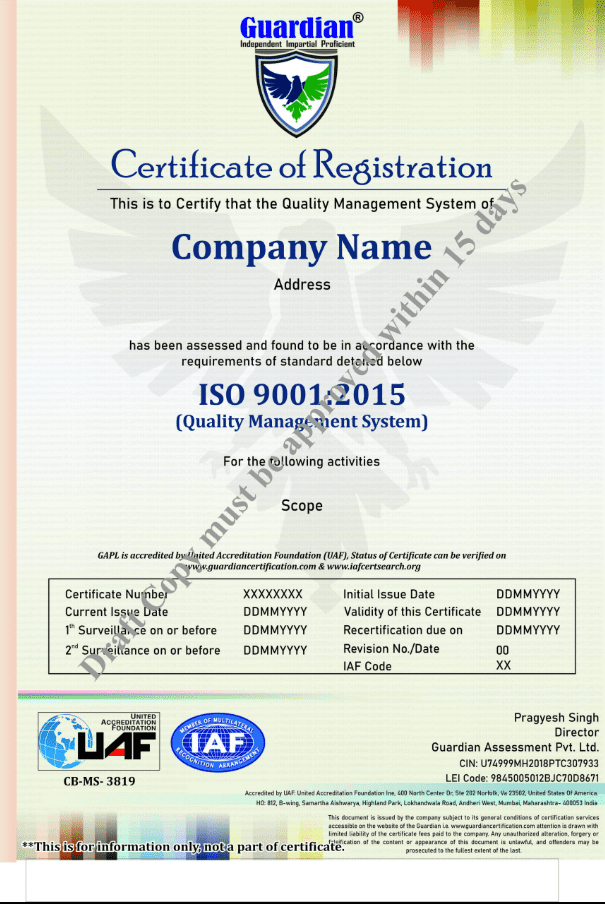
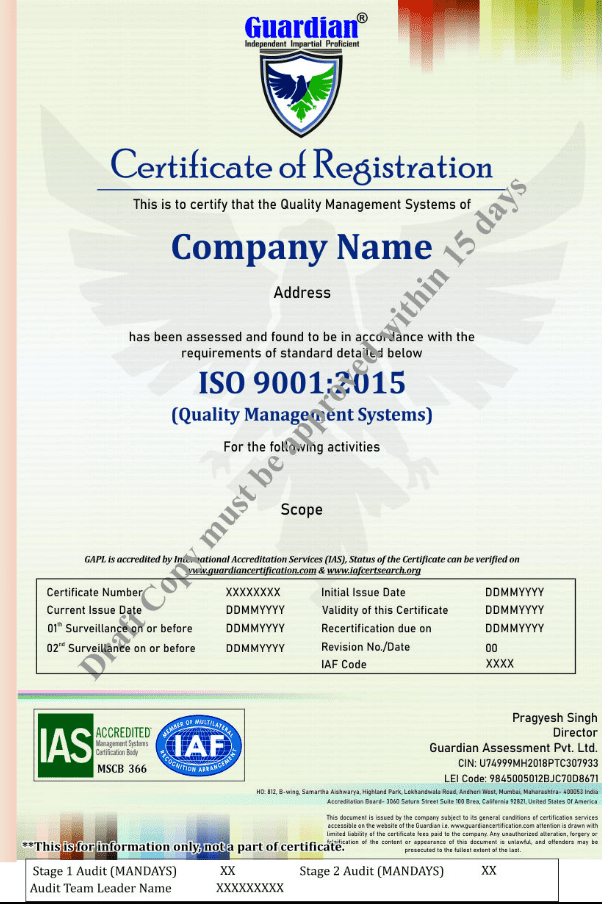
Request Quotation
Other Standards
Recognition
Sample Certificate
Eligibility Criteria for ISO 27001 Certification
To get ISO 27001 certification, your organization must:
- Create and use an Information Security Management System (ISMS) as described in ISO 27001:2022.
- Prepare and keep all the required documents, policies, and records.
- Show that your leaders are involved and care about security.
- Identify risks and create plans to manage or reduce them.
- Show proof, with records and documents, that you follow and improve your system all the time.
There are no size or industry limits—the ISO 27001 standard is for organizations of any kind.
ISO 27001 Documents and Records
You must document how your ISMS works to earn or keep ISO 27001 certification. Here’s what you need:
Mandatory Documents
- Scope of ISMS: Explains which parts of your business the ISMS covers.
- Information Security Policy: Your main statement on information security.
- Risk Assessment & Treatment Method: How you find and control risks.
- Statement of Applicability (SoA): Lists which security controls you are using and why.
- Security Objectives: Your goals and how you’ll measure success.
- Competency & Awareness Evidence: Training records and staff qualifications.
- Document Control Procedures: How you manage all ISMS paperwork.
Mandatory Records
- Security Monitoring Logs: Proof of checks, security reviews, and tests.
- Audit Records: Dates, results, and follow-up from internal security checks.
- Management Review Meeting Notes: Summaries of what leaders discussed and decided.
- Correction Records: Details of any mistakes and how you fixed things.
Helpful Non-Mandatory Documents
- Extra rules on passwords, access controls, supplier checks, backup plans, and incident response.
These documents must be up to date and reviewed regularly for ISO 27001 certification.
ISO 27001 Certification Process
Getting ISO 27001 certification follows these steps:
- Gap Analysis
- Compare your current security with ISO 27001:2022.
- Find out what’s missing and make a list of what you need to do.
- Develop Your ISMS
- Write or update all documents, policies, and procedures to match the ISO 27001 standard.
- Train people so everyone knows the rules.
- Implement the System
- Start running the ISMS—follow your new controls and keep records to show you’re doing it.
- Internal Audit
- Run an internal check to find gaps or mistakes before the outside audit.
- Fix any issues you discover.
- Management Review
- Have leaders review how the ISMS is doing and decide what needs to improve.
- Certification Audit – Stage One
- The auditor looks at your documents and records, usually remotely.
- They confirm you’re prepared for the main audit.
- Certification Audit – Stage Two
- Auditors visit the workplace, talk to your team, and check that all processes are being followed.
- Fix Non-Conformities
- If auditors find problems, you must fix them and prove it.
- Certification and Surveillance
- If you pass, you get ISO 27001:2022 certification.
- You need to have smaller audits every year to keep your certificate.
- Recertification
- Every three years, go through a big audit to renew your ISO 27001 certification.
ISO 27001 Certification Costs
The price of ISO 27001 certification depends on:
- How big your company is and how many offices you have.
- The complexity of your processes.
- How ready you are (existing security measures).
- Training and preparation costs.
- Certification body fees.
Small companies can expect lower costs than large, complex global organizations. You can save money by starting your ISMS with your current team or focusing only on the essential parts of your business first.
Always get a personalized quote for ISO 27001 certification as fees vary.
Importance of Accreditation in ISO 27001
Make sure your ISO 27001 certification comes from an accredited body. Why? Because:
- Accredited certificates are widely recognized, depending on customer, tender, or regulator expectations.
- Unaccredited ones may cause you to lose business or fail to meet client needs.
- Accredited bodies follow strict, recognized rules.
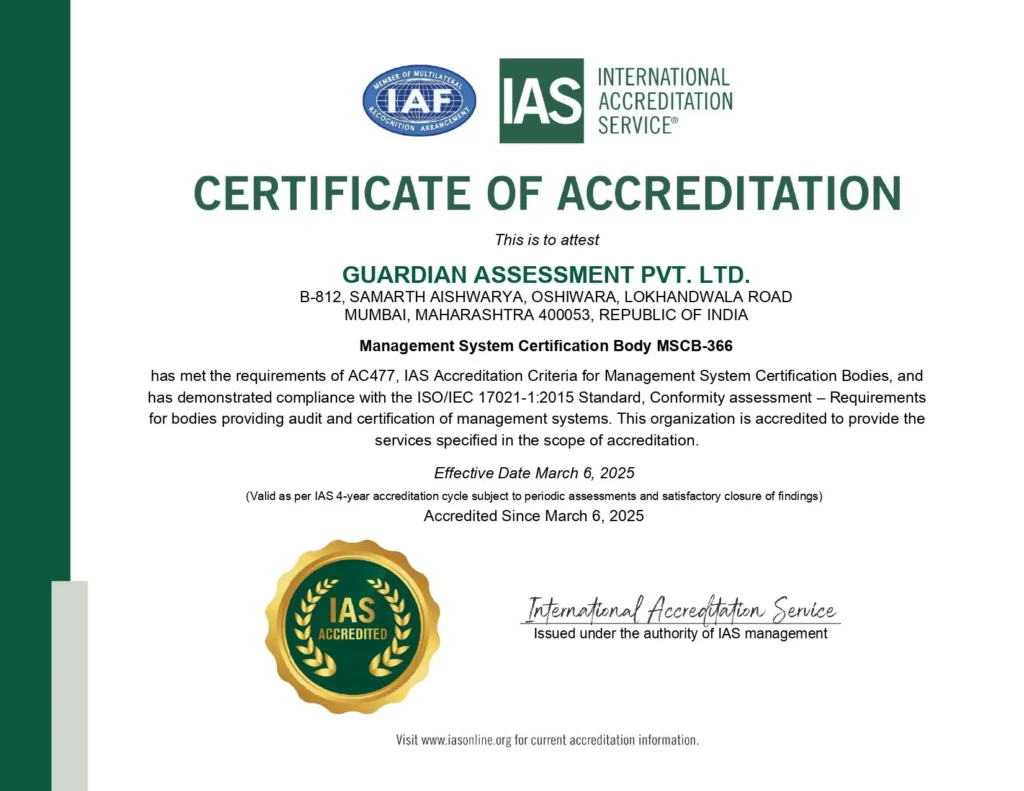
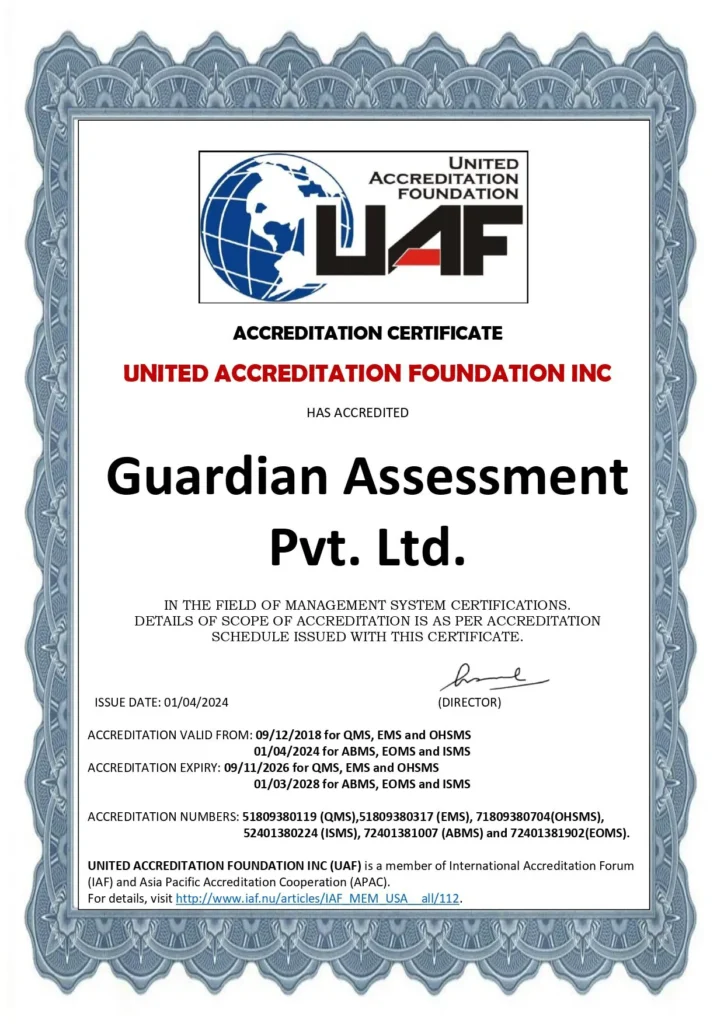
For example, Guardian Assessment Pvt. Ltd. (GAPL) states accreditation with the United Accreditation Foundation (UAF) and International Accreditation Service (IAS). For high-stakes use cases, verify scope and status directly with the accreditation body or certification body listings.
Both of these are members of the International Accreditation Forum (IAF). This means a certificate from GAPL is valid anywhere in the world. You can even check the validity of our certificates on the global database: www.iafcertsearch.org.
Integrating ISO 27001 with Other Standards
Some businesses need to follow several standards (quality, environment, safety, etc.). Luckily, the ISO 27001 standard has a structure that matches other popular ISO rules, which means you can combine them into one easy-to-manage system.
Reasons to Integrate:
- Less paperwork.
- Fewer audits.
- Training and reviews cover more topics at once.
- Easier to manage for staff and management.
For instance, you could combine ISO 9001 (quality), ISO 14001 (environment), and ISO 27001 (information security) for a complete management approach.
Next Steps Toward ISO 27001 Certification
Working towards ISO 27001 certification is a smart choice for any organization. When you understand what ISO 27001 is and follow the ISO 27001:2022 requirements, you are not only protecting your business, you are also showing stakeholders that you take information security seriously. ISO 27001 is a widely used framework to manage information security risks, support customer confidence, and drive continual improvement.
Remember: certification is not just a badge—it’s a path. As the world changes, keep reviewing and improving your system. Ready to get started? Choose an accredited body, get your team behind you, and move step by step.
Apply for ISO 27001 Certification in India
If you plan to pursue ISO 27001:2022 certification, request a quotation by providing your organization’s information in the application form. You can download the inquiry form from our website download section or submit your inquiry through the “Contact Us” button. Alternatively, send your inquiry via email to guardianassessment@gmail.com. You have the option to choose more than one standard, and if you consider that other standards may benefit your organization, you may integrate the standards within the accredited certification range and apply for certification for ISO 9001, ISO 14001, ISO 45001, ISO 21001, ISO 27001, and ISO 37001.
Frequently Asked Questions (FAQ)
Here are the answers to the questions we hear most often about ISO 27001 certification.
Ans) ISO 27001 is the key international standard for showing you take information security seriously. It suits all industries and gives clear steps to protect your data, prevent leaks, and build trust.
Ans) ISO 27001:2022 brings the standard up to date for the digital age, with stronger rules for cloud and remote work, easier language, and more flexible controls.
Ans) After your first certificate, the certifying body must check you every year (a ‘surveillance audit’). Every three years, you must have a full re-certification audit.
Ans) No. ISO 27001 certification means you follow global best practices, but no system can promise you zero incidents. It does, however, help you react and recover quickly.
Ans) Yes. The ISO 27001 standard fits all business types: from banks to doctors to small design agencies.
Ans) Use the IAF CertSearch database (https://www.iafcertsearch.org) to check if a company’s certificate is valid and properly accredited.
Ans) If you get non-conformities, fix them as soon as possible. Major issues must be solved before you get certified. Minor ones can be corrected within an agreed period.
Ans) It often can. Many insurers charge less for ISO 27001-certified businesses, seeing them as lower risk.
Ans) Yes! The management system format is similar, so you can combine much of the documentation and processes to save time.