You have decided to get ISO certified. You contact a few certification bodies and ask for quotations. One gives you a very low price. Another says the certificate can be issued quickly. A third talks about international recognition, but you are not quite sure what that means for your business.
So which one should you choose?
The wrong choice can affect a tender, supplier approval, or your final bill. This guide explains how to choose an ISO certification body in India, in plain language. We’ll walk through seven checks that help you compare providers, ask better questions, and know what you’re paying for.
How Do You Choose the Right ISO Certification Body?
Start by checking whether the certification body is accredited for the ISO standard your business needs. Then find out whether it understands your industry, follows a proper audit process, and can issue a certificate that meets your customer or tender requirements. Before deciding, compare the total fees, ask how the certificate can be verified, and read the terms for future audits. Choose the provider that gives you clear, checkable answers—not just an attractive price.
Why Do Businesses Need an ISO Certification Body?
You can follow an ISO standard without having a certificate. For instance, a company can use ISO 9001 to improve how it manages quality. But if a customer or tender asks for proof from an outside organisation, you’ll generally need a certification body to audit your management system.
The roles are easier to understand than they sound:
- ISO writes the standards. It tells organisations what the requirements are, but it does not issue ISO certificates.
- An accreditation body checks certification bodies. It assesses whether they are competent to carry out particular types of certification.
- A certification body audits your organisation. It reviews how your management system works and decides whether certification can be granted.
- Your business puts the system into practice. Your team follows the processes and shows the auditors what actually happens at work.
In India, the National Accreditation Board for Certification Bodies (NABCB) accredits certification bodies for a range of activities. Some providers working in India have accreditation from overseas bodies instead. Both options may be suitable, depending on what you need.
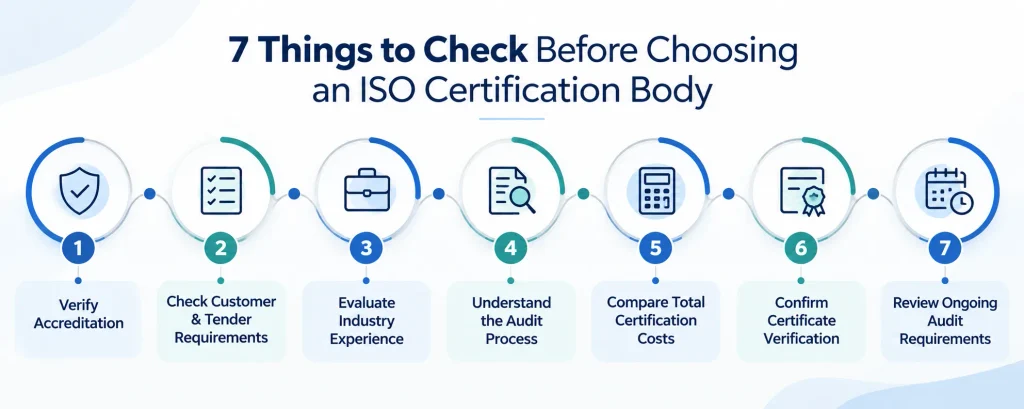
1. Check Whether the Certification Body Is Properly Accredited
When a provider says, “We are accredited,” that’s a good starting point. But ask one more question: “Is your accreditation valid for the ISO standard and type of work we need?”
Here’s why. A certification body might be accredited for ISO 9001 but not for ISO/IEC 27001. Its approval may also cover some types of business activity and not others. So a logo or a general statement on the website is not enough to make your decision.
What Should You Ask the Provider?
Ask for the company’s registered name, accreditation number, the organisation that accredited it, and the document showing which standards and activities its accreditation covers. This last document is often called the accreditation scope—in simple terms, the work it is approved to certify.
You may also notice older IAF MLA or ILAC MRA marks on documents. Since January 2026, Global ACI has taken over their international recognition arrangements, with transition rules for older marks. You don’t need to understand every part of that change. What matters is checking the provider’s current accreditation record rather than judging it by a logo.
Where Can You Check It?
If the provider says it is accredited by NABCB, look it up in the NABCB management system certification listings. If it names an overseas accreditation body, use that body’s official directory. Where international recognition is required, you can also check Global ACI’s recognition information.
Table 1: Accreditation Checks Before You Choose a Certification Body
| What to check | Where to look | What you need to know |
| Company’s registered name and accreditation number | Official accreditation directory | Is this the same company that will issue your certificate? |
| Current accreditation status | Directory record | Is its accreditation active for the relevant work? |
| ISO standard covered | Published accreditation scope | Does it cover the standard you want? |
| Industry activities covered | Scope details or written clarification | Can it certify the type of work your business does? |
| International recognition, if required | Relevant accreditation records and Global ACI information | Does the recognition meet your buyer’s conditions? |
Practical tip: Ask the provider to share the link to its official accreditation record. It’s much more useful than a brochure full of logos.
2. Check Whether the Certificate Will Meet Your Business Needs
A certificate can be genuine and still be the wrong one for your customer.
For example, your customer may want ISO 9001 certification for manufacturing, while the certificate you receive covers only office administration. The problem isn’t necessarily that the certificate is fake. It’s that it doesn’t cover the work the customer asked about.
Read the Customer or Tender Requirement First
Before requesting a quotation, check these points:
- Which ISO standard is required? Don’t assume ISO 9001 is enough if the tender asks for a different standard or more than one.
- Which work must be covered? Make sure your proposed certificate describes the products or services the customer is buying from you.
- Which locations must be included? A factory, branch, warehouse, and head office may not all be covered automatically.
- Does the customer specify accreditation? Some buyers have particular conditions about recognised certification. Confirm these before you apply.
- When is the certificate needed? Check whether you must already be certified when submitting the bid or only by a later date.
If anything is unclear, ask the buyer before paying for an audit. An ISO management system certificate also doesn’t replace any separate BIS approval, product license, or legal permission.
3. Find Out Whether the Certification Body Understands Your Industry
Think about how different a factory is from an IT company or a hospital. They might all use ISO 9001, but their day-to-day work, customer concerns, and risks are quite different. That’s why the audit team’s knowledge matters. You want auditors who can understand what your employees do and ask sensible questions about how the business operates—not just ask for documents because a checklist says so.
Questions Worth Asking About the Auditors
- Have you audited businesses like ours? Ask about experience with similar activities rather than just counting the names on a client list.
- How do you select our audit team? The provider should be able to explain why its auditors are suited to your operations.
- Can you cover our sites and work shifts? A factory running night shifts may need different audit arrangements from an office open only during the day.
- Will we understand the audit findings? Findings should be explained clearly, with examples of what the auditors observed and which requirement needs attention.
A good auditor looks at the evidence fairly rather than approving everything without checking.
4. Understand What Actually Happens During the Audit
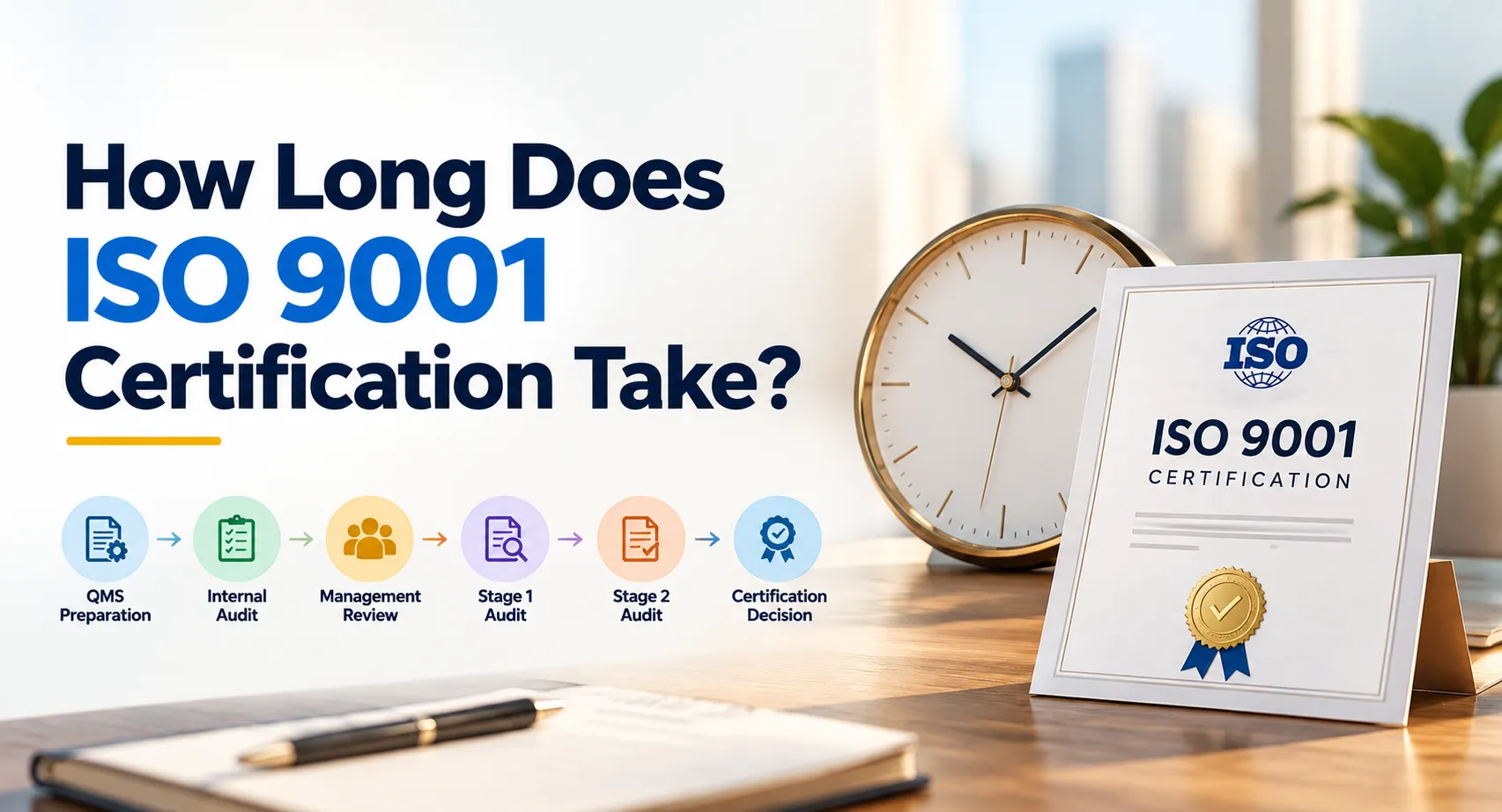
You should know what will happen after you submit the application. If a provider can’t explain the steps in a way you understand, ask for a clearer explanation before you agree to anything. For most accredited ISO management system certifications, the first certification generally works like this:
- You share your business details. The certification body asks about your activities, people, locations, and the standard you want. It uses this information to plan the audit.
- The Stage 1 audit checks your readiness. The auditors review how you’ve prepared your management system and whether you’re ready for the main audit.
- The Stage 2 audit checks what happens in practice. Auditors may speak to employees, look at records, and observe work being done. They’re checking whether the system is actually followed.
- You address any gaps found. If something doesn’t meet the standard, your team takes appropriate corrective action and provides evidence as required.
- The certification body makes a decision. The audit results are reviewed by authorised people who weren’t part of that audit team. Certification is granted only when the applicable requirements have been met.
Be Careful With Promises That Sound Too Easy
You may come across offers such as “Guaranteed certificate” or “No audit needed.” Treat these as warning signs, particularly when the provider hasn’t even asked what your business does. A proper certification decision still depends on what the audit finds. No certification body should guarantee a pass before checking the evidence.
5. Compare the Full Cost, Not Just the First Quotation
It’s completely reasonable to care about the price. But two quotes that look very different may not cover the same work. One quote may include travel and two sites; another may cover only one site, with travel charged separately.
Why Do ISO Certification Fees Differ?
Your business size, number of employees, type of work, shifts, locations, and how complicated the operations are all affect the audit plan. A small office generally won’t need the same audit arrangements as a manufacturing plant running several shifts.
Ask the provider a simple question: “How many audit days have you included, and how did you decide that?” A professional provider should be able to give you a sensible explanation. For more information, read our ISO Certification Cost Guide.
What Should Be Included in the Quote?
Table 2: ISO Certification Quotation Comparison Checklist
| What you’re paying for | What to ask | Why it matters |
| Initial certification audit | Does the price include both Stage 1 and Stage 2 and related charges? | You know what the first payment covers. |
| Audit days and locations | How many days and which sites are included? | You can compare the same amount of work. |
| Auditor travel | Will travel and accommodation cost extra? | You avoid surprises after the audit is booked. |
| ISO Surveillance audits | What are the charges for follow-up audits? | You can plan for costs after year one. |
| ISO Recertification audit | How will the next certification cycle be priced? | You know what to expect later. |
| Taxes and extra charges | Is GST included? What happens if extra audit time is required? | You understand the payment terms. |
Ask for an estimate of the costs across the normal three-year certification cycle, with any variable charges clearly marked. A low quote isn’t automatically a bad one. You just need to know why it is lower and whether anything important has been left out.
6. Ask How Someone Can Verify Your ISO Certificate
Imagine sending your ISO certificate to a new customer. Their purchasing team replies, “Can you share a link where we can check this?” You should be able to answer that question without going back and forth for days. This check is about proving that the certificate was issued and is still valid. It isn’t about whether the certificate meets a particular tender condition—that was Check 2.
What Information Helps With Verification?
A management system certificate normally includes the certified company’s name, ISO standard, activities covered, relevant locations, issuing certification body, certificate number, and important dates. These details help the customer check the correct record.
Where Can a Customer Check It?
One place is IAF CertSearch, where relevant certificate records are available. Some certification bodies also have their own online directories or official verification process. Ask your provider which route customers should use.
And one important point: not finding a certificate in CertSearch doesn’t automatically mean it’s fake. Some records may not be available there. In that situation, contact the issuing certification body and, if needed, its accreditation body. The CertSearch verification guidance explains the limitations.
7. Know What Happens After Your Certificate Is Issued
Receiving the certificate is a big milestone, but it doesn’t mean your management system can be put aside. Your business needs to keep following its processes, and the certification body will check that through planned follow-up audits.
What Does the Three-Year Certification Cycle Look Like?
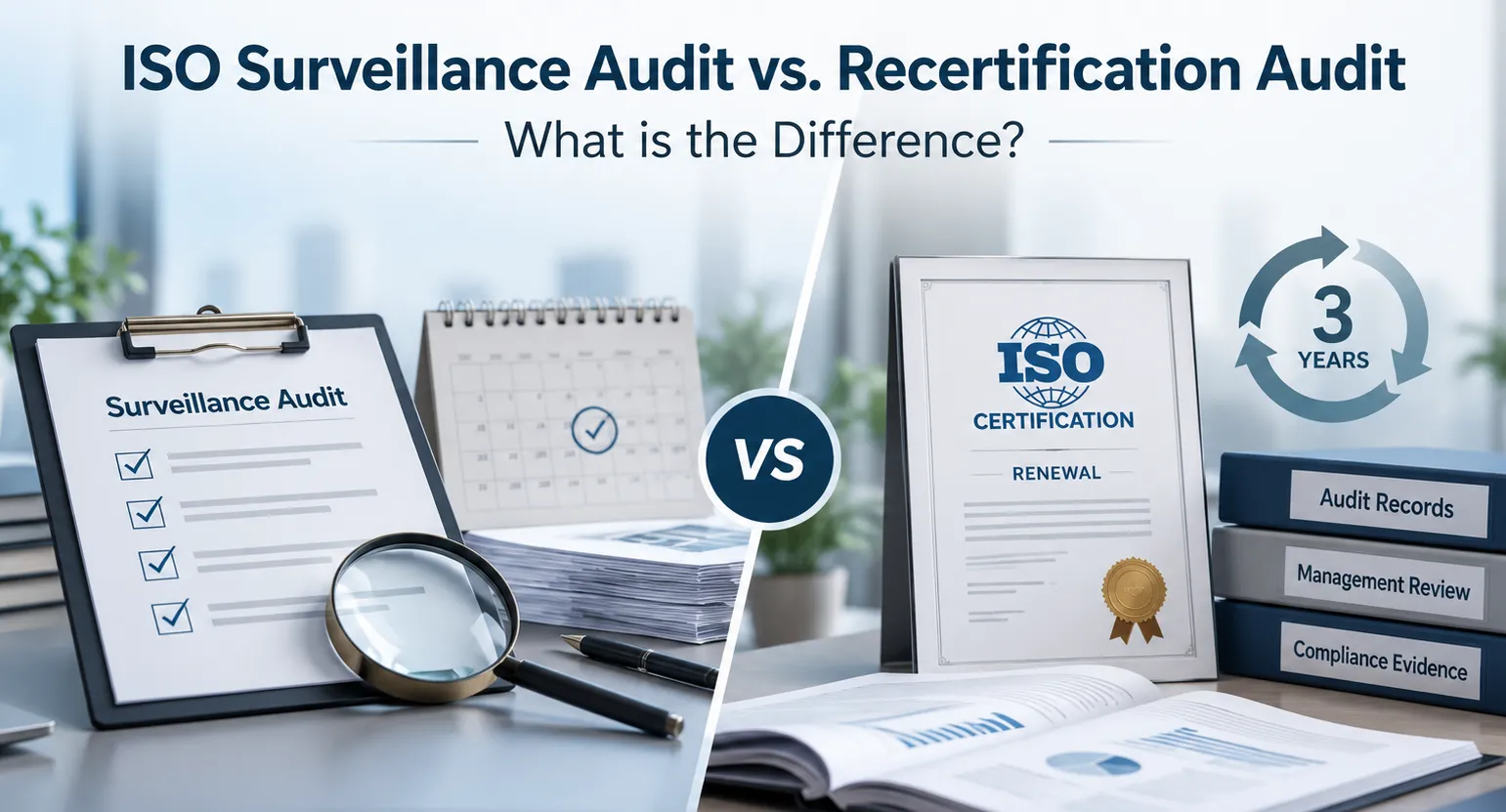
For many accredited ISO management system schemes, certification follows a normal three-year cycle. After the initial certification, there are surveillance audits during the cycle, followed by recertification before the certificate expires.
The first surveillance audit is normally carried out within 12 months of the initial certification decision. A further surveillance audit generally follows in the second year. The exact schedule depends on the certification program and standard involved. Think of these visits as a check that the system is still working—not a repeat of every part of the initial certification process.
Read the Agreement Before Signing
Make sure you understand the practical arrangements:
- Future audit dates: Find out how surveillance visits will be scheduled and who will coordinate with your team.
- Changes in your business: Ask what to do if you add a new factory, change activities, or want more locations included.
- Problems or disagreements: Check how you can raise a complaint or appeal a certification decision.
- Certificate status: Understand what could lead to suspension or withdrawal and how you’ll be informed.
- Changing providers: If you later decide to move to another certification body, ask how a transfer of an eligible certificate would work. Check these terms before you sign.
Common Mistakes to Avoid When Choosing an ISO Certification Body in India
Below are the four avoidable mistakes:
- Leaving out information when requesting a quote. If you don’t mention a second site, night shift, or important activity, the audit plan may have to change later. Give accurate details from the beginning.
- Comparing quotations for different work. Make sure providers have used the same employee figures, locations, and certification requirements before comparing prices.
- Trusting a verbal promise instead of the agreement. If a fee, audit date, or service matters to you, get it confirmed in writing.
- Applying just before a tender deadline. Audits may identify problems that need correcting, and the final decision takes time. Leave enough room in your schedule
- Most of these problems can be prevented with one simple habit: ask questions early, and keep the answers in writing.
How to Make Your Final Decision Between Certification Bodies
If you now have two or three providers on your shortlist, don’t try to compare everything at once.
First, remove any option that doesn’t meet your accreditation or customer requirements. Next, compare the audit plan, industry experience, full fees, and service terms of the remaining providers. Finally, ask them to clear up anything you’re unsure about before signing. Choose a body that explains its work, backs up its claims, and suits your business—not simply the one with the most impressive brochure.
Choose a Certification Body That Fits Your Business
Choosing an ISO certification body shouldn’t feel like a guessing game. You deserve to understand what you’re paying for, how the audit will work, and whether the certificate will serve its purpose.
Planning ISO certification for your business in India? Tell Guardian Assessment which ISO standard you need, what your business does, how many locations you want covered, and whether a customer or tender has given you specific conditions. The team can explain the relevant certification process and what to do next. Contact Guardian Assessment